Winter Estimation Jar Challenges: Fun Math at Home
Estimation is a foundational mathematical skill that connects numbers to real-world reasoning. Winter estimation jar challenges offer a simple yet effective way to practice this skill through hands-on activities that engage children during the winter months. By asking students to estimate quantities, refine guesses, and justify reasoning, these activities strengthen number sense, proportional thinking, and problem-solving in a tangible, memorable way.
What Is a Winter Estimation Jar Challenge?
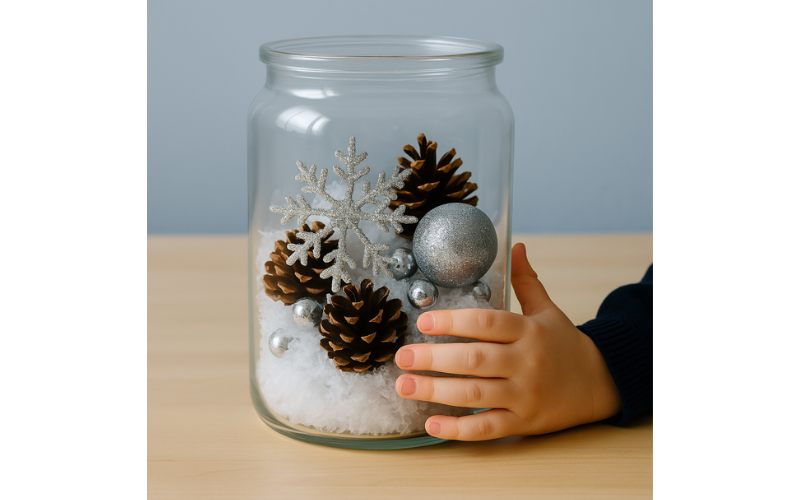
A winter estimation jar challenge involves placing a collection of objects into a transparent container and asking students to estimate how many items are inside without counting them individually. Common winter-themed materials include pom-poms, mini marshmallows, cotton balls, popcorn kernels, pinecones, or small ornaments.
The key mathematical idea is estimation—making a reasonable numerical judgment based on available information rather than exact counting. Unlike guessing, estimation requires strategy, comparison, and revision, all of which are essential math habits.
These challenges are low-cost, flexible, and easy to repeat with different objects, making them well suited for home learning.
How Estimation Skills Develop by Age
Estimation jar activities can be adapted to different developmental stages, allowing the same activity to support a wide range of learners.
Ages 4–7: Building Early Number Sense
For younger learners, the focus is on:
- Comparing quantities
- Recognizing “more” vs. “less”
- Connecting numbers to physical amounts
Use larger items and smaller totals. Instead of asking for an exact number, guide students with comparison questions:
- Is it closer to 10 or 20?
- Is it more than last time or less?
At this stage, the goal is not accuracy, but reasoned thinking about quantity.
Ages 8–12: Developing Proportional Reasoning
Older students can use more advanced strategies. For example:
- Make an initial estimate.
- Remove and count a small sample (such as 10 items).
- Compare the sample to the total volume.
- Adjust the estimate based on that comparison.
This introduces proportional reasoning, a key skill for fractions, ratios, and later algebra. Students learn that estimates can improve when new information is used logically.
Encouraging students to explain how they arrived at their estimate strengthens mathematical communication and reasoning.
What Math Skills These Activities Actually Build
When used intentionally, estimation jar challenges develop specific, transferable skills:
- Number sense: Understanding the size and meaning of numbers
- Reasonableness checking: Evaluating whether an answer makes sense
- Multiplicative thinking: Using groups or samples to scale estimates
- Problem-solving strategies: Revising answers based on evidence
- Math vocabulary: Terms such as “about,” “roughly,” “close to,” and “too high/low”
These are core skills emphasized across elementary and middle school math standards.
How to Make Estimation Jars More Effective
To move beyond novelty, a few simple practices make estimation jars more educational:
- Ask for justification, not just an answer
- Record estimates over time to track improvement
- Compare strategies, not just results
- Vary container size and item type to prevent pattern guessing
The most valuable part of the activity is the discussion that follows—why one estimate was closer and how a different strategy might work better next time.
Making Estimation a Winter Learning Routine
Estimation jar challenges work best when repeated regularly rather than used once. Rotating materials weekly or tying jars to seasonal themes keeps the activity fresh while reinforcing the same core math skills. Over time, students become more confident, faster, and more accurate in their reasoning.
This consistency helps transform estimation from a one-time game into a lasting mathematical habit.
Conclusion
Winter estimation jar challenges provide a practical, engaging way to develop essential math skills through real-world reasoning. By encouraging students to estimate, revise, and explain their thinking, these activities strengthen number sense, proportional reasoning, and problem-solving—skills that support long-term success in mathematics.
To reinforce these concepts beyond hands-on activities,
Think Academy offers free math worksheets for Kindergarten through Grade 10.
Organized by topic and paired with complete answer keys, these worksheets help students practice estimation, number sense, and logical reasoning in a structured way—turning playful winter math into lasting understanding.
About Think Academy
Think Academy, part of TAL Education Group, helps K–12 students succeed in school today by building strong math foundations and critical thinking skills. At the same time, we focus on the bigger picture—developing learning ability, curiosity, and healthy study habits that inspire a lifelong love of learning. With expert teachers, proven methods, and innovative AI tools, we support every child’s journey from classroom confidence to long-term growth.
Want more insights on math learning and parenting? Fill out the form on this page and subscribe to our newsletter for weekly tips and the latest resources.
Leave a Comment & Share Your Thoughts!

Share This Story, Choose Your Platform!
Related Posts










