What Is a CTE Program? Pathways, Benefits, and Planning
Career and Technical Education (CTE) programs have become a core part of the modern U.S. education system, offering students structured pathways to explore careers while completing strong academic coursework. For parents navigating options beyond the traditional “college-only” model, CTE provides a practical, flexible approach that blends learning, skills, and long-term planning.
This guide explains what CTE programs are, what fields they cover, who can participate, how students enroll, when families should start planning, and why CTE can be a powerful complement to college preparation.
What Is Career and Technical Education (CTE)?
Career and Technical Education (CTE) is an educational framework that integrates academic subjects with career-focused, hands-on learning. Rather than teaching skills in isolation, CTE connects math, science, literacy, and technology to real-world applications.
CTE programs are formally supported and regulated through the U.S. Department of Education and state education agencies. Most programs operate under federal funding provided by the Carl D. Perkins Career and Technical Education Act, commonly called the Perkins Act.
This federal structure means that high-quality CTE programs are:
- Aligned with workforce and industry needs
- Held to accountability standards
- Designed as multi-year pathways rather than single electives
CTE is most commonly offered in grades 9–12, but many states introduce career exploration earlier and extend CTE into postsecondary education.
What Directions Do CTE Programs Cover?
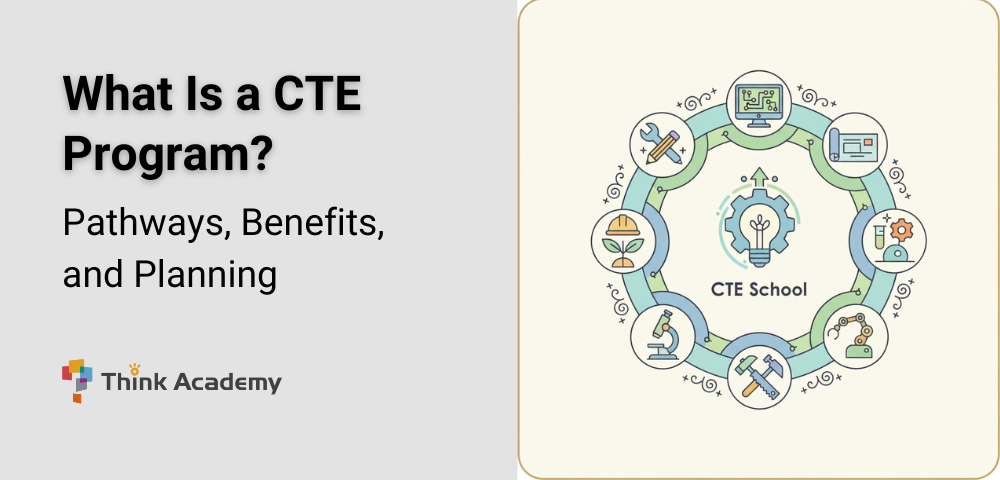
Modern CTE programs span a wide range of industries, many of which align directly with high-demand careers and college majors.
Common CTE pathways include:
- Information Technology and Cybersecurity
- Engineering and Advanced Manufacturing
- Health Sciences (medical assisting, biotechnology, nursing support)
- Business, Finance, and Entrepreneurship
- Agriculture and Environmental Science
- Media, Design, and Digital Communications
- Construction, Electrical, and Skilled Trades
- Culinary Arts and Hospitality
These pathways are designed to remain flexible. Students can use CTE to enter the workforce, continue into community college, or pursue four-year degrees.
Who Can Take CTE Programs?
CTE programs are open to a broad range of students, not only those pursuing trades or technical jobs.
CTE students often include:
- College-bound students seeking applied learning
- STEM-oriented students exploring engineering or technology fields
- Students who learn best through hands-on instruction
- Students looking for career clarity before choosing a college major
A key misconception is that CTE replaces academic rigor. In reality, many students complete CTE pathways alongside AP, honors, IB, or dual-enrollment courses.
How Do Students Enroll in CTE Programs?
Enrollment varies by district and state, but common access models include:
- CTE courses embedded within a regular high school schedule
- Dedicated CTE high schools or career academies
- Magnet or application-based programs
- Regional technical centers shared by multiple schools
- Dual-credit programs offering both high school and college credit
- Work-based learning such as internships or apprenticeships
Most students begin CTE through course selection and counselor guidance, though competitive programs may require applications or prerequisite courses.

When Should Families Start Planning for CTE?
Although formal CTE coursework typically begins in high school, effective planning starts much earlier.
A realistic timeline looks like this:
- Ages 4–7: Build curiosity, logic, and problem-solving habits
- Ages 8–12: Explore applied learning, technology, and multi-step projects
- Middle school: Career exploration and pathway awareness
- High school: Formal CTE pathway enrollment and credential building
Early awareness helps families make strategic choices when high-school course planning begins.
Why CTE Programs Offer Long-Term Benefits
CTE provides value far beyond short-term job training.
Industry Certifications Matter
One of the most important outcomes of strong CTE programs is access to industry-recognized certifications. These credentials verify skill mastery and are portable across schools and employers.
Examples include:
- IT and Cybersecurity certifications
- Healthcare support credentials
- Safety and technical trade certifications
- Business or entrepreneurship credentials
Parents should always ask:
“What certifications can students earn through this pathway?”
CTE Can Reduce College Costs
Many CTE pathways include:
- Dual-enrollment or articulated college credits
- Alignment with associate degree programs
- Credit toward technical certificates
This can significantly reduce college time and tuition, while giving students flexibility if they later change majors.
CTE Helps Students Make Better College Decisions
CTE is not just about skills—it provides career clarity.
Students who complete CTE pathways often:
- Enter college with clearer goals
- Change majors less frequently
- Understand how academic subjects connect to careers
This reduces trial-and-error in college and supports more confident decision-making.
Career Outlook and Skills Value
According to the U.S. Bureau of Labor Statistics, many CTE-aligned careers offer strong demand and stable wages:
- Electricians: median pay around $60,000 with steady growth
- Medical assistants: faster-than-average job growth
- Technology and cybersecurity roles: above-average growth nationwide
Beyond specific jobs, CTE builds durable skills such as:
- Computational and systems thinking
- Quantitative reasoning and data interpretation
- Logical troubleshooting
- Teamwork and professional communication
These skills remain valuable regardless of career direction.

How Early Learning Supports CTE Success
CTE success is built on early foundations.
Ages 4–7: Foundational Skills
Focus on:
- Building and construction activities
- Recognizing shapes, patterns, and measurements
- Counting, estimating, and comparing quantities
- Encouraging “how” and “why” questions
Ages 8–12: Applied Problem-Solving
Encourage:
- Robotics or simple coding kits
- Budgeting and project planning
- Engineering or electronics kits
- Multi-step projects that require persistence
These experiences connect academics to real-world applications and prepare children for applied learning later on.
Is a CTE Program Right for Your Child?
CTE programs are especially well-suited for students who:
- Enjoy hands-on learning
- Like building, fixing, or designing
- Prefer applied learning over purely abstract instruction
- Show patience with complex, multi-step tasks
CTE does not limit options—it expands them by adding skills, experience, and clarity.
How Parents Can Support CTE Foundations at Home
Regardless of future pathway, parents can support readiness by:
- Encouraging curiosity and experimentation
- Connecting math and science to real-life situations
- Supporting long-term projects that involve planning and measurement
- Valuing both academic achievement and practical skills
Final Takeaway for Parents
Career and Technical Education programs offer a powerful bridge between academics and real-world application. Supported by federal standards, aligned with industry needs, and increasingly connected to college credit, CTE has become a college-and-career pathway, not an alternative to college.
By understanding CTE early and supporting foundational skills at home, parents give children the flexibility to choose pathways that match their interests, strengths, and long-term goals—while keeping future options wide open.
To reinforce the math and reasoning skills that many CTE pathways rely on, families can also download free math worksheets focused on measurement, logic, problem-solving, and real-world applications. Working through these together helps children build the analytical foundation that supports success in CTE programs and beyond.
About Think Academy
Think Academy, part of TAL Education Group, helps K–12 students succeed in school today by building strong math foundations and critical thinking skills. At the same time, we focus on the bigger picture—developing learning ability, curiosity, and healthy study habits that inspire a lifelong love of learning. With expert teachers, proven methods, and innovative AI tools, we support every child’s journey from classroom confidence to long-term growth.
Check our math programs:
- Early Childhood — PreK
- Lower Elementary — Grades K–2
- Upper Elementary — Grades 3–5
- Middle School — Grades 6–10
Want more insights on math learning and parenting? Fill out the form on this page and subscribe to our newsletter for weekly tips and the latest resources.
Leave a Comment & Share Your Thoughts!

Share This Story, Choose Your Platform!
Related Posts










