U.S. Coins for Kids: Pennies, Nickels, Dimes & Quarters
Learning about pennies, nickels, dimes, and quarters is one of the first and most practical steps in building financial literacy for children. These everyday coins help students connect numbers to real-world value and give parents a natural way to introduce math, history, and problem-solving through daily life.
This guide explains what U.S. coins are, where their names come from, how much each is worth, what they are made of, and includes memorable stories and real events that help children truly understand and remember what they learn.
What Are Pennies, Nickels, Dimes, and Quarters?
Pennies, nickels, dimes, and quarters are the four most commonly used coins in the United States. Each coin has:
- a unique name
- a fixed value in cents
- a size, color, and edge that help identify it
- a design connected to U.S. history
For children, learning coins is not just about memorization. It builds number sense, comparison skills, and an early understanding of how money works in real life.
Who Is This Learning For?
This topic supports a wide range of learners:
- Preschool to Grade 2 (ages 4–8): identifying coins and matching names to values
- Grades 3–5: counting mixed coins, making change, and solving word problems
- Upper grades: reinforcing decimals, percentages, and everyday financial decisions
Parents can adjust the depth based on their child’s age, but the same core ideas grow with the student.
Why Learning About Coins Matters
Understanding coins helps children:
- see math as useful and real
- practice addition, subtraction, and skip counting
- gain confidence when paying for small items
- build early habits around saving and spending
Coins turn abstract numbers into something children can touch, sort, and use.
Where Do Coin Names Come From?
The names of U.S. coins have simple meanings that help children remember their values:
- Penny comes from an old English word for a small coin
- Nickel is named after the metal used to make it
- Dime comes from a word meaning “one-tenth,” because it is one-tenth of a dollar
- Quarter means one-fourth of a dollar
Understanding these names helps children see that coin values follow clear logic.
Coin Values, Features, and What They Are Made Of
U.S. coins all have a fixed value, but their designs can change over time. These updates are carefully planned by the United States Mint to honor history, people, and places. Importantly, a design change never changes a coin’s value.
This is helpful for children to know, because they may notice that two coins look different but are still worth the same amount.
You can explain it simply to kids:
“Coins are like books with different covers. The pictures may change, but the value inside stays the same.”
Below is a clear, child-friendly explanation of each coin’s value, features, materials, and design variations.
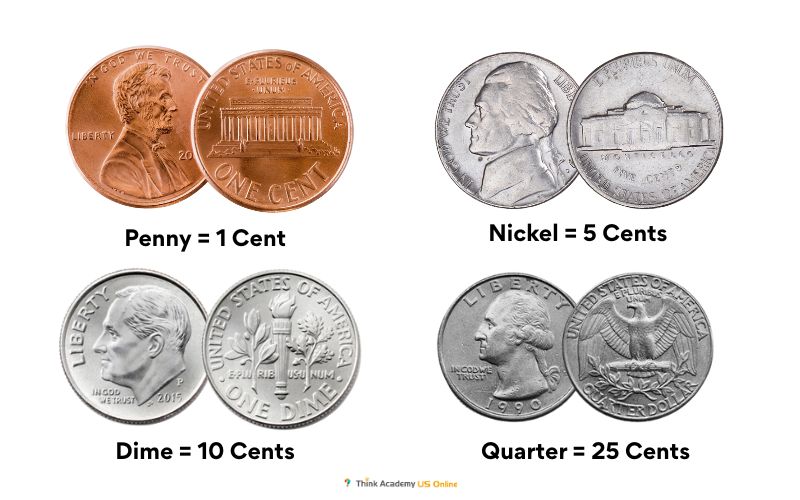
Penny (1¢)
- Value: 1 cent
- Color: copper-colored
- Front design: Abraham Lincoln
- Edge: smooth
- Material: mostly zinc with a thin copper coating
The penny has shown Abraham Lincoln on the front since 1909. The back design has changed several times, but Lincoln has always stayed. For children, “Lincoln = penny” is always a safe rule.
Nickel (5¢)
- Value: 5 cents
- Color: silver-colored
- Front design: Thomas Jefferson
- Edge: smooth
- Material: copper and nickel
Jefferson has remained on the front of the nickel, but his portrait has appeared in slightly different styles over the years. Some nickels may look older or newer, but they are all worth 5 cents.
Dime (10¢)
- Value: 10 cents
- Color: silver-colored
- Front design: Franklin D. Roosevelt
- Edge: ridged (grooved)
- Material: copper with a nickel coating
The dime is one of the most consistent U.S. coins. Roosevelt has appeared on the front since 1946, making it easy for children to recognize.
Quarter (25¢)
- Value: 25 cents
- Color: silver-colored
- Front design: George Washington
- Edge: ridged
- Material: copper with a nickel coating
Design note for families:
Quarters are the coin children are most likely to see with different designs. Over the years, special programs have featured:
- U.S. states
- National parks
- Important American women
In most cases, George Washington still appears on the front, and the coin is clearly labeled as a quarter. Even when designs change, a quarter is always worth 25 cents.
Ready to Practice? Free Resources for Families
To help your child apply what they’ve learned, click to download:
- Problem Checklist
- Printable Worksheets
These materials are designed to support K–12 learners with clear steps and hands-on practice
A Simple Story to Remember All Four Coins
Parents often find this short story helpful:
- The penny is small and common
- The nickel is bigger but sneaky
- The dime is tiny but strong
- The quarter is big and popular
This helps children remember size, value, and personality all at once.
How Parents Can Help at Home
You can support coin learning through everyday activities:
- Name coins and describe their features
- Count pennies one by one
- Count nickels by 5s, dimes by 10s, and quarters by 25s
- Practice mixed-coin counting
- Play “store” and let your child pay using coins
Hands-on practice helps correct the common mistake of thinking larger coins are always worth more.
For accurate and child-friendly background information, families can explore resources from the United States Mint.
Once your child understands coin values and features, the next step is learning how to combine coins and use them in math problems. This helps children move from recognition to real problem-solving.
We recommend this parent-friendly guide from Think Academy: Money Math for Kids: 8 Fun Games and 15 Practice Problems
Final Takeaway for Families
Understanding pennies, nickels, dimes, and quarters helps children connect math, history, and real life. When coins are taught with clear explanations and simple stories, children don’t just memorize values—they understand them, remember them, and use them with confidence.
For even more practice, visit the Think Academy worksheets page to download additional free math worksheets and continue building strong money and math skills at home.
About Think Academy
Think Academy, part of TAL Education Group, helps K–12 students succeed in school today by building strong math foundations and critical thinking skills. At the same time, we focus on the bigger picture—developing learning ability, curiosity, and healthy study habits that inspire a lifelong love of learning. With expert teachers, proven methods, and innovative AI tools, we support every child’s journey from classroom confidence to long-term growth.
Check our math programs:
- Early Childhood — PreK
- Lower Elementary — Grades K–2
- Upper Elementary — Grades 3–5
- Middle School — Grades 6–10
Want more insights on math learning and parenting? Fill out the form on this page and subscribe to our newsletter for weekly tips and the latest resources.
Leave a Comment & Share Your Thoughts!

Share This Story, Choose Your Platform!
Related Posts










