The Skills-Over-Knowledge Problem in K–12 Education
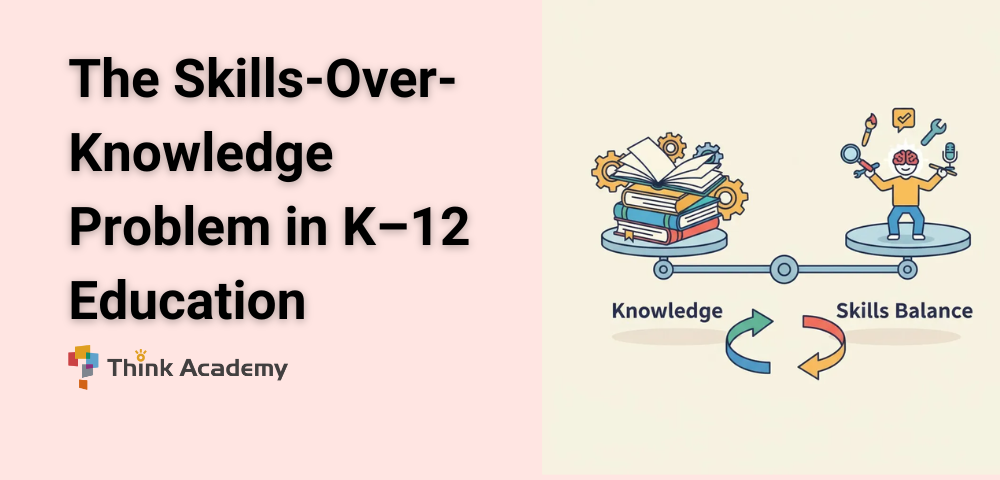
In modern classrooms, students are learning to code before they can name historical leaders — and mastering digital tools before they truly understand the ideas behind them. This growing imbalance between skills training and knowledge acquisition has become one of the most pressing challenges in K–12 education.
While the world increasingly values employable skills, the neglect of foundational knowledge in history, civics, science, and culture risks creating a generation of students who can perform tasks but lack depth, context, and intellectual curiosity.
The Skills-Over-Knowledge Dilemma
Across the U.S., schools emphasize measurable skills such as coding, STEM competition readiness, and test-taking techniques. These are valuable abilities, but the narrow focus often comes at the expense of broad academic literacy.
Students might write flawless code yet fail to explain why data privacy matters. They may excel at solving equations but struggle to connect those numbers to real-world phenomena like climate change or public policy.
According to the National Assessment of Educational Progress (NAEP), civics and history scores among eighth graders have steadily declined, with only 13% of students demonstrating proficiency in U.S. history and 22% in civics (NAEP, 2022). This decline signals that practical proficiency alone doesn’t guarantee understanding — or wisdom.

Why This Imbalance Exists
Several systemic forces drive this “skills-first” culture in education:
- Testing and accountability pressures. Schools are rewarded for quantifiable results. Skills such as reading speed or digital fluency are easier to test and track than abstract understanding or historical reasoning.
- Parental expectations for early employability. Many families, driven by competition and anxiety, push their children to “get ahead” through coding camps and robotics workshops, believing these are the surest paths to success.
- Teacher training and curriculum constraints. Educators often lack the tools or time to integrate broader content areas into skill-based lessons. Curriculum pacing guides tend to emphasize “can-do” objectives over “understand-why” outcomes.
- Cultural shifts toward productivity. Modern education mirrors workplace efficiency — fast, optimized, and output-driven — rather than reflective or exploratory learning.
The Consequences: Superficial Success, Deeper Gaps
An overemphasis on skills may produce students who perform well in the short term but lack long-term depth and resilience.
- Shallow understanding: Students learn how to do things without understanding why they matter. They can execute but not innovate.
- Loss of curiosity: When learning is reduced to completing tasks, students often lose the motivation to explore, question, or make connections across disciplines.
- Weak critical thinking: Without a base of knowledge, it’s difficult to evaluate information or form independent opinions — skills essential for civic participation and leadership.
- Limited adaptability: Trends in technology shift quickly. Students trained for one set of tools may struggle to adapt without conceptual understanding to guide them.
Ultimately, the result is a generation of learners who are technically capable but intellectually undernourished — able to pass exams, but not necessarily prepared to solve real-world problems or engage thoughtfully with society.

What Can Be Done
Avoiding this imbalance requires a redefinition of success in education — one that values understanding as much as performance.
- Integrate context into skill-based lessons. When teaching coding, discuss its historical evolution and ethical implications. When teaching math, connect concepts to global challenges like data analysis in climate science or economics.
- Redesign assessments. Move beyond test scores to evaluate depth of understanding through projects, reflective essays, or interdisciplinary challenges.
- Invest in teacher development. Provide educators with resources to blend skill-based instruction with historical and cultural content, so lessons nurture both proficiency and perspective.
- Encourage lifelong curiosity. Shift classroom culture from “completion” to “exploration.” Reward students for asking insightful questions, not just providing correct answers.
- Promote balance at home. Parents can supplement school learning with reading, discussion, and exposure to diverse subjects — helping children connect skills to meaning.
As the OECD’s Education 2030 Framework notes, real education should help students “apply knowledge with understanding and purpose” (OECD). Building that bridge between knowing and doing will define the next generation’s ability to think critically, create responsibly, and lead wisely.
Conclusion
In the race to build a skilled workforce, we risk neglecting the intellectual foundations that make lifelong learning possible. True education is not a choice between skills and knowledge, but a partnership between them.
When students understand history, ethics, and ideas — not just code, formulas, or shortcuts — they develop the insight to use their skills wisely. The goal of K–12 education should not only be to make students job-ready, but world-ready.
About Think Academy
Think Academy, part of TAL Education Group, helps K–12 students succeed in school today by building strong math foundations and critical thinking skills. At the same time, we focus on the bigger picture—developing learning ability, curiosity, and healthy study habits that inspire a lifelong love of learning. With expert teachers, proven methods, and innovative AI tools, we support every child’s journey from classroom confidence to long-term growth.
Want more insights on math learning and parenting? Subscribe to our newsletter for weekly tips and the latest resources.
Leave a Comment & Share Your Thoughts!
Share This Story, Choose Your Platform!
Related Posts