The Great Water Race: Understanding Volume and Capacity
Volume and capacity are foundational measurement concepts in elementary math, yet they are often confusing for young learners when introduced only through definitions. Children understand these ideas more clearly when they encounter them through hands-on, real-life situations that involve pouring, comparing, and choosing containers.
This math story uses a familiar activity—watering a garden—to help children ages 4–12 develop a concrete understanding of volume and capacity through observation, comparison, and reasoning.
Understanding Capacity: How Much a Container Can Hold
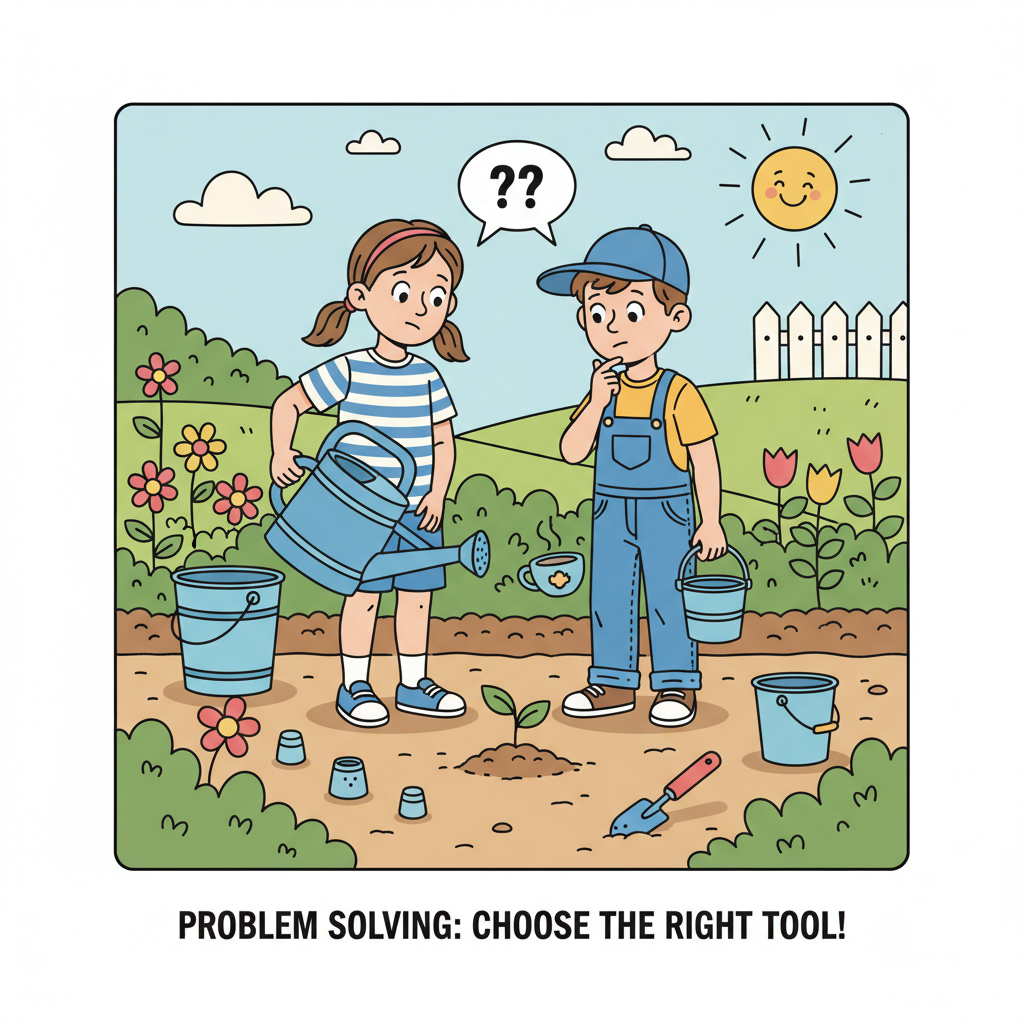
While helping water their grandmother’s garden, Lily and Tom were given three containers: a small teacup, a medium plastic bottle, and a large bucket. Each container could hold water, but not the same amount.
This led to an important idea: capacity refers to the maximum amount of liquid a container can hold. Even before measuring, the children could predict that:
- The teacup had a small capacity
- The bucket had a much larger capacity
Making these predictions is an essential early math skill—estimating based on size and shape.
Exploring Volume Through Filling and Pouring
As Lily and Tom filled each container with water, they began observing volume, which describes the amount of space the water occupies inside the container.
To compare volumes accurately, they chose a consistent measuring unit: the teacup.
They discovered:
- One plastic bottle held four teacups of water
- The bucket held ten bottles of water
By repeatedly pouring smaller units into larger containers, the children practiced:
- Counting and repeated addition
- Comparing quantities using the same unit
- Early multiplicative thinking (groups of equal size)
This process helped them understand that volume comparisons require a standard reference.
Comparing Containers Using Measurement Reasoning
Through their observations, Lily and Tom learned that:
- Larger capacity does not always mean easier to use
- Smaller containers can be useful measurement tools
- Choosing the right container depends on the task
They also saw that volume and capacity are related but not identical:
- Capacity describes the container
- Volume describes how much liquid is inside
Distinguishing between these two concepts is a key learning goal in elementary measurement standards.
Applying Measurement Concepts to Solve a Problem
After experimenting, the children adjusted their strategy:
- They used the bucket to transport large volumes of water efficiently
- They used the bottle to control the volume given to each plant
This decision showed practical understanding of measurement:
- Large capacity for efficiency
- Smaller volume control for accuracy
The math learning was embedded in problem-solving, not isolated practice.
What This Activity Teaches Mathematically
This story models several important math concepts:
- Capacity as a property of containers
- Volume as a measurable quantity
- Unit consistency when comparing amounts
- Reasoned decision-making using measurements
These ideas support later learning in:
- Scientific measurement
- Liquid measurement
- Fractions and unit conversion
- Data representation

Final Takeaway: Building Measurement Understanding Through Practice
Volume and capacity are best learned through repeated, meaningful comparison—not memorization. When children pour, count, and explain their choices, they develop lasting measurement understanding.
To reinforce these concepts with structured practice,
provide targeted support in measurement and volume from Kindergarten through Grade 10. These worksheets help students build confidence applying measurement concepts in real contexts
When real-life experiences are paired with guided worksheet practice, children gain both conceptual clarity and mathematical precision—a strong foundation for future math and science learning.
About Think Academy
Think Academy, part of TAL Education Group, helps K–12 students succeed in school today by building strong math foundations and critical thinking skills. At the same time, we focus on the bigger picture—developing learning ability, curiosity, and healthy study habits that inspire a lifelong love of learning. With expert teachers, proven methods, and innovative AI tools, we support every child’s journey from classroom confidence to long-term growth.
Check our math programs:
- Early Childhood — PreK
- Lower Elementary — Grades K–2
- Upper Elementary — Grades 3–5
- Middle School — G6-10
Want more insights on math learning and parenting? Fill out the form on this page and subscribe to our newsletter for weekly tips and the latest resources.
Leave a Comment & Share Your Thoughts!

Share This Story, Choose Your Platform!
Related Posts










