The Great Race: Learning How to Calculate Speed
Speed describes how fast something moves. Children notice speed naturally—cars passing by, animals walking, toys rolling—but learning how to calculate speed turns observation into mathematics. Understanding speed helps students connect motion, measurement, and division in a meaningful way, laying the groundwork for later science and math learning.
Early Ideas About Motion and Speed
People have always compared motion, even before math formulas existed. Ancient thinkers noticed that some objects move faster than others, but they described this difference using words rather than numbers.
Aristotle, writing in the 4th century BCE, discussed motion and speed qualitatively. He explained movement in terms of natural tendencies and resistance, but he did not measure speed or define it mathematically. At this stage, speed was an idea—not yet a calculation.
This distinction matters because it shows that understanding motion came first, while measuring it precisely came later.
Measuring Motion: Turning Speed Into a Number
The major breakthrough came in the early modern period, when scientists began treating motion as something that could be measured.
Galileo Galilei was the first to systematically study motion using numbers. In the late 1500s and early 1600s, Galileo measured how far objects traveled over equal amounts of time. He showed that motion could be analyzed using distance and time rather than descriptions alone.
This shift—from observation to measurement—turned speed into a mathematical concept.
Defining Speed and the Formula We Use Today
The modern definition of speed was formalized through classical physics.
Isaac Newton incorporated speed into a complete mathematical framework of motion. In this system, speed became a rate, describing how much distance is covered in a given amount of time.
From this framework comes the formula students still use today:
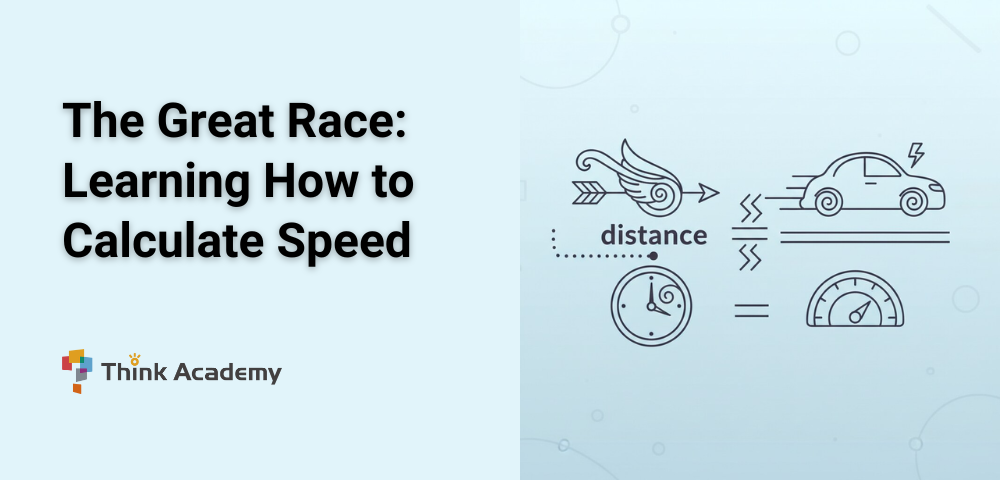
Speed = Distance ÷ Time
This formula means:
- An object is faster if it covers more distance in the same time
- An object is faster if it covers the same distance in less time
The units of speed depend on how distance and time are measured, such as feet per second or miles per hour, but the relationship stays the same.
Speed vs. Related Concepts (Important Distinction)
- Speed: how fast something moves (distance ÷ time)
- Velocity: speed with direction
- Acceleration: how speed changes over time
For elementary and middle school math, speed is usually taught first because it relies on division and measurement, making it accessible and practical.

A Backyard Experiment: Calculating Speed Step by Step
To make the concept concrete, Alex and his parent set up a simple experiment at home.
They measure a straight path of 10 feet in the backyard. Alex pushes a toy car along this path while his parent times how long it takes to reach the end.
In the first trial:
- Distance = 10 feet
- Time = 5 seconds
Using the formula:
- Speed = 10 ÷ 5 = 2 feet per second
In a second trial, a different toy car travels the same 10 feet in 2 seconds:
- Speed = 10 ÷ 2 = 5 feet per second
Because the second car covers the same distance in less time, it has a greater speed. This comparison helps Alex clearly see how time affects speed even when distance stays the same.

Why This Example Works for Learning
This simple activity reinforces several important ideas:
- Division is used to compare quantities
- Faster speed means more distance covered per unit of time
- Numbers can describe real-world motion precisely
Students also learn that speed does not depend on size. A large truck is not automatically faster than a small object; speed depends only on distance and time.
For formal definitions and broader applications of speed, reference sources such as Encyclopaedia Britannica describe speed as a fundamental measurement used across science and mathematics.
Helping Children Practice Speed Calculations
Families can extend this learning at home by:
- Timing walks, bike rides, or toy movements
- Comparing how long different objects take to travel the same distance
- Asking children to explain why one object is faster
To reinforce these skills with structured practice,
include problems that build fluency with division, measurement, and real-world word problems. These foundational skills help students confidently apply speed calculations across subjects.
Conclusion
Understanding speed helps children connect math to the world they see every day. By observing motion, measuring distance and time, and applying a simple formula, students learn how numbers describe how things move.
Learning how to calculate speed with clear examples strengthens problem-solving skills, supports future science learning, and encourages curiosity about the physical world. When math is grounded in real experiences, it becomes both meaningful and memorable.
About Think Academy
Think Academy, part of TAL Education Group, helps K–12 students succeed in school today by building strong math foundations and critical thinking skills. At the same time, we focus on the bigger picture—developing learning ability, curiosity, and healthy study habits that inspire a lifelong love of learning. With expert teachers, proven methods, and innovative AI tools, we support every child’s journey from classroom confidence to long-term growth.
Check our math programs:
- Early Childhood — PreK
- Lower Elementary — Grades K–2
- Upper Elementary — Grades 3–5
- Middle School — Grades 6–10
Want more insights on math learning and parenting? Fill out the form on this page and subscribe to our newsletter for weekly tips and the latest resources.
Leave a Comment & Share Your Thoughts!

Share This Story, Choose Your Platform!
Related Posts










