Teacher Pay Gap and the U.S. Teacher Shortage Crisis
The United States is facing a deepening education crisis driven by two interconnected problems: stagnant teacher pay and a nationwide teacher shortage.
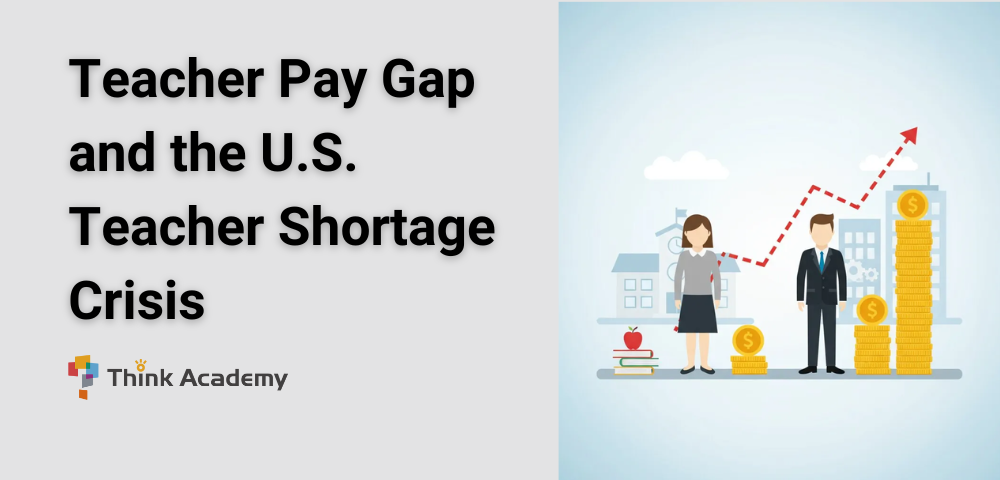
Today, the gap between what teachers earn and what other professionals with the same college education make is the largest in modern history. According to the Economic Policy Institute’s 2024 report, teachers earn roughly 73 cents for every dollar earned by comparable college graduates.
This imbalance not only undervalues the teaching profession but also fuels a growing shortage of qualified educators in classrooms across the country.

The Widening Income Gap
Teacher pay has failed to keep pace with salaries in other professional sectors for decades. While industries such as technology, finance, and healthcare have seen steady wage growth, education has lagged behind due to slower budget increases and limited public funding.
Data from the U.S. Bureau of Labor Statistics shows that the median annual wage for K–12 teachers remains significantly below that of other professionals with bachelor’s degrees. The Economic Policy Institute’s pay gap analysis confirms that this disparity has widened steadily since the mid-1990s.
Several factors contribute to this imbalance:
- Economic prioritization: Private-sector fields like software and finance attract higher investments and can offer better pay to retain skilled workers.
- Public sector funding limits: State and local education budgets often struggle to match inflation or rising regional living costs.
- Public perception: Teaching is frequently framed as a “calling” rather than a profession, leading to lower salary expectations despite growing responsibilities.
The result is an income gap that undervalues teaching as a highly skilled, essential profession, even though educators are responsible for shaping the next generation’s workforce.

Consequences for the Teacher Shortage
The growing wage gap has led to fewer students pursuing teaching degrees and more current teachers leaving the field.
According to the National Center for Education Statistics (NCES), enrollment in teacher preparation programs has dropped sharply over the past decade. College graduates often avoid education because it offers lower starting pay and limited financial growth compared with other careers.
For those already in the classroom, low salaries and limited career advancement contribute to burnout and high turnover. The NCES Teacher Attrition and Mobility Report shows that nearly one in ten teachers leaves the profession each year, with many citing low pay as a key factor. This turnover not only disrupts learning continuity but also increases the strain on schools struggling to fill vacancies.
The effects are visible nationwide:
- Larger class sizes: Schools combine classes due to staffing shortages, reducing individual attention for students.
- Short-term or uncertified hires: Districts turn to temporary or less-qualified instructors to fill urgent needs.
- Reduced learning outcomes: Frequent teacher turnover affects student achievement and school stability.
The Economic Policy Institute has warned that the teacher shortage is not only real but “larger and growing”, creating a long-term challenge for U.S. education systems.
Long-Term Implications
The teacher pay crisis has ripple effects across society. When qualified educators leave the profession or avoid it altogether, the talent pool for future generations shrinks. This threatens educational equity, especially in low-income or rural districts where shortages are most severe.
Over time, underpaying teachers erodes public education quality and contributes to economic inequality. Schools with fewer experienced teachers often see higher turnover, lower test scores, and reduced student engagement—creating long-term disadvantages for entire communities.
Addressing the problem requires systemic reform: sustained investment in teacher salaries, state funding tied to living costs, and public recognition that education is not a charity—it’s infrastructure.
Key Takeaway
The U.S. cannot solve its education challenges without addressing the teacher pay gap. Competitive, fair compensation is essential not only to attract new talent but also to retain experienced teachers who drive student success.
Investing in educators means investing in the nation’s future workforce, innovation, and civic well-being. The sooner the gap closes, the stronger America’s classrooms—and its communities—will become.
About Think Academy
Think Academy, part of TAL Education Group, helps K–12 students succeed in school today by building strong math foundations and critical thinking skills. At the same time, we focus on the bigger picture—developing learning ability, curiosity, and healthy study habits that inspire a lifelong love of learning. With expert teachers, proven methods, and innovative AI tools, we support every child’s journey from classroom confidence to long-term growth.
Want more insights on math learning and parenting? Subscribe to our newsletter for weekly tips and the latest resources.
Leave a Comment & Share Your Thoughts!

Share This Story, Choose Your Platform!
Related Posts