René Descartes and the Coordinate Plane: A Math Story
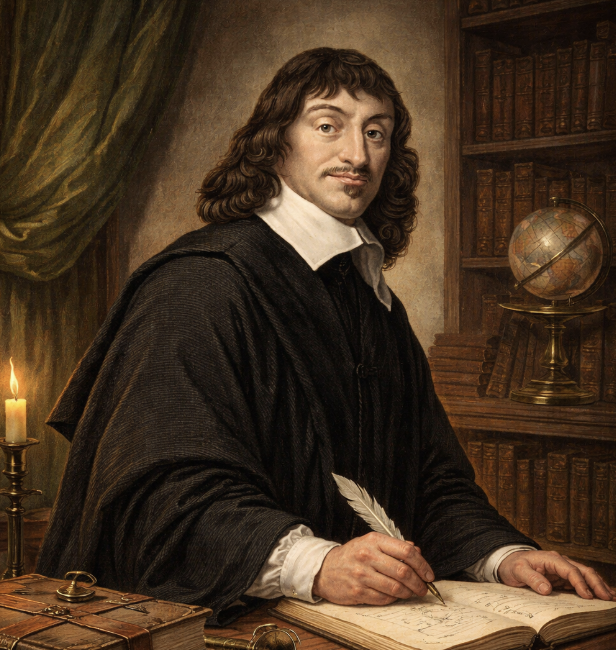
René Descartes’ math story begins with a simple but powerful question: How can we describe shapes and motion using numbers alone? Long before graph paper appeared in classrooms, Descartes imagined a way to connect algebra and geometry—two subjects that had been taught separately for centuries.
His idea changed mathematics forever.
A Curious Thinker Who Loved Order
René Descartes was born in France in 1596. From a young age, he was known for questioning everything. He believed that knowledge should be built on clear reasoning, not memorization or tradition.
Although Descartes studied philosophy, science, and medicine, mathematics became one of his most important tools. To him, math was the language that could explain the world logically and precisely.
The Problem Before Descartes
Before Descartes, geometry and algebra lived in separate worlds.
- Geometry focused on shapes, lines, and diagrams
- Algebra focused on numbers and equations
If you wanted to describe a curve, you had to draw it. If you wanted to solve an equation, you worked only with numbers.
There was no simple way to connect the two.
The Big Idea: Turning Shapes into Numbers
Descartes’ breakthrough was surprisingly simple:
What if every point on a shape could be described using numbers?
He imagined two number lines crossing at right angles:
- One horizontal
- One vertical
By measuring how far a point was from each line, its position could be described with two numbers.
Today, we call this system the coordinate plane.
The Birth of the Coordinate System
In Descartes’ system:
- The horizontal line became the x-axis
- The vertical line became the y-axis
- Every point could be written as (x, y)
For the first time, students could:
- Draw equations
- Write formulas for shapes
- See algebra and geometry working together
A circle, a line, or a curve could now be described by an equation instead of just a picture.
This idea laid the foundation for coordinate geometry, sometimes called Cartesian geometry, named after Descartes himself.
Why Descartes Used x, y, and z
Descartes also helped standardize how we write algebra.
He popularized the use of:
- x, y, z for unknown values
- a, b, c for known values
This convention made algebra easier to read and teach—and it’s still used in classrooms today.
When students graph equations like y = 2x + 3, they are using Descartes’ ideas directly.
How Descartes’ Math Changed the World
Descartes’ work didn’t just improve math class—it shaped modern science.
His coordinate system made it possible to:
- Calculate motion and speed
- Design buildings and machines
- Map the Earth and the stars
- Develop physics, engineering, and computer graphics
Every time students plot points on graph paper or use a graphing calculator, they are using Descartes’ invention.
Why René Descartes’ Story Matters for Students
Descartes shows students that math ideas don’t appear out of nowhere. They are created by people trying to solve real problems.
His story teaches important lessons:
- Math connects ideas, not just numbers
- Visual thinking and logical thinking work together
- One good question can change an entire field
Understanding where graphs and coordinates come from helps students see math as a human invention—not a set of rules to memorize.
Strengthening Coordinate Geometry Skills with Practice
René Descartes’ ideas come to life when students begin working with graphs, coordinates, and equations on their own. Understanding the story behind the coordinate plane is powerful—but mastery comes from practice.
Think Academy Math Worksheets support this learning by providing structured, grade-appropriate practice in coordinate geometry from upper elementary through middle school. These worksheets help students:
- Plot points accurately on the coordinate plane
- Understand the relationship between equations and graphs
- Practice linear relationships, slope, and intercepts step by step
- Build confidence moving from visual graphs to algebraic expressions
Used alongside stories like Descartes’, targeted worksheet practice helps students connect historical ideas, visual understanding, and formal math skills. This combination prepares learners for middle school algebra, geometry, and more advanced STEM thinking.
About Think Academy
Think Academy, part of TAL Education Group, helps K–12 students succeed in school today by building strong math foundations and critical thinking skills. At the same time, we focus on the bigger picture—developing learning ability, curiosity, and healthy study habits that inspire a lifelong love of learning. With expert teachers, proven methods, and innovative AI tools, we support every child’s journey from classroom confidence to long-term growth.
Check our math programs:
- Early Childhood — PreK
- Lower Elementary — Grades K–2
- Upper Elementary — Grades 3–5
- Middle School — Advanced math topics, including Algebra 1, Algebra 2, and Geometry
Want more insights on math learning and parenting? Fill out the form on this page and subscribe to our newsletter for weekly tips and the latest resources.
Leave a Comment & Share Your Thoughts!

Share This Story, Choose Your Platform!
Related Posts










