Pascal’s Triangle: A Story of Math Wonder for Kids
Blaise Pascal for kids provides an engaging entry point into mathematical thinking by connecting abstract concepts with real historical inquiry. Introducing children to Pascal’s early experiments, inventions, and foundational work in probability helps them see math not as a list of rules, but as a discipline shaped by curiosity, creativity, and logical exploration. This perspective nurtures stronger STEM readiness and encourages children to view mathematics as both a creative and analytical pursuit.
A Child’s Curiosity Awakens Mathematical Thinking
Imagine a young boy growing up in 17th-century France whose curiosity could not be contained. Blaise Pascal showed a natural fascination for patterns long before he saw a single math book. His father—hoping Pascal would focus on languages first—kept formal mathematics away from him. But young Pascal began discovering geometric ideas on his own by drawing shapes on the floor.
He noticed relationships between lines, angles, and figures. Without guidance, he independently reasoned through geometric principles. This early self-driven discovery impressed his father so deeply that he allowed Pascal to begin formal mathematical study much earlier than planned.
This story provides children with a powerful message: math begins with noticing patterns and asking questions, not with complicated formulas.

From Early Calculators to the Mathematics of Chance
Pascal’s curiosity didn’t stop at geometry. At age 19, he created a groundbreaking device called the Pascaline, one of the earliest mechanical calculators. Designed to help his father perform tax calculations, the Pascaline could add and subtract through a system of gears and rotating wheels.
This invention introduces children to an important academic concept:
mathematical operations can be automated by mechanical systems—a foundational idea behind modern computing.
Learn more about the Pascaline.
Later, Pascal turned to a new area of mathematics: probability, the study of how likely events are. Inspired by problems involving dice and games of chance, Pascal exchanged letters with mathematician Pierre de Fermat. Their discussions formed the basis of modern probability theory.
Children can relate to this idea easily:
If you roll a die, every number has an equal chance of appearing. Pascal showed that these chances follow mathematical rules, even though the events feel “random.” This is the same math behind weather predictions, sports statistics, and many decisions in science and economics.
The Wonderful World of Pascal’s Triangle
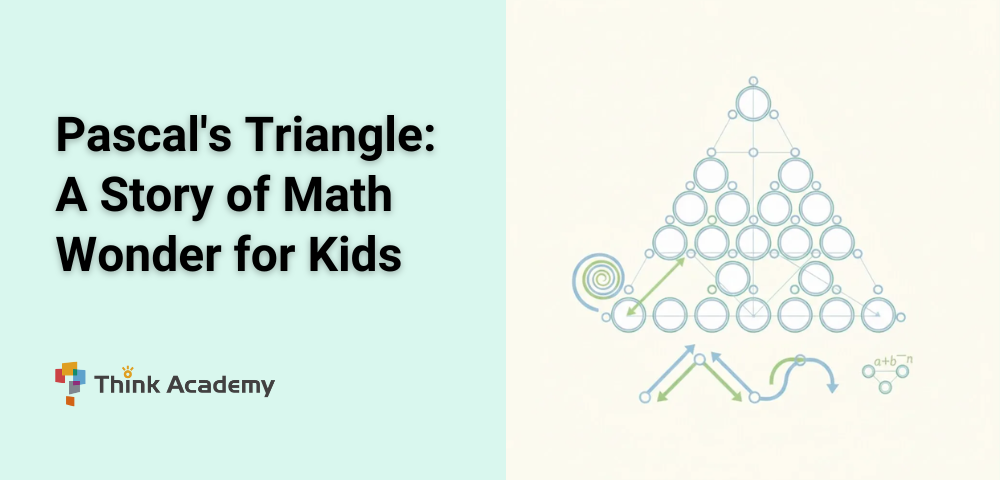
One of Pascal’s most exciting contributions for young learners is Pascal’s Triangle—a simple yet powerful arrangement of numbers.
The rules are easy to understand:
Each number in the triangle is the sum of the two numbers directly above it.
This playful structure reveals deep mathematical ideas:
- In algebra, it provides the coefficients for expanding expressions like ((a + b)^n).
- In combinatorics, the triangle shows how many ways you can choose items from a set (e.g., “3 choose 2”).
- In probability, it helps calculate the likelihood of different outcomes, like coin-flip patterns.
- In nature, similar triangular patterns appear in branching trees, flowers, and shells.
The beauty of Pascal’s Triangle is that a child can understand it, but mathematicians still study it—a perfect example of how simple ideas unlock deeper insights.

Why Pascal’s Story Matters for Young Learners
Pascal’s journey teaches several academic habits essential for early STEM learning:
- Observation – noticing patterns in shapes, numbers, and systems.
- Abstraction – turning real-world problems into mathematical ideas.
- Logical reasoning – using step-by-step thinking to reach conclusions.
- Mathematical modeling – describing real situations (like chance events) using numbers.
- Creativity – inventing tools, diagrams, or new ways of thinking.
By sharing Pascal’s story, parents help children understand that great ideas often start with simple curiosity—a reminder that mathematics is a living subject shaped by human imagination.
Conclusion
Blaise Pascal’s life shows children that mathematics grows from curiosity, observation, and creative thinking. His inventions, problem-solving methods, and number patterns highlight how mathematical ideas shape our understanding of the world. When kids encounter math through stories like Pascal’s, they build not only knowledge but also a mindset for inquiry—an essential ingredient for long-term STEM success.
To extend this mindset at home,
Think Academy offers free, high-quality math worksheets
designed to strengthen the foundational skills Pascal himself relied on: number sense, logical reasoning, pattern recognition, and structured problem-solving. These worksheets help families build consistent at-home learning habits, giving children the confidence to approach math with the same curiosity and perseverance that fueled Pascal’s genius. Paired with historical stories, they create a powerful pathway for joyful, meaningful math learning.
About Think Academy
Think Academy, part of TAL Education Group, helps K–12 students succeed in school today by building strong math foundations and critical thinking skills. At the same time, we focus on the bigger picture—developing learning ability, curiosity, and healthy study habits that inspire a lifelong love of learning. With expert teachers, proven methods, and innovative AI tools, we support every child’s journey from classroom confidence to long-term growth.
Want more insights on math learning and parenting? Fill out the form on this page and subscribe to our newsletter for weekly tips and the latest resources.
Leave a Comment & Share Your Thoughts!
Share This Story, Choose Your Platform!
Related Posts