New Education Policy 2020 in K12 Education: Progress, Challenges & Impact
The National Education Policy (NEP) 2020 is India’s most sweeping education reform in decades. Its goal is to redesign the K–12 schooling system to be more flexible, holistic, skill-oriented, inclusive, and future-ready. While implementation is still unfolding, signs of change are emerging across states, schools, and classrooms.

Progress of NEP Implementation
Structural and Curriculum Reforms
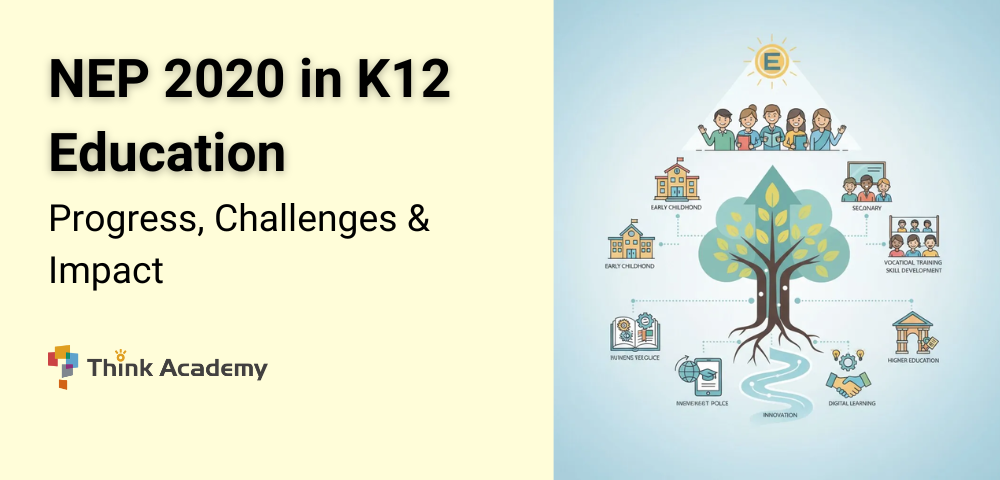
The most visible shift has been the introduction of the 5+3+3+4 school structure, which replaces the old 10+2 model. This reorganizes schooling into four phases: foundational (ages 3–8), preparatory (8–11), middle (11–14), and secondary (14–18), aligning with stages of child development.
The policy also recommends the mother tongue or regional language as the medium of instruction until at least Grade 5, supporting better comprehension and stronger conceptual clarity.
From Grade 6 onward, students are expected to receive vocational exposure in areas such as coding, carpentry, agriculture, or design, preparing them with practical skills for future careers.
Foundational literacy and numeracy are a top priority. The National Mission on FLN aims to ensure that every child attains basic reading and arithmetic skills by Grade 3.
Holistic education is emphasized as well. Programs like the School Health & Wellness Programme integrate arts, sports, ethics, life skills, and mental health into the learning experience.
CBSE has already begun rolling out curriculum changes under the National Curriculum Framework for the Foundational Stage (NCF-FS 2022), while UNESCO has partnered with CBSE and NCERT to strengthen teacher training and wellness programs in thousands of schools.

Challenges in Rollout
Teacher Training and Capacity Building
A major challenge is reskilling teachers. Many educators are still transitioning to inquiry-based and experiential learning approaches. The government has piloted initiatives like the Bluebook on Mentoring to guide professional development, but coverage across states remains uneven.
Infrastructure and Resource Gaps
Urban schools are better positioned to adopt labs, digital classrooms, and vocational workshops, while many rural schools lack even basic infrastructure such as internet access or science labs. This inequality limits the pace of reform.
Language Implementation
Although using the mother tongue can enhance comprehension, India’s linguistic diversity makes it difficult to ensure teacher availability and resources in every language. The three-language formula also faces practical and political challenges in several states.
Assessment Reforms
Replacing rote memorization with competency-based assessments requires not just new exam formats but also a shift in mindset for teachers, students, and parents. This transition is still at an early stage.
Variability Across States
Because education is a concurrent subject, implementation depends heavily on state governments. Some states are ahead in adopting reforms, while others move more slowly. This leads to an uneven national picture.
Implications for Students and Parents
For families, NEP 2020 brings concrete changes. Students now enjoy more flexibility in subject choices, with the ability to mix science, arts, and vocational streams. Early emphasis on foundational literacy and numeracy aims to close learning gaps, improving readiness for higher studies and competitive exams. Vocational modules provide real-world skills and career exposure earlier than before. Holistic development, including arts, sports, and mental health, is formally part of the curriculum. Finally, exam pressure is expected to reduce as assessments gradually shift from rote to competency-based models.
Looking Forward
To fully realize its vision, NEP 2020 will require stronger teacher training programs, upgraded infrastructure through public–private partnerships, localized language solutions, and robust monitoring to measure outcomes. Parent awareness is also critical, since families play a vital role in supporting these educational shifts.
The NEP is ambitious and long-term. While challenges remain, its potential to reshape Indian schooling into a system that nurtures creativity, critical thinking, and lifelong learning is undeniable.
About Think Academy
Think Academy, part of TAL Education Group, helps K–12 students succeed in school today by building strong math foundations and critical thinking skills. At the same time, we focus on the bigger picture—developing learning ability, curiosity, and healthy study habits that inspire a lifelong love of learning. With expert teachers, proven methods, and innovative AI tools, we support every child’s journey from classroom confidence to long-term growth.
Want more insights on math learning and parenting? Subscribe to our newsletter for weekly tips and the latest resources.
Leave a Comment & Share Your Thoughts!
Share This Story, Choose Your Platform!
Related Posts