Master’s Degree vs Job Market: How to Decide After College
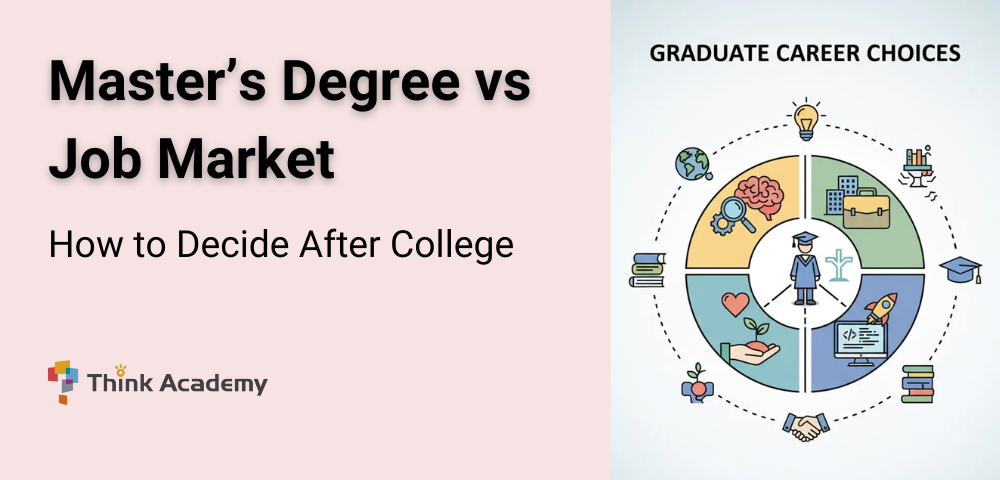
Career planning after graduation can feel overwhelming. Many fresh graduates stand at a crossroads, unsure whether to pursue a master’s degree or enter the job market right away. Both options carry unique advantages—and potential drawbacks. This guide explores the benefits, trade-offs, and key factors to help you make a more informed decision.

The Benefits of Pursuing a Master’s Degree
A master’s degree offers the chance to dive deeper into specialized fields, conduct advanced research, and gain mentorship from experts. But beyond academics, the numbers also show a real economic impact:
- Higher earnings: Among 25–34 year olds working full time, the median annual salary is $80,200 with a master’s or higher vs. $66,600 with a bachelor’s—a roughly 20% premium (NCES).
- Weekly income: On average, master’s degree holders earn $1,840 per week vs. $1,543 for bachelor’s holders, according to the U.S. Bureau of Labor Statistics (BLS).
- Lifetime advantage: Research shows men with graduate degrees earn $1.5 million more than high school graduates over a lifetime; for women, the difference is about $1.1 million (SSA).
It’s no surprise that more people are choosing this route. About 14.4% of U.S. adults now hold a master’s or higher degree (National University).
Careers Where a Master’s Is Often Required
Some professions simply expect advanced education:
- Psychologists, counselors, and social workers (MSW)
- Speech-language pathologists and audiologists
- Economists and policy analysts
- Data scientists and advanced researchers
- School counselors, librarians (MLIS), and education administrators
- Public health and urban planning specialists
- Engineering researchers and R&D roles
In fact, the U.S. Bureau of Labor Statistics projects 40 occupations will require a master’s for entry, with jobs in this category expected to grow about 16.7% by 2026 (BLS).
The Advantages of Direct Employment
On the other hand, entering the job market right after graduation can provide benefits that no classroom can match:
- Immediate financial independence: By starting work earlier, graduates earn income right away and begin building savings.
- Real-world experience: Employers value practical skills—teamwork, communication, and problem-solving—that are best learned on the job (Britannica).
- Faster career progression: An early start gives workers a head start in climbing the corporate ladder. Some industries, especially tech and business, reward years of experience and achievements more than degrees.
Careers Where Experience Matters More Than Degrees
In many fields, years of experience (YOE) and results outweigh advanced credentials:
- Software engineering and IT (portfolios, projects, certifications)
- Sales, business development, and marketing (measured by performance)
- Operations, logistics, and supply chain management
- Project or program management (track record of delivery)
- Entrepreneurship, startups, and creative roles (design, content, UX)
Indeed, many job postings specify “X years of experience” as a must, regardless of academic qualifications (Indeed).

Key Factors to Consider
There’s no universal answer to the degree-versus-work dilemma. Instead, weigh these factors:
- Financial situation: Can you afford more years of tuition, or do you need income now?
- Career goals: Does your target career path demand advanced credentials, or does it reward practical experience more?
- Personal interests: Are you passionate about research and theory, or eager to apply knowledge in the field?
- Flexibility: Remember, you can always return for a master’s later, often with employer sponsorship.
FAQs on Career Planning After Graduation
Is a master’s degree worth it?
It depends on your field. In STEM, health, and social sciences, a master’s can open essential doors. In some other fields, experience may matter more.
Can I work first and study later?
Yes. Many professionals gain work experience and then pursue a master’s (often part-time or employer-funded) once their goals are clearer.
Do employers prefer education or experience?
Most prefer a balance. Advanced degrees help signal expertise, but practical achievements prove real-world ability.
Conclusion
Choosing between a master’s degree and direct employment is one of the biggest career decisions fresh graduates face. A master’s can boost long-term earnings and open specialized career paths, while early work provides financial independence, skills, and experience that degrees alone can’t deliver.
The best choice depends on your financial readiness, professional aspirations, and learning style. Take time to reflect on your goals—and remember that career paths aren’t always linear. Whether you start in graduate school or the workforce, what matters most is continuous growth and alignment with your future vision.
About Think Academy
Think Academy, part of TAL Education Group, helps K–12 students succeed in school today by building strong math foundations and critical thinking skills. At the same time, we focus on the bigger picture—developing learning ability, curiosity, and healthy study habits that inspire a lifelong love of learning. With expert teachers, proven methods, and innovative AI tools, we support every child’s journey from classroom confidence to long-term growth.
Want more insights on math learning and parenting? Subscribe to our newsletter for weekly tips and the latest resources.
Leave a Comment & Share Your Thoughts!

Share This Story, Choose Your Platform!
Related Posts