Leonardo da Vinci & Geometry: Inspire Kids With Math
Leonardo da Vinci offers one of the clearest examples of how mathematics—especially geometry—can spark creativity, invention, and scientific insight. Many families want their children to see math as more than worksheets and equations, and da Vinci’s life shows exactly how powerful mathematical thinking can be. His ability to observe patterns, analyze shapes, and apply geometric reasoning transformed art, engineering, anatomy, and even the study of nature. Sharing da Vinci’s story helps children discover that math is not just useful—it is magical.
Leonardo da Vinci: A Polymath Shaped by Mathematics
Leonardo da Vinci (1452–1519) was a painter, anatomist, inventor, engineer, architect, and scientist—one of the most extraordinary minds of the Renaissance. Britannica describes him as the model of the “Renaissance man,” whose intellectual range stretched across nearly every discipline.
What made Leonardo truly exceptional was not just talent, but his ability to view the world mathematically. He recognized geometry as the underlying structure of nature—its language. Whether sketching plants, studying flight, or dissecting the human body, he used mathematical reasoning to uncover patterns and relationships invisible to others.
Leonardo didn’t treat math as an abstract subject. He used it to explain the world.

da Vinci’s Early Geometrical Journey
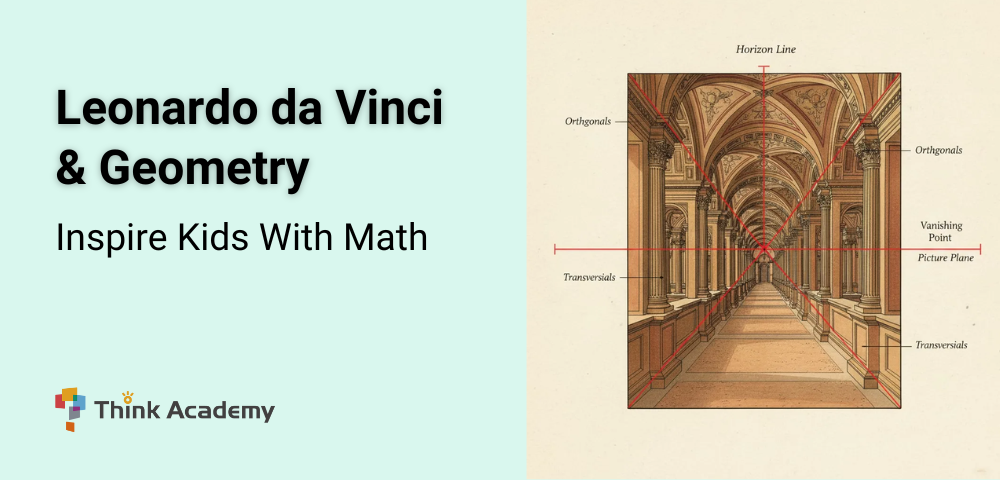
As a young apprentice in Florence, Leonardo trained in drawing, perspective, drafting, and basic engineering. These skills required a precise understanding of how shapes behave. Perspective drawing, for example, depends on:
- vanishing points
- converging lines
- ratios and proportional scaling
Learning these principles allowed Leonardo to create depth on a flat page—an innovation that transformed Renaissance art. He quickly recognized that the same geometric principles guiding artistic perspective also governed nature: the angles of bird wings, the spirals of shells, the arcs of water flow.
Geometry became his method for decoding the world.
Geometry in Art and Invention
da Vinci’s artwork showcases his geometric brilliance. His iconic Vitruvian Man is more than a drawing—it is a mathematical demonstration of perfect human proportions. Inscribing a figure within a circle and square illustrates harmony between the human body and geometric principles.
His studies often involved analyzing:
- symmetry
- the golden ratio (≈1.618)
- proportional relationships
- rotational and reflective patterns
These mathematical insights shaped his architectural ideas, anatomical sketches, and aesthetic decisions.
Geometry also fueled his engineering genius. When designing flying machines, bridges, hydraulic systems, or armored vehicles, Leonardo broke complex mechanisms into simple geometric parts. Triangles, circles, and arcs helped him visualize force, lift, rotation, and stability. His notebooks reveal hundreds of diagrams showing how geometry supports movement and structure.

da Vinci’s Mathematical Legacy
da Vinci demonstrated that geometry is far more than schoolwork—it is a universal language linking art, science, and engineering. His studies influenced fields as varied as anatomy, architecture, physics, and biomechanics. Architects still use principles of perspective and proportion he refined; scientists still study fluid motion and spirals he sketched centuries ago.
This legacy teaches children several meaningful lessons:
- Math is a tool for understanding the world
- Geometry helps us see patterns everywhere
- Creativity and mathematics are deeply connected
- The greatest innovations combine logic and imagination
da Vinci’s life shows that by studying shapes and proportions, we can deepen insight in both artistic and scientific domains.
Conclusion
Leonardo da Vinci’s journey reveals that geometry is not simply a subject to memorize—it is a powerful way to interpret and design the world. Sharing his story helps children see math as an active, creative, and exploratory process. By recognizing how shapes, patterns, and proportions influence art, nature, and invention, young learners develop a richer appreciation for mathematics and its limitless potential.
To build these foundational skills at home,
Think Academy offers free, high-quality math worksheets
that strengthen pattern recognition, spatial reasoning, and problem-solving—the same mathematical habits that shaped Leonardo’s genius. These resources also support consistent at-home learning routines, giving children steady practice that builds confidence and curiosity. Together, inspirational stories and structured math practice help children develop the mindset of future innovators.
About Think Academy
Think Academy, part of TAL Education Group, helps K–12 students succeed in school today by building strong math foundations and critical thinking skills. At the same time, we focus on the bigger picture—developing learning ability, curiosity, and healthy study habits that inspire a lifelong love of learning. With expert teachers, proven methods, and innovative AI tools, we support every child’s journey from classroom confidence to long-term growth.
Want more insights on math learning and parenting? Fill out the form on this page and subscribe to our newsletter for weekly tips and the latest resources.
Leave a Comment & Share Your Thoughts!

Share This Story, Choose Your Platform!
Related Posts










