Isaac Newton for Kids: Inspiring Math & Science Story
Inspiring mathematician stories for kids reveal how mathematical ideas shape the world and spark curiosity about how things work. Isaac Newton’s story shows that math is not just about calculations—it is a powerful tool for exploring motion, light, gravity, and the universe itself. His journey from a curious child in rural England to one of history’s greatest scientific thinkers demonstrates how mathematical reasoning can unlock deep mysteries of nature and inspire learners to see math as a pathway to discovery.
A Young Mind’s Journey
Isaac Newton was born in 1642 in a small English village called Woolsthorpe. As a child, he was quiet, observant, and endlessly curious. He built sundials, water clocks, and miniature windmills, trying to understand how things worked. These early experiments helped shape the scientific habits he would use all his life.
School wasn’t always easy for Newton. He was sometimes considered an average student, but his interests were unusual for his age. He loved geometry, measurement, and mechanical puzzles. Over time, his passion for math and natural philosophy (early science) grew so strong that he eventually enrolled at Trinity College, Cambridge, where his talent quickly became undeniable.

Developing New Mathematical Tools
Newton’s most productive years came during a period when Cambridge University temporarily closed because of the plague. Back home in Woolsthorpe, he entered what scientists call his Annus Mirabilis, or “Year of Wonders.” During this time, Newton developed calculus, a new branch of mathematics now taught worldwide.
Calculus allowed scientists to describe:
- how fast things move
- how shapes grow or shrink
- how planets change speed in orbit
- how forces affect motion over time
Before calculus, these questions were nearly impossible to solve precisely. Newton’s new mathematics could calculate rates of change and accumulations, giving scientists a powerful tool to model real-world behavior. His calculus work—developed independently around the same time as Gottfried Leibniz—became the foundation of modern physics and engineering.
Unveiling Universal Laws Through Math
With his new mathematical tools, Newton explored some of the biggest questions in science: Why do objects fall? What keeps planets in orbit? Do the same rules apply on Earth and in space?
Newton answered these questions by formulating:
- the Three Laws of Motion, which describe how forces affect movement
- the Law of Universal Gravitation, which states that every object in the universe attracts every other object
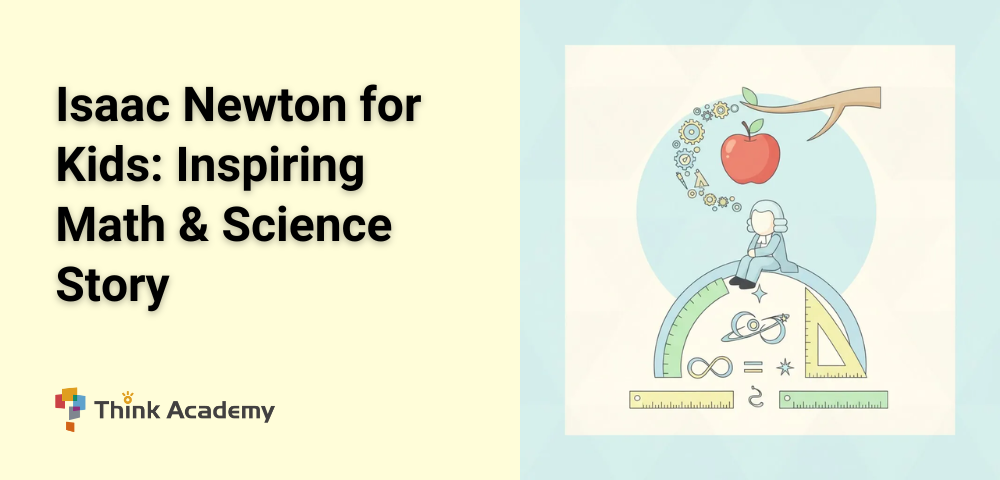
His genius was realizing that the same force that makes an apple fall to Earth also keeps the moon orbiting our planet. This idea unified the heavens and Earth under a single set of mathematical laws.
Newton published his discoveries in his famous book Philosophiæ Naturalis Principia Mathematica—often called simply Principia. It became one of the most important scientific works ever written and shaped physics for centuries.

A Lasting Mathematical Legacy
Isaac Newton’s impact on mathematics and science is almost impossible to overstate. He contributed to:
- calculus
- optics and color theory
- early algebra and geometry
- celestial mechanics
- scientific methodology
Newton was, without question, both a mathematician and a physicist—a pioneer who used mathematics as the tool to explain and predict natural phenomena. His discoveries continue to guide astronauts, engineers, physicists, and mathematicians today.
His story teaches children that asking questions, observing carefully, and exploring patterns can lead to world-changing ideas. Mathematics becomes more than a school subject—it becomes a way to understand the universe.
Conclusion
Isaac Newton’s story shows that mathematics is a powerful lens for understanding the world, revealing patterns in motion, light, gravity, and the universe itself. His discoveries remind young learners that math is not just a school subject—it is a key to answering big questions and exploring bold ideas. To help students build the same foundational skills that supported Newton’s breakthroughs,
Think Academy offers free grade-level math worksheets
that strengthen number sense, problem-solving, and logical reasoning. These essential skills prepare curious minds to tackle challenging concepts with confidence and see math as a pathway to discovery.
About Think Academy
Think Academy, part of TAL Education Group, helps K–12 students succeed in school today by building strong math foundations and critical thinking skills. At the same time, we focus on the bigger picture—developing learning ability, curiosity, and healthy study habits that inspire a lifelong love of learning. With expert teachers, proven methods, and innovative AI tools, we support every child’s journey from classroom confidence to long-term growth.
Want more insights on math learning and parenting? Fill out the form on this page and subscribe to our newsletter for weekly tips and the latest resources.
Leave a Comment & Share Your Thoughts!

Share This Story, Choose Your Platform!
Related Posts










