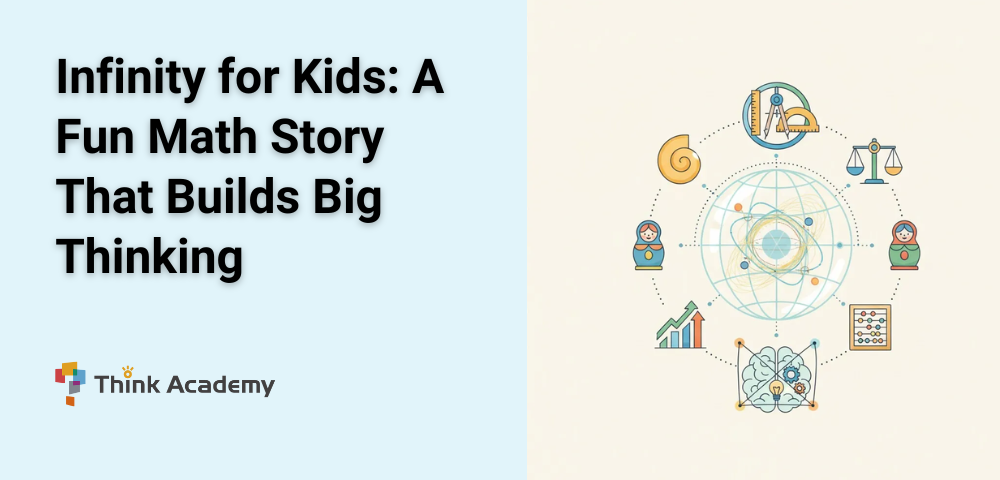
Infinity for Kids: A Fun Math Story That Builds Big Thinking
Infinity for kids provides an accessible entry point into one of mathematics’ most profound and enduring ideas. The concept of infinity has captivated thinkers for centuries, bridging arithmetic, geometry, philosophy, and science. Introducing children to infinity not only supports early mathematical reasoning but also encourages them to grapple with abstract ideas, recognize patterns without endpoints, and appreciate the unbounded nature of number systems and the universe. Through simple narratives and visual models, infinity becomes a powerful lens for developing curiosity and foundational STEM thinking.
The Idea of “Never-Ending”
Long before advanced mathematics existed, people counted the things around them—animals, crops, stars, and distances. Soon they realized a profound truth: no matter how high they counted, there was always another number waiting. Numbers didn’t stop; they stretched endlessly forward.
This realization was the beginning of the concept we now call infinity. Infinity is not a “very big number”—it is the idea of no end at all.
The Infinity Symbol: ∞
The symbol for infinity (∞), shaped like a sideways figure eight, dates back to the 17th century. It’s called a lemniscate, from a Latin word meaning “ribbon.” Its looping form represents a path that continues forever—no beginning, no end—just like the number sequence children use every day.

Counting Without Limits: The First Step Toward Infinity
The simplest way to understand infinity is through counting:
1, 2, 3, 4, …
Children quickly learn that even if you count for hours, days, or years, you will never reach a “last” number. You can always add one more. This gives children their first intuitive sense of an unending process.
Infinity on a Number Line
Imagine drawing a straight number line. Even if the paper ends, the line continues in both directions forever in our imagination. Mathematically, a line has:
- no starting point
- no ending point
- infinite length
This helps kids see infinity not as a mystery, but as an idea that helps describe things without boundaries.
Infinity All Around Us
Infinity is not only in numbers—it appears in surprising places.
1. Infinite Points on a Line Segment
Even between 0 and 1, there are infinitely many numbers.
Children can think of splitting the space in half… then splitting the halves again… and again… noticing there is always room for more numbers.
This introduces the idea that infinity can exist even inside something very small.
2. Infinity in Nature: Fractals
Nature contains patterns that repeat over and over:
- snowflakes
- fern leaves
- seashell spirals
- branching trees
These repeating designs are called fractals. When magnified, each part looks similar to the whole. The pattern could continue forever if we kept zooming in—another type of infinity kids can visualize.
3. Infinity in Space and Physics
Children may wonder:
- “Does space ever end?”
- “How many stars exist?”
Astronomers study these questions using models that often involve infinite distances or unbounded quantities. Infinity helps describe the unknown.

Endless Numbers in the Real World
Infinity may seem abstract, but “endless numbers” appear in many real-world contexts that help children understand how mathematics describes large systems, repeating patterns, and continuous processes.
1. Astronomy and Space Science
Space involves quantities so large they behave like endless numbers—billions of stars, expanding galaxies, and distances measured in light-years. Infinity helps scientists describe sizes and scales far beyond everyday counting.
2. Computer Science and Algorithms
Programming uses processes that can continue indefinitely until conditions change. Loops, expanding data structures, and repeated calculations show how computers rely on ideas connected to infinite sequences.
3. Fractals and Nature’s Patterns
Snowflakes, ferns, coastlines, and branching trees contain patterns that repeat at smaller and smaller scales. These fractals suggest endless repetition and help children see how infinity appears in natural design.
4. Decimals and Precise Measurements
Numbers like π (3.14159…) or √2 (1.41421…) have infinite decimal expansions. Engineers, architects, and scientists use these values even though they can’t be written out completely, showing how infinite numbers support real-world precision.
5. Growth Models and Change Over Time
Compound interest, population growth, and viral spread are modeled with formulas that can grow without bound under ideal conditions. These examples help children connect infinity to change, prediction, and large-scale systems in science and economics.
6. Grids, Coordinates, and Maps
Number lines and coordinate planes extend endlessly in all directions. Even though maps and blueprints are finite, the mathematical grids beneath them represent infinite space, helping describe position and movement.
Infinity becomes far more meaningful when children notice how it appears around them—in science, technology, nature, and even the numbers they use in everyday life.
Big Ideas Made Simple: Countable vs. Uncountable Infinity
For older children (ages 9–12), you can introduce a deeper idea:
Not all infinities are the same size.
- Counting numbers (1, 2, 3, …) form a countable infinity
- Numbers between 0 and 1 form an uncountable infinity (even bigger)
In simple terms:
“There are more numbers between 0 and 1 than all the whole numbers put together.”
This kind of big idea helps kids see math as full of wonder, not just memorization.
Conclusion
Infinity invites young learners to think beyond boundaries—whether imagining an endless number sequence, the infinite points on a line, or repeating patterns in nature. Introducing this concept early helps children strengthen abstract reasoning, recognize structure within large systems, and approach mathematics with curiosity rather than hesitation. Infinity becomes more than a symbol; it becomes a foundation for understanding growth, patterns, limits, and the structure of the number system itself.
To reinforce these skills,
Think Academy offers free, high-quality math worksheets
that build the number sense, pattern recognition, and logical thinking essential for understanding concepts like infinity. These structured practice materials also support consistent at-home learning habits, giving students the confidence to explore challenging ideas with the same openness and imagination that mathematicians bring to the study of infinite sets. When paired with engaging math stories, these worksheets help children develop a stronger, more intuitive relationship with mathematics—one that grows without limits.
About Think Academy
Think Academy, part of TAL Education Group, helps K–12 students succeed in school today by building strong math foundations and critical thinking skills. At the same time, we focus on the bigger picture—developing learning ability, curiosity, and healthy study habits that inspire a lifelong love of learning. With expert teachers, proven methods, and innovative AI tools, we support every child’s journey from classroom confidence to long-term growth.
Want more insights on math learning and parenting? Fill out the form on this page and subscribe to our newsletter for weekly tips and the latest resources.
Leave a Comment & Share Your Thoughts!
Share This Story, Choose Your Platform!
Related Posts