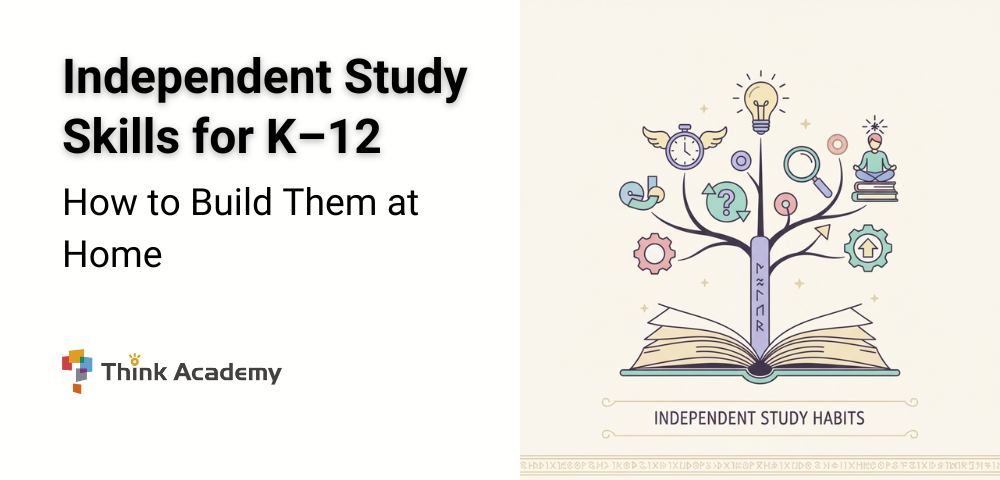
Independent Study Skills for K–12: How to Build Them at Home
Independent study refers to a student’s ability to plan learning tasks, practice skills, monitor understanding, and adjust strategies with gradually reduced adult support. It does not mean learning without guidance. Instead, it describes a developmental process in which responsibility for learning shifts from adults to students over time.
In K–12 education, independent study typically includes:
- Knowing what needs to be done and when
- Working through tasks without constant reminders
- Recognizing mistakes and attempting corrections
- Reflecting on progress and next steps
Independent study is not a personality trait. It is a learnable skill set that develops through structure, repetition, and appropriate scaffolding.
The Motivation and Learning Science Behind Independent Study
Independent study is effective because it aligns with both student motivation and how the brain learns.
From a motivation perspective, research consistently shows that students engage more deeply when three conditions are met.
First, autonomy. Students are more motivated when they have some control over how work is completed, such as choosing task order or deciding when to review mistakes. Even small choices increase ownership.
Second, competence. Motivation grows when students experience visible progress. Tasks that are appropriately challenging—neither too easy nor overwhelming—help students build confidence through repeated success.
Third, purpose. Students persist longer when they understand why a task matters. Independent study works best when learning feels meaningful rather than arbitrary.
From a learning science perspective, independent study supports durable learning because it promotes active engagement.
When students solve problems independently, explain ideas in their own words, and attempt recall without prompts, they strengthen memory pathways more effectively than through passive listening or rereading. Independent study also supports metacognition—the ability to recognize what is understood and what needs more work—which is essential for long-term academic growth.
Spacing practice over time, rather than cramming, further improves retention and transfer. Independent study naturally supports this by encouraging consistent, distributed practice.

How to Build Independent Study Skills in K–12 Students
Independent study skills develop through deliberate routines, clear tools, and gradual transfer of responsibility. The goal is not to overwhelm students with systems, but to give them simple structures they can eventually manage on their own.
Step 1: Make Tasks and Time Visible With Simple Planning Tools
Independent study begins when students understand what needs to be done and when.
At home, families can use Google Calendar or Apple Reminders to externalize planning. For younger students, parents enter tasks together and review them daily. For older students, responsibility gradually shifts to the child, with weekly parent check-ins instead of daily reminders.
This builds time awareness and reduces dependence on adults to prompt every task.
Step 2: Use Skill-Based Learning Platforms for Independent Practice
Independent study requires students to practice skills without immediate adult help, while still receiving feedback.
Platforms such as Khan Academy and IXL are effective because they allow students to:
- Work at their own pace
- Receive immediate feedback
- Retry problems independently
Families can support independence by setting short, focused practice windows (15–30 minutes), limiting sessions to one or two skills, and encouraging students to read error explanations before asking for help.
Step 3: Build Independent Reading Habits With Age-Appropriate Content
Independent learners must be able to absorb information without direct instruction.
For younger students, Epic supports daily independent reading with leveled texts. For older students, Newsela introduces real-world articles at adjustable reading levels, helping students practice comprehension and critical thinking independently.
Tracking time spent reading, rather than volume alone, reinforces consistency and stamina.
Step 4: Teach Students to Process and Organize Information Actively
Independent study is ineffective if students only consume content passively.
Simple tools like Google Docs allow students to write short summaries, explanations, or reflections after practice or reading. Prompts such as “What did I learn?” or “What was confusing?” help build metacognitive awareness.
For middle and high school students managing multiple subjects, Notion can support project planning and note organization once basic habits are established.
These practices teach students to clarify thinking and take ownership of understanding.
Step 5: Strengthen Foundations That Enable Independent Work
Even with good tools, independent study breaks down when foundational skills are weak—especially in mathematics.
Math underlies many independent learning tasks, including time planning, data interpretation, measurement, and logical reasoning. Without accuracy and confidence in these areas, students struggle to work independently.
To support this foundation,
provide structured practice for Kindergarten through Grade 10. Consistent worksheet practice helps students build precision, stamina, and multi-step problem-solving skills, reducing frustration during independent work.
Strong foundations allow students to focus on planning, reasoning, and reflection rather than basic computation.
How Responsibility Shifts Over Time
Independent study looks different at each stage:
- Grades K–2: Adult-guided routines, short practice sessions, visual task lists
- Grades 3–5: Shared planning, independent skill practice, simple written reflection
- Grades 6–8: Student-managed planners, goal setting, progress review
- Grades 9–12: Long-term planning, subject prioritization, self-evaluation
The tools remain similar, but ownership gradually transfers from adult to student.

Supporting Independent Study With Strong Math Foundations
Many independent learning tasks rely on mathematics, even outside math class. Planning time, interpreting data, measuring outcomes, and explaining logical steps all depend on mathematical reasoning.
For families supporting independent study at home, Think Academy math worksheets provide structured, skill-focused practice for Kindergarten through Grade 10. While worksheets are not a replacement for instruction or planning tools, they play an important role in strengthening accuracy, reasoning, and multi-step problem-solving.
Consistent math practice helps students:
- Build confidence in independent work
- Reduce cognitive load during complex tasks
- Focus on reasoning rather than basic calculation
When foundational skills are secure, students are better equipped to plan, persist, and self-correct during independent study.
The Long-Term Benefits of Independent Study
Independent study skills extend far beyond homework completion. Over time, students who develop these skills tend to show:
- Greater academic resilience when facing challenging material
- Stronger problem-solving and reasoning abilities
- Improved self-confidence and ownership of learning
- Better preparation for advanced coursework and long-term goals
Perhaps most importantly, independent study supports lifelong learning. Students learn not only what to study, but how to learn—an ability that remains valuable long after formal schooling ends.
Final Takeaway
Independent study is not about discipline or motivation alone. It is a skill set grounded in motivation science and cognitive learning principles, built through structure, practice, and strong academic foundations.
When families support independence gradually—by providing routines, encouraging reflection, and reinforcing core skills such as mathematics—students gain the confidence and ability to take ownership of their learning. Over time, independent study becomes a powerful driver of both academic success and long-term personal growth.
About Think Academy
About Think Academy
Think Academy, part of TAL Education Group, helps K–12 students succeed in school today by building strong math foundations and critical thinking skills. At the same time, we focus on the bigger picture—developing learning ability, curiosity, and healthy study habits that inspire a lifelong love of learning. With expert teachers, proven methods, and innovative AI tools, we support every child’s journey from classroom confidence to long-term growth.
Check our math programs:
- Early Childhood — PreK
- Lower Elementary — Grades K–2
- Upper Elementary — Grades 3–5
- Middle School — Grades 6-10
Want more insights on math learning and parenting? Fill out the form on this page and subscribe to our newsletter for weekly tips and the latest resources.
Leave a Comment & Share Your Thoughts!
Share This Story, Choose Your Platform!
Related Posts