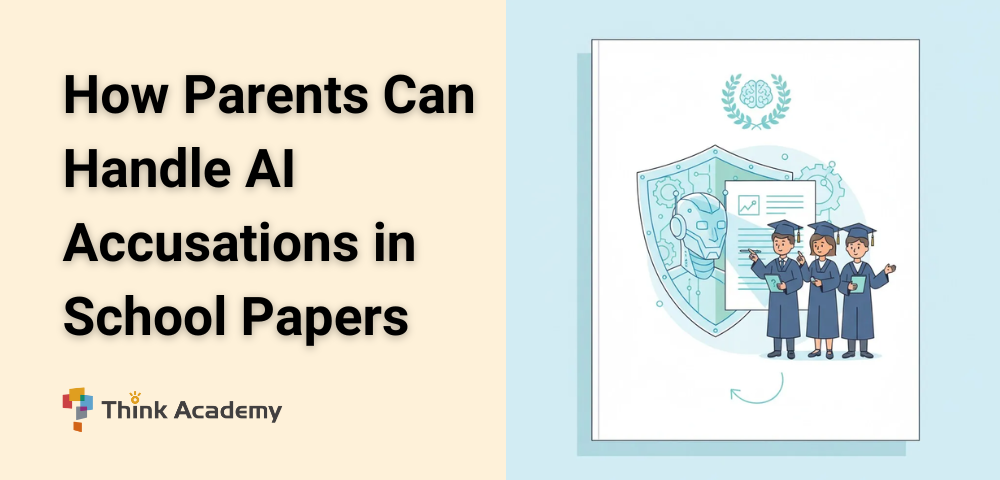
How Parents Can Handle AI Accusations in School Papers
Artificial intelligence has quickly become part of how students research, draft, and study. While these tools can support learning, many schools now use AI-detection systems to monitor academic integrity. Unfortunately, these systems are not always accurate, and even strong, well-written student work may trigger false positives. Understanding how these tools function—and what their limitations are—helps parents support their children when concerns arise.
A concerned parent reviewing a school paper on a tablet, with subtle AI graphics in the background symbolizing AI accusations, flagged papers, and response strategies.
Understanding AI Detection Tools—and Their Limits
AI detection systems look for patterns associated with machine-generated text. They analyze factors such as predictability, repetition, and sentence structure. While useful as a screening mechanism, these tools are far from definitive.
False positives happen for several reasons. Some students naturally write with clear structure or formal language, which AI detectors may misinterpret. Others produce short assignments where limited text creates unreliable results. Most importantly, many AI detectors are not scientifically validated, meaning their accuracy varies widely. This is why flagged content should always lead to a conversation, not an immediate accusation.

How to Reduce the Risk of AI Misunderstandings
One effective way to avoid problems is to help your child make their writing process more transparent. Encouraging them to save brainstorming notes, early outlines, and multiple drafts creates a clear record of how their ideas developed. This documentation not only strengthens their writing skills but also provides valuable proof of originality if a question arises.
Another helpful strategy is to support your child in developing their own writing voice. Students who express their opinions, use personal examples, or vary their sentence structure tend to produce writing that feels naturally human. A strong voice makes it less likely that a detector or teacher will mistake their work for AI-generated text.
Finally, make sure your child understands how to use sources responsibly. Properly paraphrasing information, summarizing research, and citing sources correctly are essential elements of academic integrity. Good citation habits demonstrate effort and reduce the risk of confusion about plagiarism or AI-assisted writing.
What to Do If Your Child Is Accused of Using AI
Even with preparation, a misunderstanding may happen. How you respond can influence both the outcome and your child’s emotional well-being.
Stay Calm and Gather Information
Before reacting, ask the teacher or school for clear details. It’s helpful to know:
- Which part of the assignment was flagged
- What AI detection tool was used
- What criteria triggered the flag
- Whether the teacher manually reviewed the writing
Having accurate information allows you to prepare a constructive response.
Communicate Respectfully With the School
Reach out to the teacher with an open, collaborative tone. A message such as, “We care deeply about academic integrity and would like to walk through how this assignment was created,” helps keep the discussion focused on clarity rather than conflict.
Present Evidence of Original Work
Show the materials your child saved: drafts, notes, research steps, and version history. These demonstrate the writing process clearly. If appropriate, ask your child to explain how they developed their ideas. Hearing directly from the student often reassures teachers that the work is authentic.
A parent and child sitting together at a table reviewing drafts, notes, and highlighted sections, illustrating how families can prepare evidence when responding to an AI accusation.
Encourage your child to view the experience as an opportunity to grow. Discuss the importance of academic honesty, responsible technology use, and pride in their own work.

Building Academic Integrity in the AI Era
This new era of education offers families a chance to reinforce foundational skills and values. Help your child understand that their insights and ideas matter. While AI tools can assist with brainstorming or grammar, they cannot replace a student’s genuine thinking and creativity.
It is also important to review school policies together. Many students are unclear about when AI tools are allowed and when they cross into academic dishonesty. Setting clear expectations helps avoid future misunderstandings.
Above all, be your child’s advocate. A false accusation can feel intimidating, and your reassurance plays a crucial role. By staying calm and supportive, you help your child develop resilience and confidence when facing challenges.
Conclusion
AI tools are reshaping education, but they also introduce new challenges when school papers are flagged incorrectly. By understanding how detection systems work, encouraging transparent writing habits, and responding thoughtfully when concerns arise, you can protect your child’s academic journey.
With your support, your child can learn to navigate the evolving landscape of AI in education with integrity, confidence, and pride in their own work.
About Think Academy
Think Academy, part of TAL Education Group, helps K–12 students succeed in school today by building strong math foundations and critical thinking skills. At the same time, we focus on the bigger picture—developing learning ability, curiosity, and healthy study habits that inspire a lifelong love of learning. With expert teachers, proven methods, and innovative AI tools, we support every child’s journey from classroom confidence to long-term growth.
Want more insights into math learning and parenting? Fill out the form on this page and subscribe to our newsletter for weekly tips and the latest resources.
Leave a Comment & Share Your Thoughts!
Share This Story, Choose Your Platform!
Related Posts