History of Measurement for Kids: Why Unit Conversion Matters
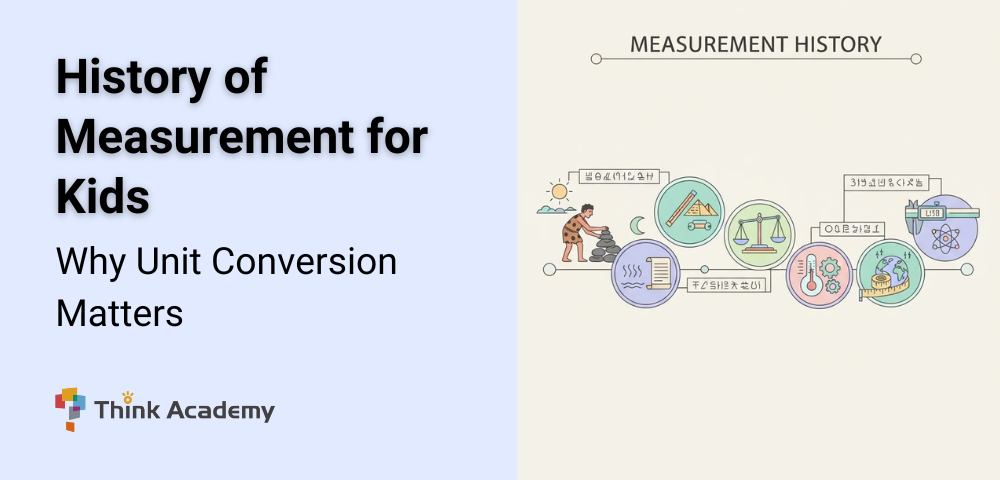
The history of measurement offers a fascinating way to show children why units and conversions matter in everyday life. Imagine a time before rulers, measuring tapes, or standards. People needed a way to measure land, build shelters, and trade goods fairly. This is where the story of measurement begins: with clever ideas, confusing challenges, and creative solutions that eventually shaped the systems we use today. When children learn the origins of measurement, abstract math transforms into a relatable journey of creativity, logic, and problem-solving.
The Earliest Ways to Measure
Long ago, people used the simplest tools they had—their own bodies. These early units felt convenient:
- A cubit stretched from elbow to fingertips
- A foot was the length of an actual foot
- A handspan matched a spread-out hand
These units worked well inside small communities, but big problems appeared quickly. Everyone’s foot was different. One person’s cubit might be much longer than another’s. This led to unfair trades, confused builders, and arguments over land.
To a child, this is like two classmates trying to measure a desk using their own shoes—no one gets the same answer!

A Need for Common Ground
As towns grew and trade expanded, accurate and consistent measurements became essential. Communities began creating standardized units—an agreed-upon measurement everyone could trust.
Examples include:
- The Royal Cubit of ancient Egypt, kept as a physical rod in a temple
- A king’s foot becoming the official “foot” for everyone in the region
- Metal or stone reference tools used to calibrate others
These standards improved life within each region, but a new challenge arose: what happened when people from different cultures traded?
The Romans used “paces.” The English used “yards.” Merchants needed to convert between systems to trade fairly. This gave rise to unit conversion, a valuable method to translate one system into another. Conversions made cross-cultural communication and trade possible—just like converting inches to centimeters helps us communicate measurements internationally today.

The Metric System and Its Global Impact
The next major leap came during the French Revolution, when scientists wanted a measurement system based on logic and nature, not human body parts or royalty. They created the metric system, a brilliant invention where units are related by powers of ten.
This made conversions incredibly simple:
- meters ⇄ centimeters
- liters ⇄ milliliters
- grams ⇄ kilograms
Many conversions became as easy as moving a decimal point.
Originally, a meter was defined as a fraction of Earth’s distance from pole to equator. A kilogram was based on the mass of water. These scientific definitions helped ensure consistency worldwide. Over time, the metric system evolved into the International System of Units (SI)—the global measurement language used in science, engineering, and most countries.
Some nations, like the United States, still use the Imperial system (feet, pounds, gallons) for everyday life. That’s why unit conversion remains a necessary skill for:
- recipes
- building projects
- international travel
- reading global news
- science and geography assignments
It helps kids navigate both systems confidently.
Conclusion
The history of measurement shows how people across time used creativity and cooperation to make sense of their world. From body-based units to global standards, each innovation helped humans communicate, trade, and build with accuracy. Teaching children about unit conversion is more than memorizing formulas — it connects math to real life, science, engineering, and everyday decision-making.
To help young learners strengthen the number sense and problem-solving skills behind measurement and conversions,
Think Academy offers free grade-level math worksheets.
These worksheets reinforce the foundational math concepts that make measurement meaningful and empower children to approach new challenges with confidence.
About Think Academy
Think Academy, part of TAL Education Group, helps K–12 students succeed in school today by building strong math foundations and critical thinking skills. At the same time, we focus on the bigger picture—developing learning ability, curiosity, and healthy study habits that inspire a lifelong love of learning. With expert teachers, proven methods, and innovative AI tools, we support every child’s journey from classroom confidence to long-term growth.
Want more insights on math learning and parenting? Fill out the form on this page and subscribe to our newsletter for weekly tips and the latest resources.
Leave a Comment & Share Your Thoughts!
Share This Story, Choose Your Platform!
Related Posts








Cool