Grace Hopper: Pioneering Logic in Computer Math
Grace Murray Hopper stands out as one of the most inspiring figures in mathematics and computer science, offering a powerful story that helps children see how abstract ideas come alive in the real world. Her journey shows how logical thinking, creativity, and problem-solving can shape the technologies we use every day. By exploring her life, young learners discover that math is not just numbers on a page—it is a tool for invention, innovation, and understanding how the digital world works.
A Foundation in Numbers
Grace Brewster Murray was born in 1906 in New York City. As a child, she demonstrated an impressive curiosity about how things worked. She famously dismantled clocks around her home just to understand their inner mechanisms. This hands-on curiosity reflected the analytical thinking that would later define her contributions to computer science.
Grace excelled academically and pursued mathematics with determination. She earned her bachelor’s degree in math and physics from Vassar College in 1928, followed by a master’s degree and Ph.D. in mathematics from Yale University. Her advanced training in mathematical logic and theoretical structures set the stage for her groundbreaking innovations in computing.

Pioneering the Digital Age
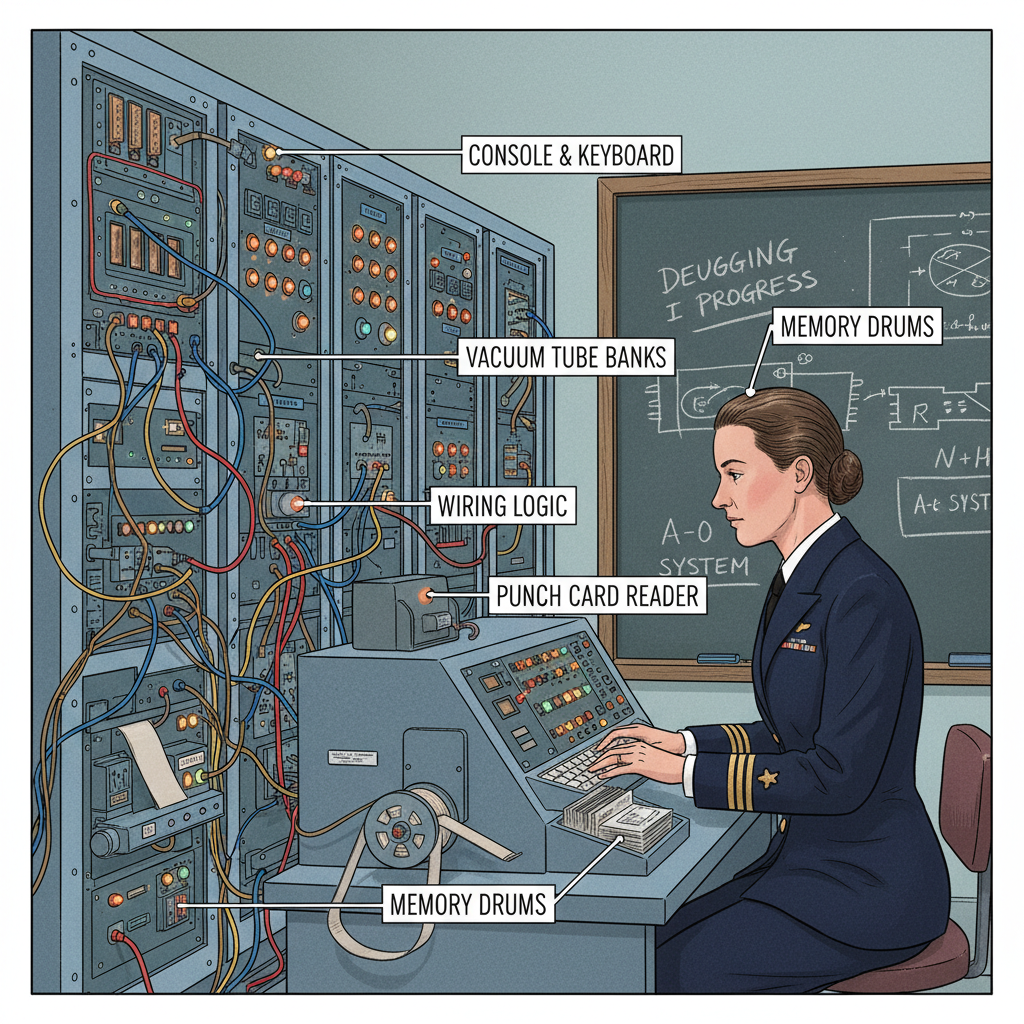
During World War II, Grace Hopper joined the U.S. Naval Reserve and was assigned to the Bureau of Ordnance Computation Project at Harvard University. There, she worked with the Mark I, one of the earliest electromechanical computers. Her role involved translating complex mathematical equations—such as ballistic trajectories—into sequences the machine could interpret.
Hopper and her team served as early programmers, manually converting mathematical problems into machine-readable instructions. This required exceptional precision, structured thinking, and an intuitive understanding of algorithms. Her mathematical background helped her identify errors, optimize processes, and rethink how humans communicate with machines.
It was during this era that she encountered the famous “computer bug”—a moth caught inside the Mark II’s hardware. Hopper documented it as the first literal case of “debugging,” a term still used today for fixing computer errors.
Inventing a New Language
Grace Hopper’s most transformative contribution was her work on compilers. At the time, programming required writing instructions directly in machine code—long strings of ones and zeros. This process was slow, difficult, and limited to specialists with deep technical training.
Hopper envisioned something revolutionary: programming computers using everyday English-like commands. In 1952, she created the first compiler, a program that translates human-readable instructions into machine code. This innovation paved the way for modern programming languages.
Her work led to the development of COBOL (Common Business-Oriented Language), one of the most widely used programming languages in history. COBOL’s structure—which is based on English sentences—made coding accessible to people outside mathematics and engineering. Hopper’s vision democratized computing, opening the field to millions of learners and transforming technology forever.
A Lasting Mathematical Legacy
Grace Hopper retired as a Rear Admiral and left behind a legacy central to both mathematics and computer science. She showed that algorithms are simply logical step-by-step instructions—mathematical thinking applied to real problems. Her work made software development possible and shaped the tools we use today, from apps to computer operating systems.
Her contributions reveal that:
- Math helps break problems into manageable steps
- Logical thinking leads to innovation
- Curiosity drives discovery
- Algorithms are the “math behind the machines” children use daily
Her story demonstrates that persistence, creativity, and a strong mathematical foundation can change the world.
Conclusion
Grace Murray Hopper’s life illustrates how mathematics becomes a tool for invention, creativity, and shaping the technologies we rely on today. Her journey—from a curious child who loved taking things apart to a trailblazer who revolutionized computer programming—shows young learners that logical thinking and persistence can lead to extraordinary breakthroughs. To help children build the same strong foundation in problem-solving and quantitative reasoning that supported Hopper’s achievements,
Think Academy offers free grade-level math worksheets.
These worksheets strengthen number sense, logical thinking, and pattern recognition—core skills that empower kids to approach challenges with confidence and explore the world with curiosity, just as Grace Murray Hopper did.
About Think Academy
Think Academy, part of TAL Education Group, helps K–12 students succeed in school today by building strong math foundations and critical thinking skills. At the same time, we focus on the bigger picture—developing learning ability, curiosity, and healthy study habits that inspire a lifelong love of learning. With expert teachers, proven methods, and innovative AI tools, we support every child’s journey from classroom confidence to long-term growth.
Want more insights on math learning and parenting? Fill out the form on this page and subscribe to our newsletter for weekly tips and the latest resources.
Leave a Comment & Share Your Thoughts!

Share This Story, Choose Your Platform!
Related Posts










