From Ancient Markets to Modern Life: The Story of Percentage
Percentages are a standardized way to describe parts of a whole using a base of one hundred. This simple idea allows people to compare values, track change, and communicate quantities clearly across different contexts. While the symbol “%” appears modern, the concept behind percentages developed gradually through centuries of practical problem-solving in trade, taxation, and measurement.
Understanding this history helps students see percentages not as an arbitrary rule, but as a tool shaped by real human needs.
Before Percentages: Early Ideas of Proportion
Long before formal mathematical notation, societies needed ways to divide resources fairly and consistently. Farmers shared land, merchants divided profits, and governments collected taxes. These tasks required proportional thinking—understanding parts of a whole.
Ancient civilizations commonly worked with fractions and ratios, even if they did not use standardized symbols. The key idea was comparison: one portion relative to another. This mindset laid the foundation for percentages by establishing the need for a common reference point.
Roman “Hundredths” and the Practical Roots of Percentages
One of the clearest early examples of percentage-like thinking comes from the Roman Empire. Roman administrators used a tax called centesima rerum venalium, meaning “the hundredth of goods sold.” This tax represented one part out of one hundred of a sale’s value.
Under Augustus, such taxes helped fund public works, infrastructure, and military expenses. While Romans did not write “1%,” the idea was identical: expressing value as a fraction of one hundred for consistency and fairness.
This stage is important because it shows that percentages did not originate in classrooms. They emerged from economic and administrative necessity.

Medieval Trade and the Birth of “Per Cent”
As commerce expanded in medieval Europe, especially in Italian city-states, merchants needed faster and clearer ways to calculate profits, interest, and losses. Fractions worked, but comparisons became complicated when dealing with different scales.
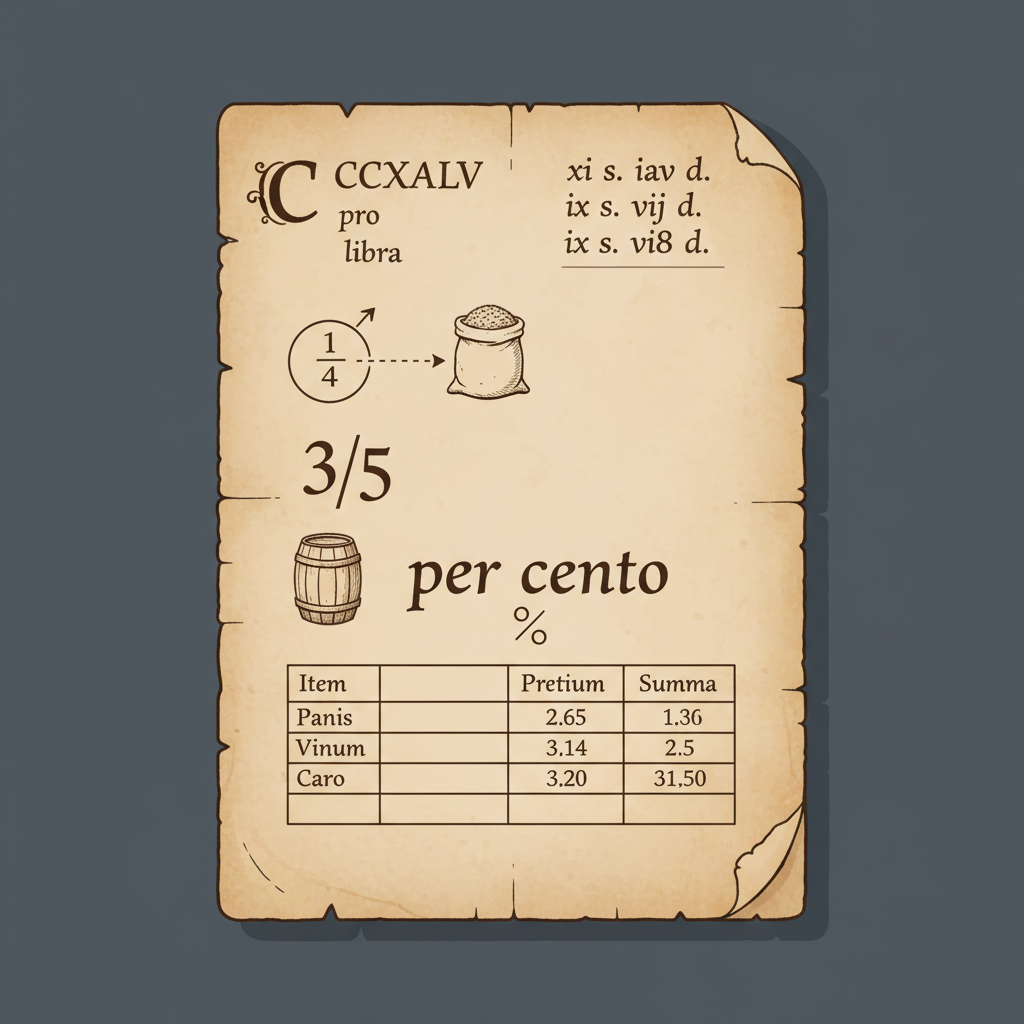
Italian traders commonly used the phrase per cento, meaning “for every hundred.” This phrase allowed merchants to standardize calculations across transactions of different sizes. Saying “5 per cento” immediately conveyed proportion without additional explanation.
Over time, per cento was shortened in written records. The modern percent symbol (%) is widely believed to have evolved from this shorthand—combining the word “per” with two zeros representing “cento,” or one hundred. This evolution marks the moment percentages became a shared mathematical language rather than a regional expression.
Why Base-100 Matters
The decision to anchor percentages to one hundred was not arbitrary. Base-100 offers several advantages:
- It aligns naturally with the decimal system
- It allows easy comparison between values
- It supports intuitive interpretation of change
For example, saying a value increased by 10% immediately communicates scale in a way that “one-tenth increase” may not for all audiences. This clarity is why percentages spread rapidly in finance, science, and public communication.
Percentages in the Modern World
Today, percentages are everywhere:
- Retail discounts and taxes
- Financial growth and interest rates
- Test scores and grading systems
- Polling data and probability forecasts
Percentages allow complex information to be summarized quickly. A “20% discount,” a “70% chance of rain,” or a “15% increase in revenue” all convey meaning efficiently, regardless of the absolute numbers involved.
For students, learning percentages strengthens proportional reasoning, a core math skill that connects fractions, decimals, ratios, and algebra. It also supports data literacy, helping students interpret graphs, statistics, and real-world reports accurately.
Learning Percentages as a Mathematical Skill
Understanding the story of percentages provides context, but mastery requires practice. Students must learn to:
- Convert between fractions, decimals, and percentages
- Calculate percentage increase and decrease
- Apply percentages to real-world scenarios
Consistent practice helps students move beyond memorizing formulas to understanding why percentage calculations work.
To support this process,
provide structured practice across elementary and middle school levels. These worksheets focus on accuracy, step-by-step reasoning, and application, helping students build confidence and fluency with percentages as a practical tool.
Conclusion
Percentages are not a modern invention designed solely for textbooks. They evolved from centuries of real-world problem-solving—from Roman taxation to medieval trade to modern data analysis. Their enduring value lies in their ability to express comparison, change, and proportion clearly and consistently.
By learning both the historical development and practical applications of percentages, students gain a deeper understanding of why this concept matters. With structured practice and real-world connections, percentages become a powerful foundation for financial literacy, data interpretation, and long-term mathematical thinking.
About Think Academy
Think Academy, part of TAL Education Group, helps K–12 students succeed in school today by building strong math foundations and critical thinking skills. At the same time, we focus on the bigger picture—developing learning ability, curiosity, and healthy study habits that inspire a lifelong love of learning. With expert teachers, proven methods, and innovative AI tools, we support every child’s journey from classroom confidence to long-term growth.
Check our math programs:
- Early Childhood — PreK
- Lower Elementary — Grades K–2
- Upper Elementary — Grades 3–5
- Middle School — Grades 6-10
Want more insights on math learning and parenting? Fill out the form on this page and subscribe to our newsletter for weekly tips and the latest resources.

Leave a Comment & Share Your Thoughts!

Share This Story, Choose Your Platform!
Related Posts










