Forensic Science Learning for Kids: STEM Skills & Inquiry
Forensic science provides a compelling entry point for introducing children to systematic inquiry, evidence-based reasoning, and foundational STEM concepts. Many families seek meaningful ways to strengthen critical thinking beyond traditional textbooks, and forensic science transforms everyday observations into structured investigations rooted in real scientific practice. By analyzing clues, identifying patterns, and evaluating possible explanations, young learners begin to view science not merely as content to memorize but as a dynamic process for understanding the world.
The Educational Value of Forensic Science
Children are naturally inclined to question, investigate, and infer—behaviors central to scientific thinking. Forensic science effectively channels this innate curiosity by contextualizing scientific principles within the familiar framework of mystery and problem-solving. As a discipline, forensic science integrates biology, chemistry, physics, and analytical reasoning, making it particularly suitable for interdisciplinary STEM learning at the elementary level. Introducing forensic activities at home or in the classroom reinforces observational precision, hypothesis generation, and structured analysis—core competencies emphasized across K–12 science curricula.

Exploring Foundational Types of Evidence
Beginning with fundamental evidence categories allows children to build conceptual understanding while developing practical investigative skills. These introductory activities are developmentally appropriate and align with national science education standards emphasizing inquiry and hands-on exploration.
Fingerprint Analysis: Patterns and Classification
Fingerprints provide a concrete example of biological uniqueness and pattern classification. Children can lift latent prints using cocoa powder or graphite and transparent tape. This activity introduces core scientific ideas such as:
- morphological pattern recognition (loops, whorls, arches)
- classification systems used in scientific fields
- the importance of individual variability in identification science
These exercises mirror authentic forensic procedures while remaining accessible.
Trace Evidence: Microscopic Clues with Macroscopic Impact
Trace evidence—including fibers, hairs, and particulate matter—illustrates how small clues contribute to broader investigative conclusions. Collecting fibers with tape and examining them under magnification allows students to practice:
- careful sample collection
- comparative analysis
- descriptive scientific observation
This reinforces the principle that scientific conclusions often rely on accumulating and interpreting multiple small data points.
DNA Introduction: Modeling Biological Information
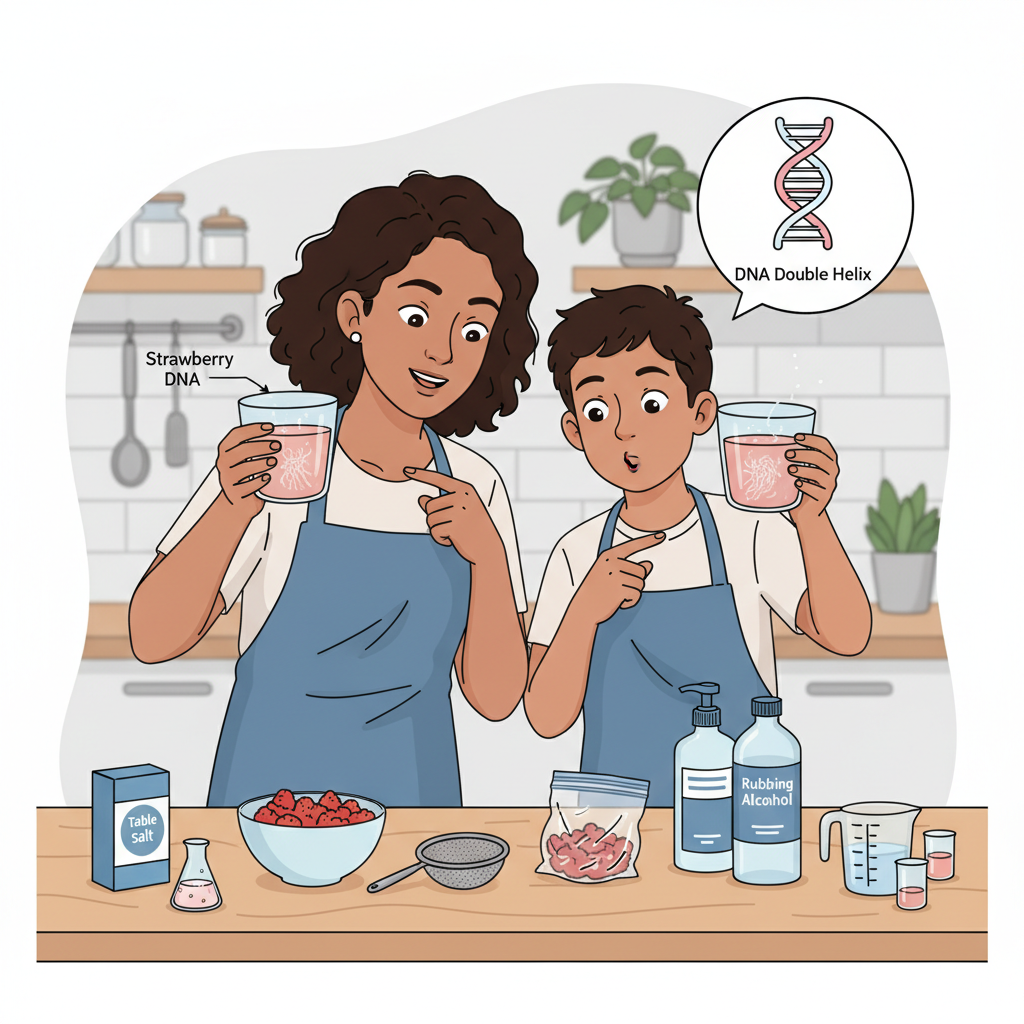
While formal genetics instruction typically occurs in later grades, young learners can grasp the conceptual role of DNA as a biological “instruction manual.” A strawberry DNA extraction provides a powerful visual model. This hands-on experiment introduces:
- basic laboratory procedures (mixing, filtering, separating materials)
- the concept of cellular structures
- the idea of molecular information
Why Forensic Science Matters
Developing Observational and Analytical Skills
Observation serves as the foundation of the forensic process. Structured activities help children distinguish between casual noticing and evidence-based observation.
Strategies include:
- describing objects using precise, sensory-rich language
- identifying changes in an environment after brief exposure
- replicating a “crime scene” scenario and recalling details
These tasks support attention to detail and enhance working memory—skills essential for scientific accuracy.
Promoting Critical and Logical Thinking
Forensic science relies heavily on deductive and inductive reasoning. Introducing children to logic puzzles, pattern recognition tasks, and step-by-step problem-solving helps them cultivate:
- hypothesis formation
- evaluation of multiple plausible explanations
- iterative reasoning, including testing and revising ideas
These cognitive processes align closely with mathematical problem-solving and scientific modeling, reinforcing cross-disciplinary skills.
Conclusion: Forensic Science as a Catalyst for STEM Curiosity
Integrating forensic science into early learning environments provides more than engaging activities—it lays the groundwork for scientific literacy, analytical reasoning, and intellectual resilience. Through fingerprinting, trace evidence analysis, DNA modeling, and logic-based investigations, children practice skills foundational to modern STEM fields. These experiences help students recognize that science is both relevant and actionable, empowering them to ask meaningful questions and pursue evidence-based answers.
To deepen these skills further,
Think Academy offers free, high-quality math worksheets
designed to strengthen quantitative reasoning, logical thinking, and foundational numeracy. These structured resources support consistent at-home learning habits, making it easy for families to sustain academic growth while fostering curiosity and confidence. Together, forensic exploration and targeted math practice provide a comprehensive approach to building the next generation of critical thinkers and problem-solvers.
About Think Academy
Think Academy, part of TAL Education Group, helps K–12 students succeed in school today by building strong math foundations and critical thinking skills. At the same time, we focus on the bigger picture—developing learning ability, curiosity, and healthy study habits that inspire a lifelong love of learning. With expert teachers, proven methods, and innovative AI tools, we support every child’s journey from classroom confidence to long-term growth.
Want more insights on math learning and parenting? Fill out the form on this page and subscribe to our newsletter for weekly tips and the latest resources.
Leave a Comment & Share Your Thoughts!

Share This Story, Choose Your Platform!
Related Posts










