Fibonacci in Nature: How Patterns Spark Kids’ Love for Math
As parents, we’re always looking for ways to make learning meaningful and fun. What if complex math wasn’t just found in textbooks—but also in the petals of a flower, the structure of a pinecone, or the spiral of a shell? Exploring these natural patterns can spark your child’s curiosity and show them that mathematics is all around us.
Leonardo’s Curious Sequence
In 1202, an Italian mathematician named Leonardo Pisano, known as Fibonacci, introduced the Western world to a remarkable number pattern: the Fibonacci sequence.
Fibonacci presented this sequence through a rabbit-population puzzle:
- You begin with one pair of baby rabbits.
- They mature in one month.
- Each mature pair produces another pair every month.
How many pairs will you have after a year?
This simple puzzle leads to one of the most famous sequences in mathematics:
0, 1, 1, 2, 3, 5, 8, 13, 21…
Each new number is the sum of the two before it.
An illustration of a spiral made of squares with side lengths matching Fibonacci numbers.

Nature’s Hidden Patterns
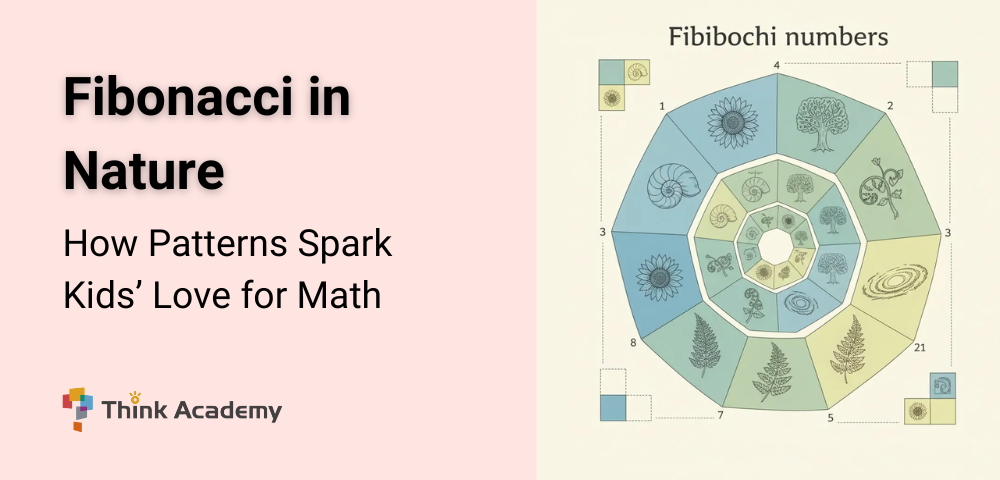
What makes Fibonacci numbers truly magical is how often they appear in nature. Once you see them, you can’t unsee them—and neither can your child.
Sunflowers
The spirals on a sunflower’s seed head typically come in pairs of consecutive Fibonacci numbers (like 34 and 55).
Pinecones
Pinecones show spiral patterns similar to sunflowers—again following Fibonacci numbers.
Leaves and Branching
The arrangement of leaves around a stem (called phyllotaxis) and the branching of many trees naturally follow Fibonacci patterns, maximizing sunlight exposure.
Flower Petals
Many flowers have a Fibonacci number of petals:
- Lilies: 3
- Buttercups: 5
- Chicory: 21
- Some daisies: 34, 55, or even 89
These recurring patterns help children see that math is not just symbolic—it is alive in the world around them.
A close-up photograph of a sunflower head showing spirals of seeds matching Fibonacci numbers.

The Golden Ratio Connection
As the Fibonacci sequence grows, something fascinating happens: dividing a number by the one before it gets closer and closer to a special constant called the Golden Ratio. This value is approximately 1.618, often associated with beauty, balance, and natural harmony.
For example:
- 8 ÷ 5 = 1.6
- 13 ÷ 8 = 1.625
- 21 ÷ 13 ≈ 1.615
With larger numbers, this ratio stabilizes near the Golden Ratio.
Where Children Can See the Golden Ratio
- Spirals in seashells
- Hurricane cloud formations
- Spiral galaxies
- Nautilus shells
- Many plants and flower structures
- Classical architecture and art
The connection between the Golden Spiral and natural forms helps kids understand that mathematics shapes everything from petals to planets.
Conclusion
Learning about Fibonacci numbers and the Golden Ratio is a beautiful way to connect math with the real world. When children see patterns in flowers, pinecones, and shells, math becomes meaningful, exciting, and alive. These discoveries help them appreciate the elegance of mathematics and encourage curiosity that extends far beyond the classroom.
About Think Academy
Think Academy, part of TAL Education Group, helps K–12 students succeed in school today by building strong math foundations and critical thinking skills. At the same time, we focus on the bigger picture—developing learning ability, curiosity, and healthy study habits that inspire a lifelong love of learning. With expert teachers, proven methods, and innovative AI tools, we support every child’s journey from classroom confidence to long-term growth.
Want more insights into math learning and parenting? Subscribe to our newsletter for weekly tips and the latest resources.
Leave a Comment & Share Your Thoughts!

Share This Story, Choose Your Platform!
Related Posts