Feynman Technique for Kids: Simple Tools for Deep Learning
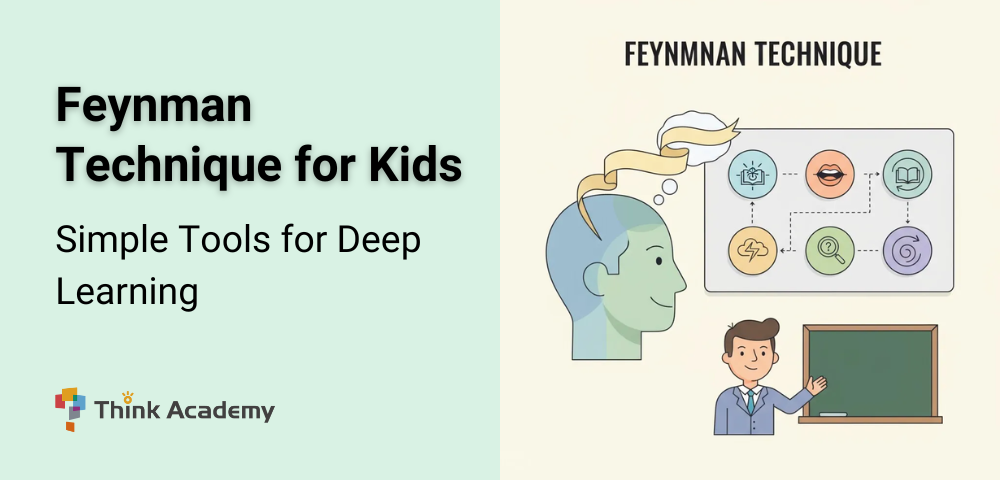
The Feynman technique simplified for kids offers a powerful way to transform confusing school topics into clear, meaningful understanding. Many students struggle when ideas feel abstract, and memorizing information often leads to frustration or forgetting. The Feynman approach turns learning into an active, engaging process by encouraging kids to explain concepts simply, identify what they don’t yet grasp, and rebuild strong comprehension step by step. This method strengthens critical thinking, deepens retention, and helps children develop confidence as they master challenging subjects.
Tool 1: Explain It Simply (The Core Principle)
The foundation of the Feynman technique is teaching the concept to someone else. When children explain an idea in their own words, they naturally break it down into basic parts. This immediately reveals what they understand—and what still feels confusing.
For example, if a child learns about the water cycle, they might explain it to a younger sibling or even a stuffed toy. Explaining aloud requires them to organize ideas logically, choose simple language, and connect each step clearly. This deep engagement makes the knowledge easier to remember and apply. More information about the Feynman method can be found on Wikipedia’s Feynman Technique page.

Tool 2: Identify Knowledge Gaps (The Self-Correction Mechanism)
While explaining, children often stumble over specific details or use vague language. These moments highlight knowledge gaps—the exact spots where understanding is incomplete. Recognizing these gaps is one of the most valuable steps in the entire technique.
Spotting unclear areas encourages metacognition, or the ability to reflect on one’s own thinking. Children learn to identify which parts they understand well and which ideas require more attention. Simple prompts can help guide this stage, such as:
- “Which part was hardest to explain?”
- “What detail did you skip or rush through?”
- “Could you describe that idea more clearly?”
Over time, this teaches learners to evaluate their own understanding with accuracy and confidence.
Tool 3: Go Back to the Source (Targeted Review)
Once knowledge gaps are identified, the next step is returning to the original learning materials. Instead of re-reading everything, children focus only on the parts that address their specific misunderstandings. This might include:
- re-reading a section of a textbook
- reviewing a classroom diagram
- re-watching a quick educational video
- asking a teacher or parent clarifying questions
This targeted review helps correct misconceptions quickly and strengthens the exact areas where understanding was weak. It also teaches children how to study efficiently—an essential skill as school content becomes more demanding. Those interested in how our brains learn can explore Britannica’s resources on cognition.

Tool 4: Organize, Simplify, and Review (Refine and Master)
Finally, children attempt to explain the concept again—but this time even more clearly and concisely. They can use analogies, draw diagrams, or create a short summary. For example, when revisiting the water cycle, a child might sketch a simple loop with arrows and labels such as “evaporation,” “condensation,” and “precipitation.”
This final round of explanation confirms genuine mastery. The ability to express a concept simply, accurately, and confidently shows that the idea has been fully internalized. This repeated refinement helps embed information deeply in memory and builds long-term confidence in learning.
Conclusion
The Feynman technique simplified for kids transforms learning from memorization into true understanding. By explaining concepts, identifying gaps, reviewing purposefully, and refining explanations, children develop essential habits for academic success and independent thinking. This method nurtures curiosity, clarity, and confidence across all subjects.
To strengthen the foundational skills that support this technique—especially number sense, pattern recognition, and logical reasoning—
Think Academy offers free grade-level math worksheets.
These worksheets reinforce the same problem-solving abilities the Feynman method relies on, giving children the tools they need to understand new concepts with ease. Pairing structured math practice with the Feynman technique builds a powerful foundation for lifelong learning.
About Think Academy
Think Academy, part of TAL Education Group, helps K–12 students succeed in school today by building strong math foundations and critical thinking skills. At the same time, we focus on the bigger picture—developing learning ability, curiosity, and healthy study habits that inspire a lifelong love of learning. With expert teachers, proven methods, and innovative AI tools, we support every child’s journey from classroom confidence to long-term growth.
Want more insights on math learning and parenting? Fill out the form on this page and subscribe to our newsletter for weekly tips and the latest resources.
Leave a Comment & Share Your Thoughts!

Share This Story, Choose Your Platform!
Related Posts










