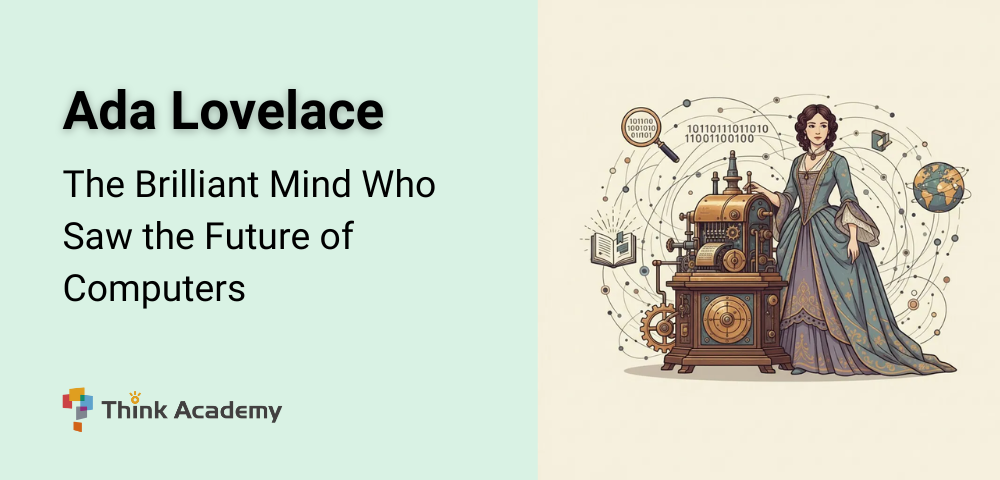
Ada Lovelace: The Brilliant Mind Who Saw the Future of Computers
Do your children ever wonder who invented the computer games they love or how tablets “know” what to do? The history of technology can feel overwhelming to explain, but introducing young learners to inspiring figures makes it accessible—and exciting. One of the most fascinating pioneers is Augusta Ada King, Countess of Lovelace, better known as Ada Lovelace. Her remarkable vision laid the foundation for the digital world we live in today, showing how curiosity, creativity, and mathematics can lead to groundbreaking ideas.
The Early Spark of a Mathematical Mind
Augusta Ada Byron was born in 1815, the only legitimate child of the famous poet Lord Byron. Her mother, Lady Annabella Milbanke Byron—nicknamed by Lord Byron as his “Princess of Parallelograms”—was deeply passionate about mathematics. Determined to give Ada a stable and scientifically grounded upbringing, Lady Byron ensured her daughter received an exceptional education, something rare for girls at the time.
Ada’s lessons extended far beyond reading and writing. She studied advanced arithmetic, geometry, algebra, astronomy, and even music. Lady Byron hoped a strong grounding in logic and analytical thinking would counterbalance the emotional unpredictability associated with her father. These early studies formed the foundation for Ada’s future insights into mechanical calculation. She also corresponded with leading scientific thinkers of the era, including Mary Somerville, a renowned Scottish science writer and mathematician.
A portrait of a young Ada Lovelace, perhaps around her teenage years, looking intellectual and determined, with mathematical symbols subtly integrated into the background design.

A Meeting of Minds and Mechanical Marvels
In 1833, at just eighteen, Ada met Charles Babbage—the brilliant inventor considered the “father of the computer.” Babbage was working on the Difference Engine, a mechanical calculator designed to produce accurate mathematical tables. Ada was immediately fascinated by the prototype and the possibilities behind its machinery.
But Babbage had an even more ambitious idea: the Analytical Engine, a programmable, general-purpose mechanical computer capable of performing all types of calculations. Unlike the Difference Engine, which could complete only one type of task, the Analytical Engine could follow instructions and execute sequences—much like a modern computer.
Ada recognized its significance immediately. She understood that this machine could manipulate symbols, not just numbers, and could theoretically handle letters, musical notes, or any data represented numerically. She envisioned an era where machines could assist with creative and scientific work—an idea nearly 100 years ahead of her time.
A detailed schematic or conceptual drawing of Charles Babbage’s Analytical Engine, illustrating its complex gears, columns, and printing mechanism, with an overlay of early coding-like sequences.
The World’s First Computer Program
In 1843, Babbage asked Ada to translate a French article on the Analytical Engine by Italian mathematician Luigi Menabrea. Instead of simply translating it, Ada added extensive notes—three times longer than the original text. These notes became legendary.
In them, Ada described how the Analytical Engine could follow a step-by-step procedure to compute Bernoulli numbers. This sequence of operations—an algorithm written specifically for a machine—is now recognized as the world’s first computer program. With it, Ada became the first computer programmer long before any modern computer existed.
Ada also articulated a critical insight: machines could not “think” on their own. They could only execute the instructions they were given. This distinction between programmed processing and human intelligence remains central to conversations about computing and artificial intelligence today.
She even predicted that computers might one day compose music, create graphics, and support scientific work far beyond simple arithmetic—an astonishingly accurate prediction of modern computing.

A Lasting Legacy for the Digital Age
Despite her extraordinary ideas, Ada never saw the Analytical Engine built. Funding challenges and engineering obstacles prevented the machine’s completion during her lifetime. Nevertheless, her detailed notes survived and were later rediscovered by early computer scientists, who recognized the brilliance of her vision.
Today, Ada Lovelace is celebrated worldwide as the first computer programmer and a trailblazer for women in STEM. Her story has inspired countless students to explore science, technology, engineering, and mathematics. Ada’s life demonstrates how deep understanding and imagination can shape innovations that transform the world.
Conclusion
Ada Lovelace’s extraordinary journey shows that mathematics is more than equations—it’s a way of thinking, imagining, and solving problems. Sharing her story with children encourages them to see math as a creative tool that can unlock new ideas and possibilities. Her legacy reminds us that great innovations begin with curiosity and a willingness to explore the unknown.
About Think Academy
Think Academy, part of TAL Education Group, helps K–12 students succeed in school today by building strong math foundations and critical thinking skills. At the same time, we focus on the bigger picture—developing learning ability, curiosity, and healthy study habits that inspire a lifelong love of learning. With expert teachers, proven methods, and innovative AI tools, we support every child’s journey from classroom confidence to long-term growth.
Want more insights into math learning and parenting? Subscribe to our newsletter for weekly tips and the latest resources.
Leave a Comment & Share Your Thoughts!

Share This Story, Choose Your Platform!
Related Posts










