Harker School Admissions Guide: How to Get In
For families aspiring to send their children to the nation’s most selective universities, Harker School stands out. This K-12 independent school is not just a leader in rigorous academics and comprehensive programs; it’s a proven launchpad to Ivy League and top-tier institutions.
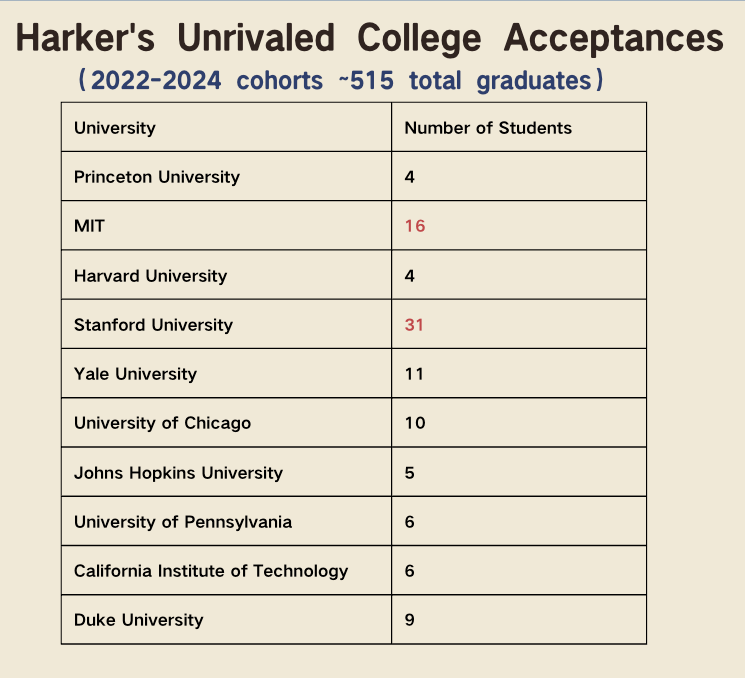
Over the past three years (2022-2024 cohorts, approximately 190 students per year, ~515 total graduates), Harker’s college matriculation is truly exceptional:
- Stanford University: 31 students
- MIT: 16 students
- Yale University: 11 students
- University of Chicago: 10 students
- Duke University: 9 students
- University of Pennsylvania: 6 students
- California Institute of Technology (Caltech): 6 students
- Johns Hopkins University: 5 students
- Princeton University: 4 students
- Harvard University: 4 students
Furthermore, a remarkable percentage of Harker graduates consistently gain admission to the highest-ranked U.S. News & World Report universities and liberal arts colleges:
- Top 10 Universities: 121 students (23.5% of graduates)
- Top 20 Universities: 240 students (46.6% of graduates)
- Top 25 Universities: 283 students (55% of graduates)
If you’re seeking a school with a demonstrated ability to open doors to the world’s most prestigious colleges, understanding the pathway to Harker admission is your essential first step. This guide will meticulously break down the Harker admissions process, offering actionable insights to help your child thrive in this competitive journey.
The Harker Admissions Journey: A Strategic Timeline
Harker’s typical admissions season runs from late summer through early spring, with major entry points in Kindergarten, G3, G4, G6, and G9. Although the 2025–26 cycle has not yet been released, here’s the 2024–25 timeline as a reference:
| Phase | Key Dates (2024–25) | What Happens |
| Application Opens | August 30, 2024 | Ravenna portal opens. Families begin submitting materials. |
| Application Deadline | January 9, 2025 @ 5PM PST | Forms, parent videos, photos, and teacher recs due. |
| Cognitive Assessment | January–February (booked by family) | WPPSI test done outside of school, results submitted. |
| Classroom Visit (Child) | January–February | Group activity observed by Harker teachers. |
| Virtual Parent Interview | Self-recorded video (1 attempt only) | Parents answer 3 timed questions. |
| Admission Decisions | March 21, 2025 @ 4PM | Via email. |
| Enrollment Deadline | March 28, 2025 @ noon | Secure your spot. |
Decoding Harker’s Expectations: What Harker Looks For in a Strong Application?
Harker’s holistic review identifies students with academic brilliance, curiosity, and strong character.
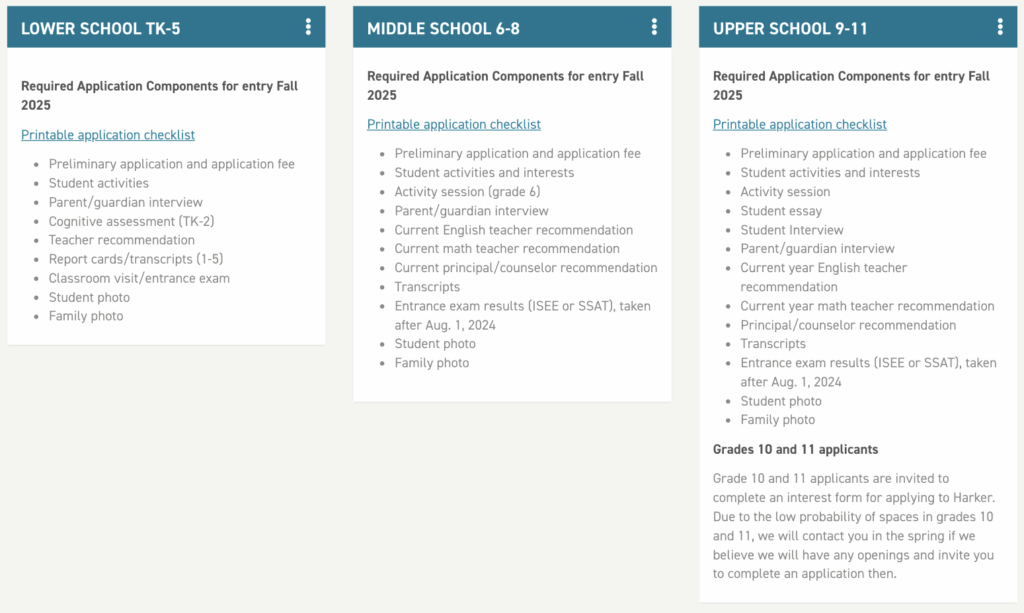
Key Application Checklist Takeaways:
- Holistic & Family-Oriented Review
- Required materials: forms, student & family photos, parent interview
- Emphasis on: family-school fit, self-driven learners, character & collaboration
- Activities and Interests
- Required across all grades
- Harker looks for: long-term commitment, depth, leadership, initiative
- Tailored Assessments
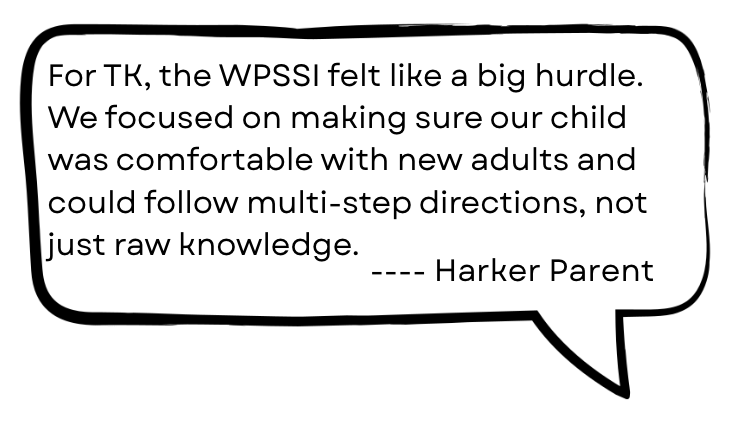
- TK–G2: WPPSI cognitive test + classroom observation
- G6–G11: ISEE/SSAT + student interviews & writing samples
- Teacher Recommendations
- Evaluates academic performance, behavior, and learning mindset
In-Depth Look: What Harker Seeks & Parent Perspectives
Now, let’s explore what makes an application truly stand out, drawing from the experiences and lessons learned by other parents:
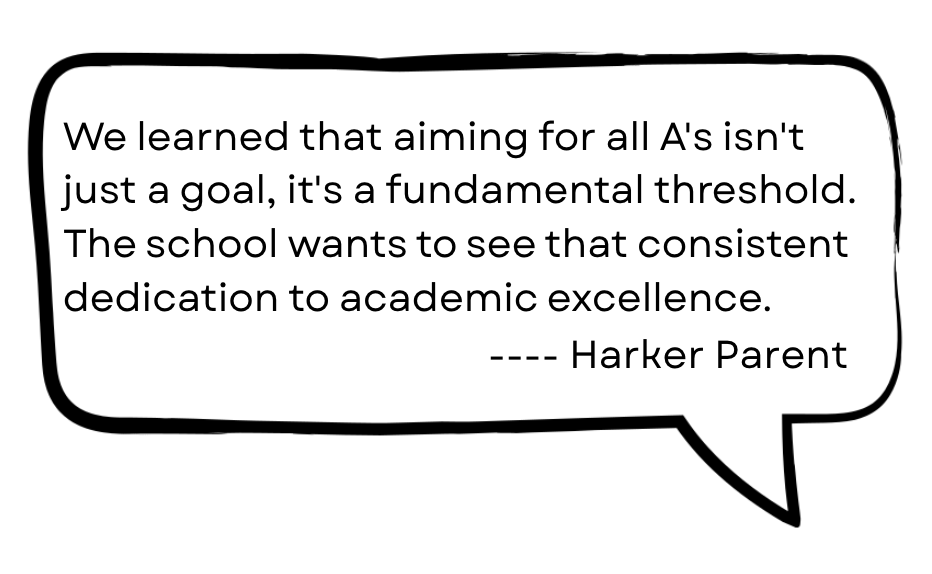
1. Academic Performance & Transcripts: The Foundation
Why Harker needs it: Harker’s rigorous academics (97-98% AP pass rate, average SAT ~1500) demand consistent excellence. Transcripts prove your child’s readiness for this demanding environment.
- ✅ Good Example: Your child consistently earns “A” grades, especially in challenging courses. Their transcripts show a clear upward trajectory, and teachers comment positively on their genuine curiosity and strong work ethic.
- ❌ Bad Example: Avoiding challenges, inconsistent effort, low engagement.
2. Teacher Recommendations: Character & Classroom Contribution
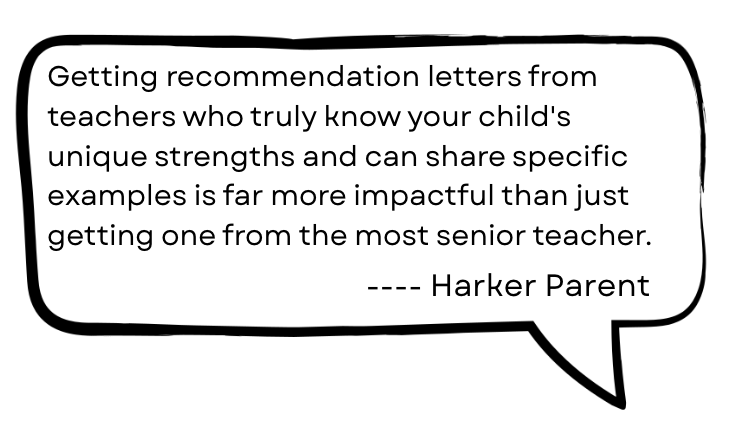
Why Harker needs it: Teachers offer objective insights into a student’s learning style, behavior, peer interactions, and overall fit for Harker’s competitive yet collaborative setting.
- ✅ Good Example: Teachers highlight specific instances of your child’s intellectual curiosity, their leadership in group projects, or their ability to problem-solve independently.
- ❌ Bad Example: Recommendations are generic, or mention issues like difficulty focusing, reluctance to participate, or challenges with peer interaction.
3. Student Essays & Activities: Voice & Passions
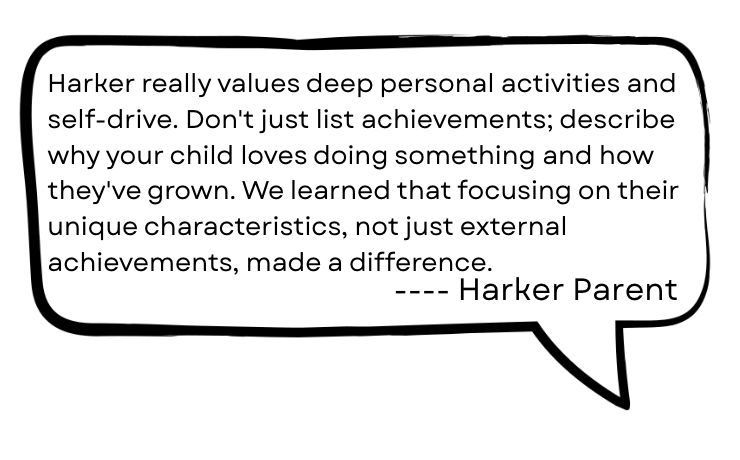
Why Harker needs it: Essays demonstrate writing skills and self-awareness. Activities reveal passions, commitment, and potential contributions to Harker’s vibrant campus life (e.g., 60+ after-school programs, top competition performance).
- ✅ Good Example: Essays use an authentic voice with specific anecdotes showing self-reflection. Activities list depth of engagement, leadership roles, and demonstrate genuine, long-term interests beyond just resume-building.
- ❌ Bad Example: Essays are generic or full of errors. Activities are listed superficially with no real commitment or passion evident.
4. Interviews & Parent Statements: Family Partnership & Fit
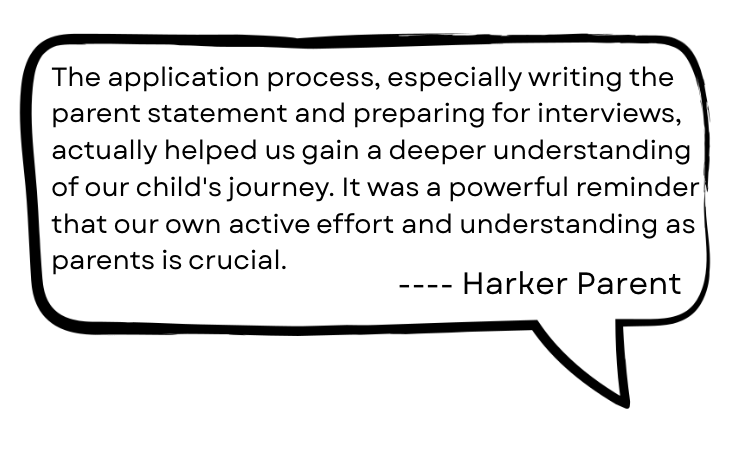
Why Harker needs it: These components assess alignment with Harker’s rigorous, fast-paced, and community-focused philosophy, emphasizing a strong school-family partnership .
- ✅ Good Example (Parent): Your parent statement uses specific details about your child’s growth and unique qualities. In the virtual interview, you articulate a parenting philosophy that aligns with Harker’s emphasis on self-drive and academic support.
- ✅ Good Example (Student): Your child articulates clear reasons for wanting to attend Harker, asks thoughtful questions, and engages confidently. For younger students, they are not shy, dare to share their opinions, and follow instructions well in new settings.
- ❌ Bad Example (Parent): Your statement is generic, focuses only on achievements, or lacks specific examples of your child’s character. Your interview answers are vague or imply a mismatch with Harker’s demands.
- ❌ Bad Example (Student): Your child is disengaged, gives one-word answers, or appears uncomfortable in the interview setting. For younger children, they struggle with following instructions or participating in group activities.
Your Partner for Success: Think Academy
Gaining admission to Harker School requires exceptional academic preparation and strong foundational skills.
Think Academy is a dedicated partner for families, providing specialized academic support to help students excel in Harker’s rigorous curriculum and competitive admissions process.
- Targeted Academic Mastery: Our programs are designed to strengthen core skills essential for Harker’s curriculum. This includes advanced math concepts, crucial for their P3 fast track and grade skipping opportunities, as well as developing strong critical thinking and problem-solving abilities.
Importantly, our math curriculum covers all knowledge points for ISEE and SSAT exams.
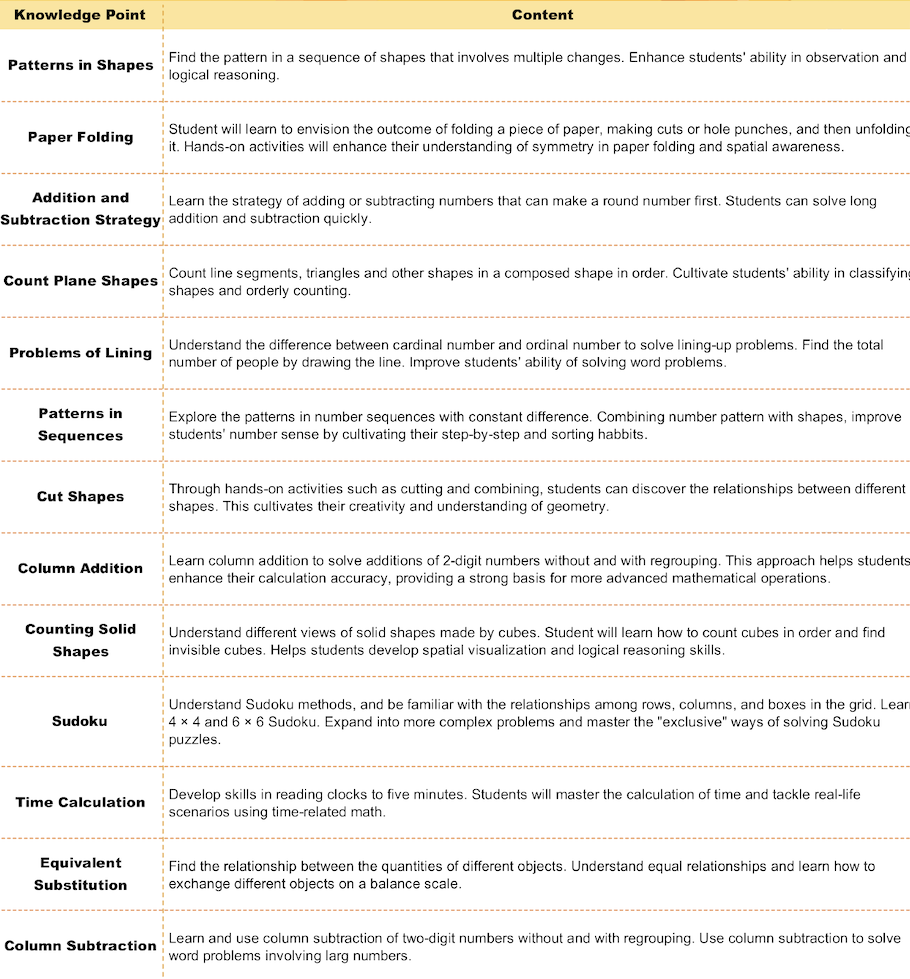
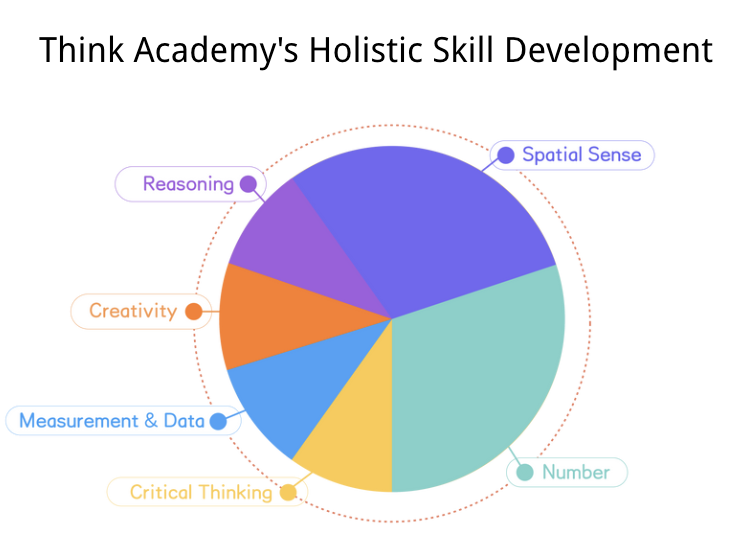
- Cultivating Well-Rounded Excellence: Beyond academics, our experienced instructors foster intellectual curiosity and offer competition math training to prepare for events like the Harker Math League and AMC 8. Our structured programs also develop essential skills like expression, hands-on ability, and critical thinking, which are crucial for compelling essays, successful interviews, and overall academic success at Harker.
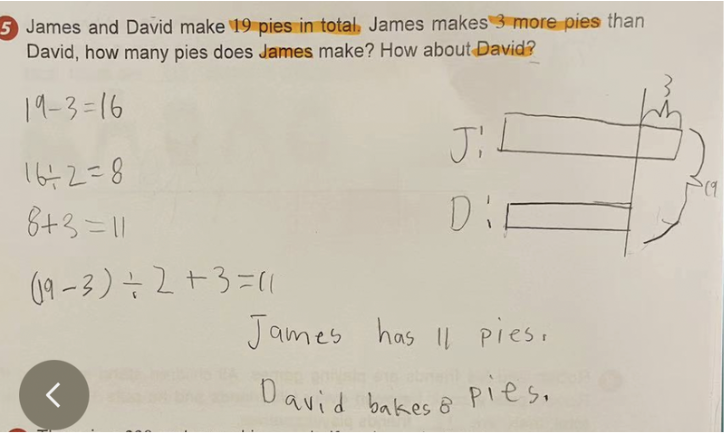
- Building Strong Learning Habits: We aim to instill the self-drive and robust learning habits that Harker values from its earliest grades, ensuring your child is not just prepared for admission, but poised for long-term academic success.
Turning Harker Admissions Insight into an Academic Strategy
Understanding Harker School’s admissions timeline, evaluation criteria, and holistic review process is a critical first step. But for families aiming for a school as academically demanding as Harker, the most decisive question is not only whether a child interviews well or presents strong activities—but whether their academic foundation can sustain Harker’s pace long term.
Across Harker’s admissions process, academic performance—especially math readiness—plays a central role. Placement on advanced tracks, success in accelerated courses, and preparedness for standardized assessments like WPPSI, ISEE, and SSAT all stem from a student’s underlying math depth, reasoning ability, and learning habits.
For many families, especially those new to elite Bay Area private school pathways, it can be difficult to answer:
- Is my child truly ready for Harker’s level of academic rigor?
- Are we on track for accelerated math placement and future AP-level coursework?
- What should we prioritize now to avoid gaps later?
A Think Academy Free Math Evaluation helps bring clarity to these questions by providing:
- a precise diagnosis of your child’s current math level and conceptual readiness
- insight into alignment with Harker’s accelerated academic expectations and fast-track pathways
- personalized 1-on-1 guidance on how to prepare early with a structured, long-term learning plan
By pairing admissions knowledge with a clear academic strategy, families can approach the Harker application process with confidence—knowing their child is prepared not just to gain admission, but to thrive in Harker’s rigorous academic environment.
Prefer to Start with Practice?
If you’d like to assess and strengthen fundamentals independently, access Think Academy’s free math worksheets for PreK through Grade 10. Worksheets are organized by grade and topic to help identify gaps and build confidence.
Recommended Reading
- All-in-One Guide: How to Get Into a Private Elementary School
- Private School Interview: How to Prepare and Question Checklist
- ISEE vs SSAT: Complete Guide for Private School Admissions
About Think Academy
Navigate your child’s educational journey with expert guidance from Think Academy, part of TAL Education Group. We provide valuable educational research and insightful analyses to help parents and students strategically plan for long-term academic growth in K–12 education. Trust Think Academy for authoritative information and resources to ensure informed decisions and successful educational outcomes.
Check our math programs:
- Early Childhood — PreK
- Lower Elementary — Grades K–2
- Upper Elementary — Grades 3–5
- Middle School — Grade 6–10
Want more insights on math learning and parenting? Fill out the form on this page and subscribe to our newsletter for weekly tips and the latest resources.

Leave a Comment & Share Your Thoughts!

Share This Story, Choose Your Platform!
Related Posts