How to Prepare for the Spelling Bee: Recommended Resource and Group
Spelling Bee preparation takes more than memorizing long word lists. To succeed, students need consistent spelling bee practice that builds vocabulary, phonetic awareness, word structure knowledge, and confidence speaking under pressure. Whether your child is preparing for a school-level bee or aiming for regional and national competitions, understanding how the Spelling Bee works—and how to practice the right way—is the first step toward meaningful progress.
What is Spelling Bee?
The Spelling Bee is a long-running academic competition in the United States, organized by Scripps National Spelling Bee organization, that challenges students to spell words aloud correctly, based on how they are pronounced. Every year, approximately 11 million students participate in the Scripps National Spelling Bee program, starting at the classroom and school levels.
Most Spelling Bee competitions follow a multi-level structure:
- School-level competitions: students compete within their own schools. This is often the first exposure families have to Spelling Bee.
- Regional or district competitions: winners from schools advance to local or regional bees.
- State-level competitions: top spellers from each region compete at the state level.
- Scripps National Spelling Bee: state champions advance to the Scripps National Spelling Bee finals. It will issue no more than 225 invitations. If there are 226 or more applications, it will base invitation decisions on a point system.
Grades: Most spelling bees are open to students in Grades 1–8, with exact eligibility depending on the organizer. The Scripps National Spelling Bee is limited to students in Grade 8 or below who are under 16.
Format: Spelling bees typically use an oral elimination format, where students spell words aloud one at a time. A student is eliminated after a misspelling, and the competition continues until a winner is determined.
Difficulty: Word difficulty increases at each level, from grade-level vocabulary at school bees to advanced, uncommon words at regional, state, and national competitions.
What does Spelling Bee test?
A Spelling Bee evaluates a student’s ability to accurately spell a wide range of English words, from common vocabulary to more complex and less familiar terms. However, success in a Spelling Bee goes far beyond memorization.
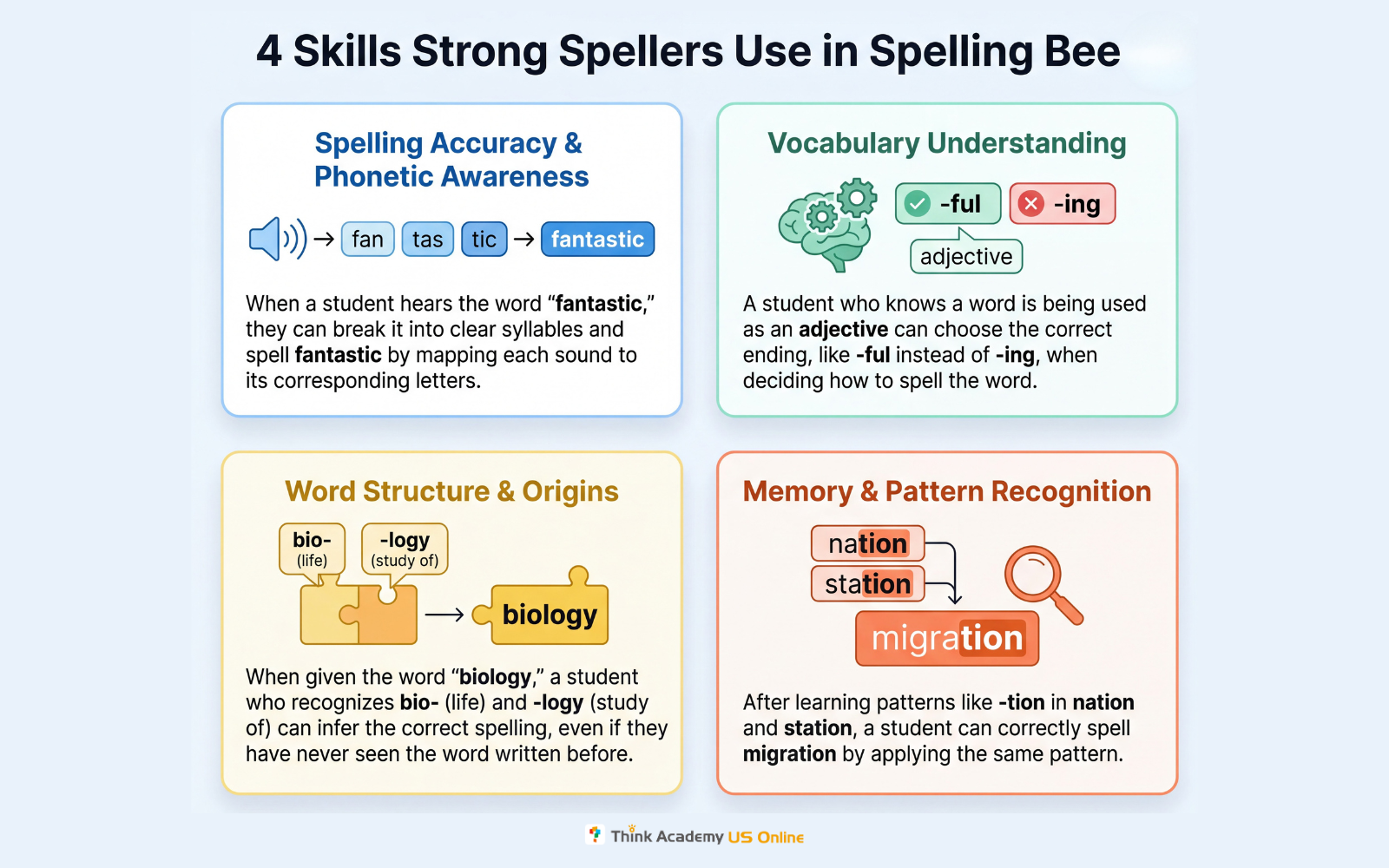
Key skills assessed in a Spelling Bee include:
- Spelling accuracy and phonetic awareness: Correctly spelling words based on how they are pronounced, with the ability to accurately interpret sounds and map them to the correct letter patterns.
- For example, when a student hears the word “fantastic,” they can break it into clear syllables and accurately spell fantastic by mapping each sound to its corresponding letters, without relying on memorization.
- Vocabulary understanding: Knowing word meanings and using definitions or context to support spelling decisions.
- For example, a student who knows a word is being used as an adjective can choose the correct ending, such as -ful instead of -ing, when deciding how to spell the word.
- Word structure and origins: Recognizing prefixes, suffixes, and language roots (such as Greek, Latin, or German) to infer correct spelling, especially for unfamiliar words.
- For example, when given the word “biology”, a student who recognizes bio- (life) and -logy (study of) can infer the correct spelling, even if they have never seen the word written before.
- Memory and pattern recognition: Retaining common spelling patterns and applying them to both familiar and new words, rather than relying on memorization alone.
- For example, after learning spelling patterns such as -tion in nation and station, a student can correctly spell a new word like migration by applying the same pattern, rather than memorizing it as a completely new word.
How to prepare for Spelling Bee?
1. Build Your Word Foundation the Official Way
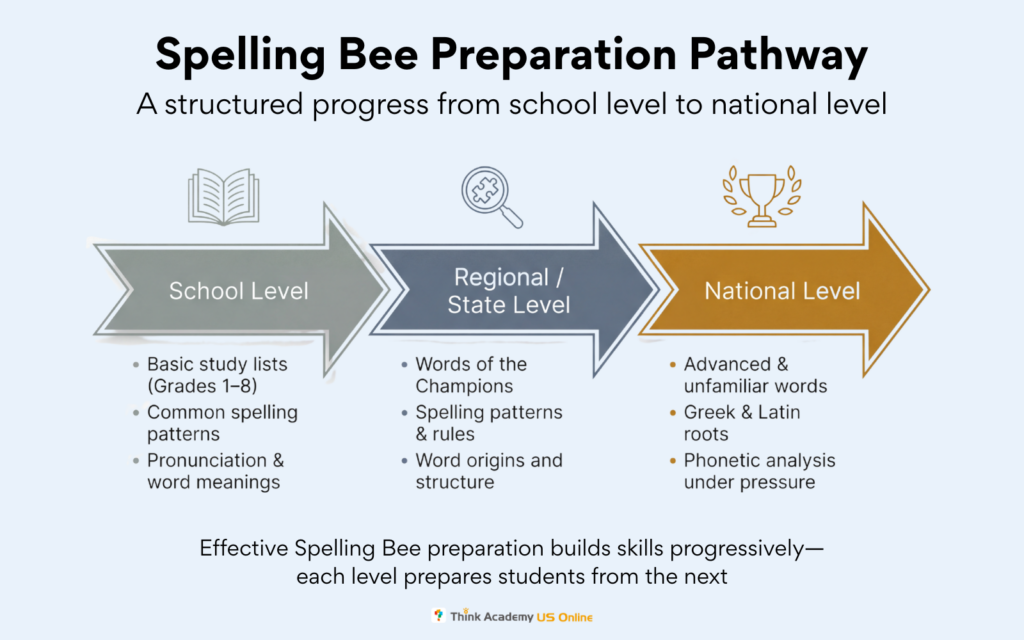
According to official guidance, effective Spelling Bee preparation should follow a clear progression by difficulty level, rather than jumping straight into advanced word lists.
| Preparation Stage | Focus Vocabulary | Approximate Vocabulary Coverage | What Students Work On | Key Goal | Key Indicator of Readiness |
|---|---|---|---|---|---|
| School Level | Basic study lists (Grades 1–8) | ~2,500–3,500 words | Common spelling patterns, pronunciation basics, and word meanings | Build a strong spelling and vocabulary foundation | Can spell familiar words accurately |
| Regional / State Level | Words of the Champions | ~4,500–6,000 words | Recognizing spelling patterns, understanding word origins, and applying rules to unfamiliar words | Move beyond memorization to analytical spelling | Can spell many new words with guided analysis |
| National Level | Advanced and unfamiliar words | 8,000–12,000+ word coverage | Deep knowledge of language roots, phonetic analysis, and reasoning under pressure | Spell accurately using analysis, not recall | Can spell unfamiliar words through logic, not memorization |
2. Learn How Words Work—Not Just How They Look
One of the most important shifts strong spellers make is moving from memorization to understanding. Instead of treating each word as an isolated item to remember, they learn how words are built and why they are spelled a certain way.
Successful spellers recognize common spelling patterns, prefixes and suffixes, Greek and Latin roots, and sound changes that affect letter combinations. This approach significantly reduces the number of words students need to memorize and helps them handle unfamiliar words with confidence.
At a deeper level, effective Spelling Bee preparation brings together three essential skills:
- Spell: Accurately spelling words by hearing, saying, and writing them, rather than relying on visual memory alone.
- Understand: Knowing word meanings, pronunciation, and structure—including roots and origins—to make informed spelling decisions.
- Apply: Using spelling rules and patterns to reason through new or unfamiliar words, especially under competition conditions.
When students understand why words are spelled a certain way, spelling becomes a problem-solving task—not a guessing game.
3. Use Games and Structured Practice to Stay Motivated
Spelling Bee preparation is most effective when learning feels engaging and sustainable, not repetitive. Official resources such as Word Club, the Scripps National Spelling Bee’s official app, use interactive practice to help students stay motivated while building real spelling skills.
A strong practice routine usually includes three parts:
- Fun Word Games: Games help kids stay engaged and enjoy spelling practice.
- Word Game Time – Spelling Bees
- RoomRecess Spelling Games
- ABCya Spelling Spree
- Smart Memorization Strategies: Instead of memorizing random lists, students benefit from grouping words by patterns, roots, and spelling rules.
- Practice Spelling, Understanding, and Application: Effective practice combines listening, meaning, and usage—not just spelling.
4. Practice Under Real Competition Conditions with the Right Support
Effective Spelling Bee preparation should closely reflect real competition conditions. Official guidance emphasizes that students need to practice spelling words aloud and receive clear feedback on their mistakes. While families can support basic memorization at home, it is often difficult to recreate a realistic Spelling Bee environment or provide consistent, structured feedback without additional support.
This is why many families choose to prepare through a guided practice group. A well-designed practice group addresses the most common challenges families face by offering:
- Fun word games that keep students engaged while reinforcing spelling patterns
- Clear memorization strategies that help students learn how to remember words more efficiently
- Structured practice that integrates spelling, understanding, and application—mirroring the actual Spelling Bee format
5. Free Spelling Bee Practice Group
The good news is that families don’t have to figure this out on their own. To help students practice under real Spelling Bee conditions—with structure, feedback, and consistency—we’re opening a free Spelling Bee Practice Group this February.
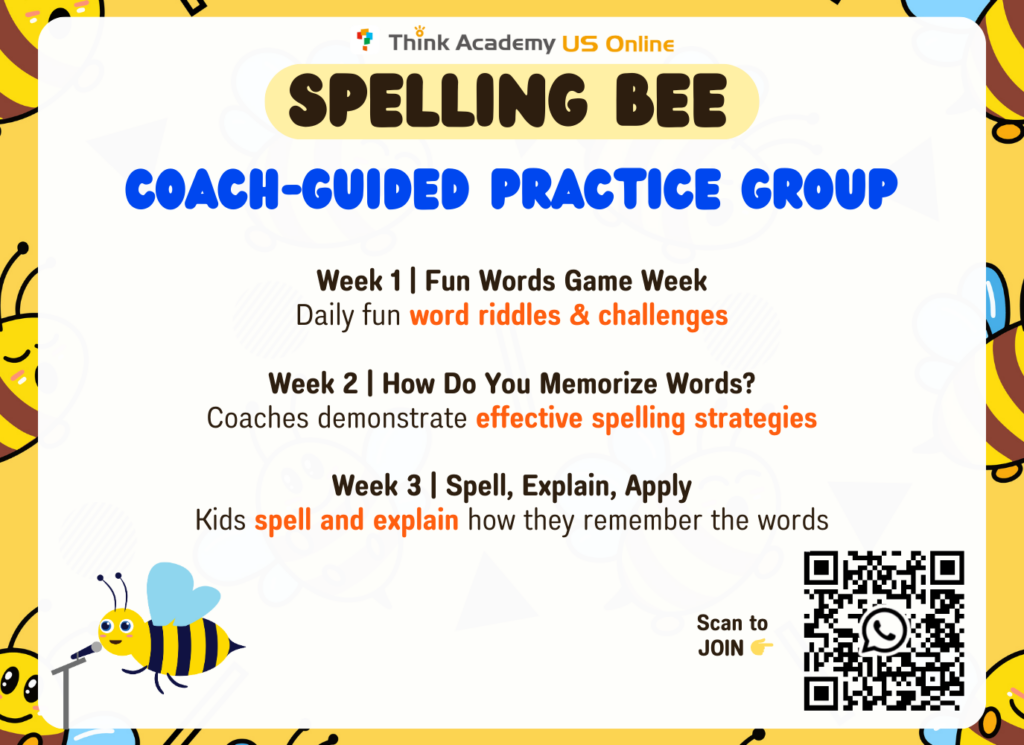
What will kids do each week?
Week 1 – Fun Words Game
Turn spelling into games and riddles so kids feel more confident speaking and sharing.
Week 2 – How Do You Memorize Words?
Learn simple, effective memory strategies that actually stick—sounds, stories, patterns, and more.
Week 3 – Spell, Explain, Apply
Practice spelling words clearly and explaining how they remember them, building both accuracy and understanding.
Why parents like it
- Spelling tips to help kids memorize words better
- Encourages kids to speak and explain, not just repeat
- Coach feedback helps you see what your child needs next
- Completely FREE
About Think Academy English
Think Academy US Online, part of TAL Education Group (NYSE: TAL), helps K–12 students build a clear academic pathway toward their goals through structured curriculum, expert teaching, and responsive service. Our engaging English learning program is designed to help kids grow into confident readers, thinkers, and communicators.
It’s a clear learning cycle:
- Students read carefully chosen texts to build vocabulary, language patterns, and understanding.
- They think through what they read by answering guided questions, explaining ideas, and using evidence from the text.
- Then they express out their understanding through speaking and writing, turning reading into clear, confident communication.
Our goal is to help kids enjoy learning English while developing strong thinking and expression skills that last.
Want more insights on math learning and parenting? Fill out the form on this page and subscribe to our newsletter for weekly tips and the latest resources.
Leave a Comment & Share Your Thoughts!

Share This Story, Choose Your Platform!
Related Posts