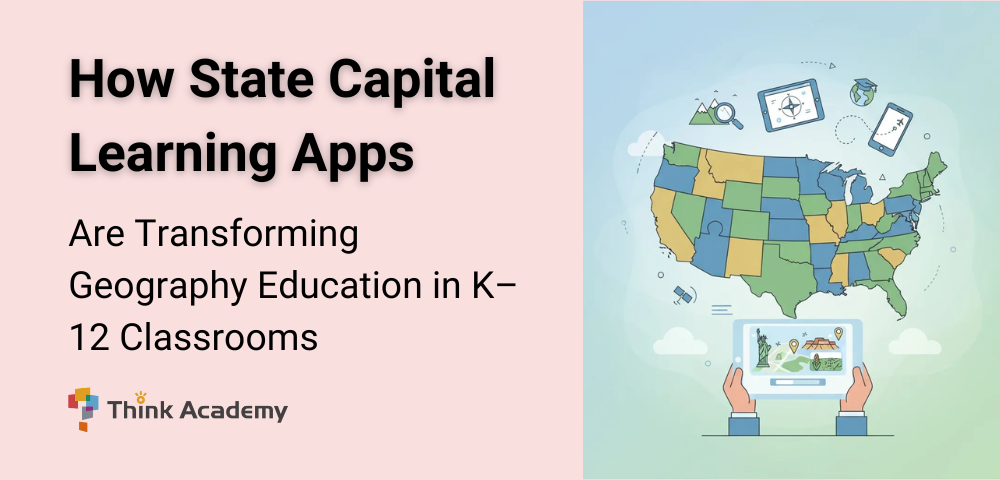
How State Capital Learning Apps Are Transforming Geography Education in K–12 Classrooms
Memorizing all 50 U.S. state capitals once meant flipping through flashcards or reciting long lists. Today, however, technology has revolutionized how students learn geography. State capital learning apps and educational games bring interactivity, challenge, and fun into K–12 classrooms.
These tools not only help students remember information more effectively but also teach them to view geography as a living subject that connects culture, history, and place. For digital-native learners, interactive geography makes learning both engaging and meaningful.
The Rise of State Capital Learning Apps in U.S. Geography Education
Traditional geography lessons focused on rote memorization—students were expected to recall state capitals without context or deeper understanding. Modern learning apps, however, use interactive maps, quizzes, and games to turn memorization into active exploration.
Popular examples include:
- Stack the States 2, a puzzle-style geography game where players answer state-related questions to “stack” and collect states as rewards (Stack the States 2 – App Store).
- Seterra Geography, which offers timed map quizzes for mastering U.S. states, capitals, and regions through repetition and challenge (Seterra Geography – U.S. States and Capitals Game).
- GeoGuessr, a global geography game that uses Google Street View to place learners in real-world locations, encouraging them to use geographic clues to determine where they are (GeoGuessr – Explore the World Game).
The American Geographical Society notes that digital mapping tools and interactive games help build spatial reasoning and map literacy, key foundations of geography education.

How State Capital Learning Apps Work
Most geography apps rely on gamification—integrating competition, achievement, and instant feedback into the learning process. This approach keeps students motivated while improving retention.
Common features include:
- Interactive maps: Students click, drag, and explore to learn locations.
- Timed challenges: Encourage focus and engagement.
- Audio-visual aids: Narration and visuals enhance understanding.
- Adaptive difficulty: Levels adjust to match student progress.
- Progress tracking: Dashboards allow teachers and students to monitor improvement.
This aligns with principles in educational psychology, which emphasize that active participation and immediate reinforcement strengthen learning.
Benefits of Digital Geography Tools
- Active learning through play: Students explore and problem-solve instead of memorizing passively.
- Instant feedback: Apps immediately correct errors, reinforcing correct knowledge.
- Self-paced progress: Learners can study at their own speed, supporting inclusivity.
- Accessibility: Visual, auditory, and interactive formats benefit different learning styles.
- Motivation: Games sustain curiosity and persistence better than drills.
The Edutopia article “Using Gamification to Ignite Student Learning” describes how well-designed educational games encourage persistence, collaboration, and curiosity—skills that go far beyond geography.

Limitations of Current State Capital Learning Apps
While these apps have transformed how students engage with geography, they’re not without challenges:
- Limited depth: Some focus solely on memorization without explaining cultural or geographic context.
- Quality inconsistency: Not all apps are verified by educators or aligned with standards.
- Learning-style limitations: Students who prefer reading or discussions may find visual-only tools less effective.
- Overemphasis on competition: Constant scoring can discourage slower learners.
These limitations highlight the importance of teacher guidance and curriculum integration—apps should complement, not replace, traditional teaching.
Improving Geography Learning with Educational Psychology
To make these tools even more effective, developers and educators can integrate insights from educational psychology:
- Encourage exploration and discovery. Let students investigate state cultures, geography, and landmarks within the app, rather than focusing only on memorization.
- Promote project-based learning. Students can create digital travel guides or virtual reports linking capitals to real-world facts.
- Support multiple learning styles. Apps should combine text, visuals, and interactive elements to engage visual, auditory, and kinesthetic learners.
- Add context and cross-disciplinary connections. Integrating civics, economics, and history deepens understanding of why geography matters.
- Enable collaboration and teacher input. Leaderboards and progress dashboards can be used to foster teamwork and constructive competition.
By combining gamification with sound pedagogy, geography apps can develop not only knowledge but also curiosity and critical thinking.
Conclusion
State capital learning apps are redefining geography education in the K–12 world. By merging interactivity, play, and adaptive design, these tools help students master U.S. geography while enjoying the process. Still, their greatest potential lies in being part of a broader strategy—where games, projects, and inquiry-based learning work together to build lasting geographic literacy.
When students learn through exploration rather than memorization, maps become more than names and borders—they become gateways to understanding the world.
About Think Academy
Think Academy, part of TAL Education Group, helps K–12 students succeed in school today by building strong math foundations and critical thinking skills. At the same time, we focus on the bigger picture—developing learning ability, curiosity, and healthy study habits that inspire a lifelong love of learning. With expert teachers, proven methods, and innovative AI tools, we support every child’s journey from classroom confidence to long-term growth.
Want more insights on math learning and parenting? Subscribe to our newsletter for weekly tips and the latest resources.
Leave a Comment & Share Your Thoughts!
Share This Story, Choose Your Platform!
Related Posts