How Math Makes Airplanes Fly: A Kid-Friendly Guide
Airplanes look almost magical as they lift off the ground and glide through the sky, but their flight is not magic at all. It is the result of mathematics, physics, and careful engineering working together. For many parents, explaining how airplanes fly can feel intimidating. When broken down into clear ideas and simple examples, however, the math behind airplanes becomes both understandable and exciting for children.
This article explains where the math of flight comes from, how it developed over time, and how children can explore these ideas through hands-on learning.
Early Ideas About the Math Behind Flight
Long before equations existed, humans observed birds and wondered how flight was possible. Ancient thinkers understood that air was not “nothing.” It could push, carry, and resist motion. They noticed that lighter objects were more easily lifted by wind, while heavier objects fell quickly.
Without mathematics to measure speed, force, or pressure, these ideas remained descriptive rather than precise. For centuries, people knew wings were important, but the exact relationship between wing shape, air speed, and lifting force was unclear. Flight remained a mix of imagination and trial-and-error experimentation.
Turning Observations Into Mathematics
The mathematical understanding of flight began to form when scientists started describing nature using numbers and formulas.
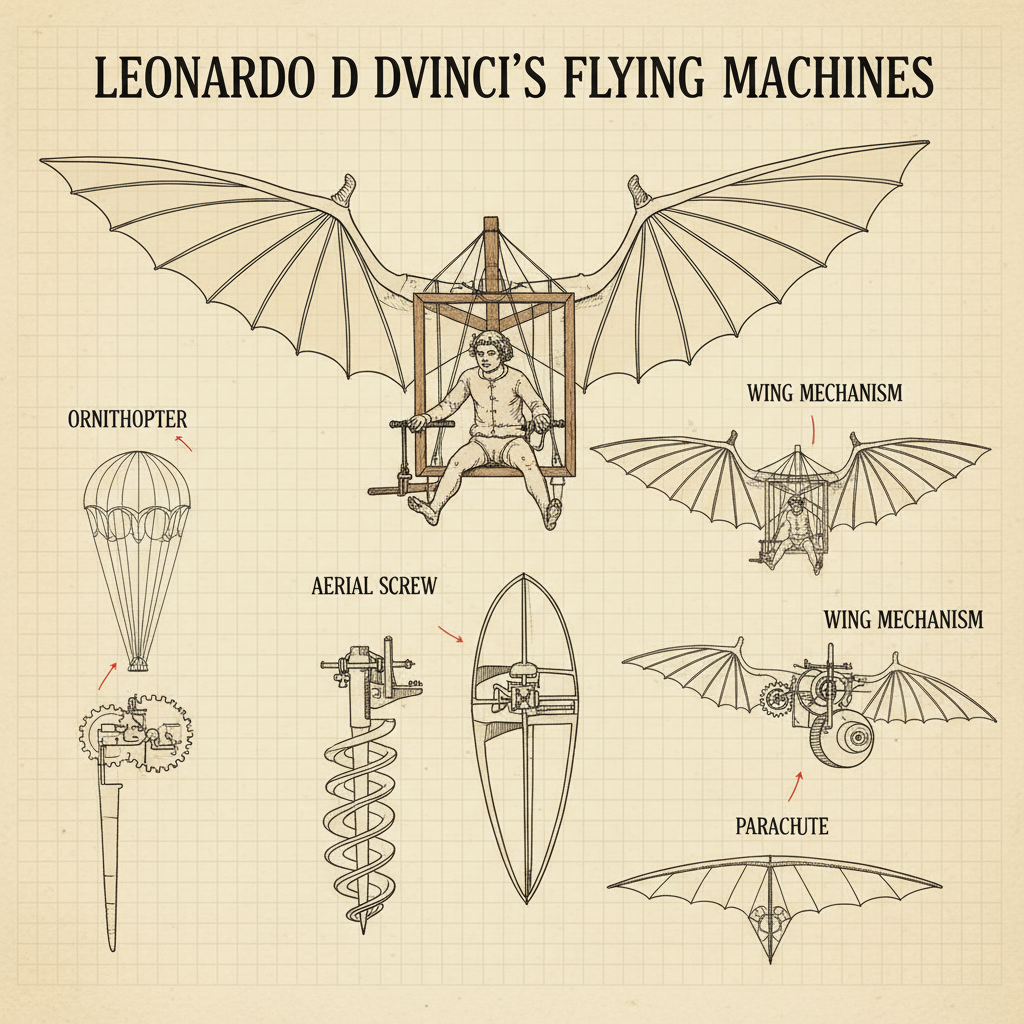
Thinkers like Leonardo da Vinci carefully studied birds and sketched flying machines. Although his designs never flew, he recognized that flight could be studied systematically rather than guessed at.
In the 17th century, Isaac Newton introduced laws of motion that explained how forces cause objects to accelerate, slow down, or change direction. These ideas made it possible to analyze flight using measurable forces instead of observation alone.
Later, in the 18th century, Daniel Bernoulli showed how the speed of a moving fluid affects its pressure. This insight became essential for understanding how wings generate lift. Together, these ideas transformed flight into a problem that mathematics could explain.
The Four Forces of Flight
Modern aviation explains airplane motion using four fundamental forces that act on every aircraft.
- Lift pulls the airplane upward.
- Weight pulls it downward due to gravity.
- Thrust moves the airplane forward.
- Drag resists motion through the air.
Airplanes fly when lift is greater than weight and thrust is greater than drag. Each of these forces can be described and predicted using mathematical relationships.
How Math Explains Lift
Lift is created by the shape and angle of the wing, known as an airfoil. As an airplane moves forward, air flows both over and under the wing.
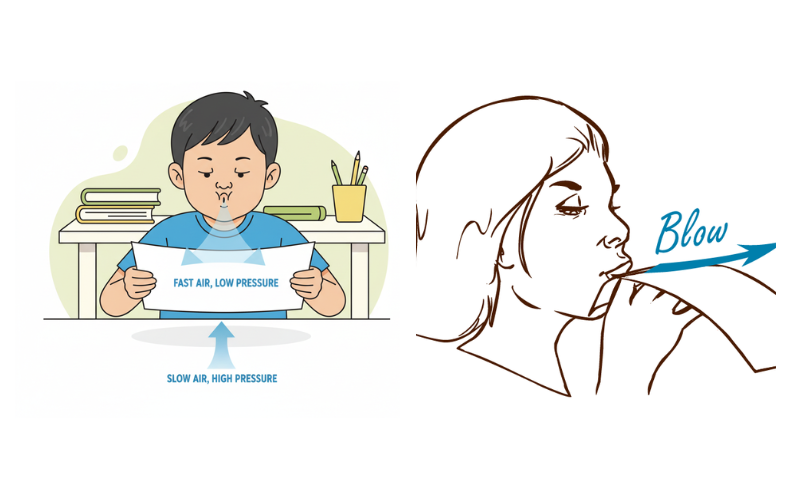
Air moving over the curved top surface travels faster, which lowers the pressure above the wing. Air below the wing moves more slowly and has higher pressure. This pressure difference creates an upward force called lift.
Engineers often describe lift using the lift equation:
L = ½ × ρ × V² × A × Cₗ
Where:
- L is the lift force
- ρ (rho) is air density
- V is airspeed
- A is wing area
- Cₗ depends on wing shape and angle
Children don’t need to memorize this formula, but understanding that speed, shape, and area all matter is key.
Important Concepts That Often Get Confused
Understanding flight also means learning to distinguish related ideas.
- Speed vs. Velocity: Speed is how fast something moves. Velocity includes both speed and direction, which matters for navigation.
- Mass vs. Weight: Mass is how much matter something has. Weight is how strongly gravity pulls on that mass.
- Aerodynamics vs. Fluid Dynamics: Aerodynamics focuses on air, while fluid dynamics applies to all fluids, including water.
Learning these distinctions builds scientific precision and clear thinking.
A Simple At-Home Experiment to Show Lift
Lift can be demonstrated with a single sheet of paper. Hold one end of the paper to your lips so it hangs downward. Blow steadily across the top surface. Instead of falling, the paper rises upward.
This happens because the air you blow moves faster over the top of the paper, lowering the pressure above it. The higher pressure below pushes the paper upward. The same math and physics apply to real airplane wings.
Learning Through Paper Airplanes
Paper airplanes allow children to explore flight concepts through experimentation. By changing wing width, length, or angle, children are testing the same variables engineers use.
A wider wing can create more lift but also more drag. A longer, thinner wing may fly faster but require more speed to stay airborne. By observing how each change affects flight, children naturally develop an understanding of cause and effect.
Why the Math Behind Airplanes Is Powerful for Learning
Airplanes show children that math is not abstract or disconnected from real life. Math explains how massive machines lift off the ground, travel long distances, and land safely.
Learning the math behind airplanes helps children:
- Build intuition about forces and motion
- Practice observation and problem-solving
- See how math connects to real-world technology
To support this learning at home, families can download free math worksheets designed to strengthen foundational skills such as measurement, logical reasoning, data interpretation, and step-by-step thinking. Working through these worksheets alongside hands-on activities like paper airplanes helps children connect math concepts to real experiences, reinforcing understanding in a practical and engaging way.
About Think Academy
Think Academy, part of TAL Education Group, helps K–12 students succeed in school today by building strong math foundations and critical thinking skills. At the same time, we focus on the bigger picture—developing learning ability, curiosity, and healthy study habits that inspire a lifelong love of learning. With expert teachers, proven methods, and innovative AI tools, we support every child’s journey from classroom confidence to long-term growth.
Check our math programs:
- Early Childhood — PreK
- Lower Elementary — Grades K–2
- Upper Elementary — Grades 3–5
- Middle School — Advanced math topics, including Algebra 1, Algebra 2, and Geometry
Want more insights on math learning and parenting? Fill out the form on this page and subscribe to our newsletter for weekly tips and the latest resources.
Leave a Comment & Share Your Thoughts!

Share This Story, Choose Your Platform!
Related Posts










