What Are Ratios? Everyday Examples and Origins Explained for Kids
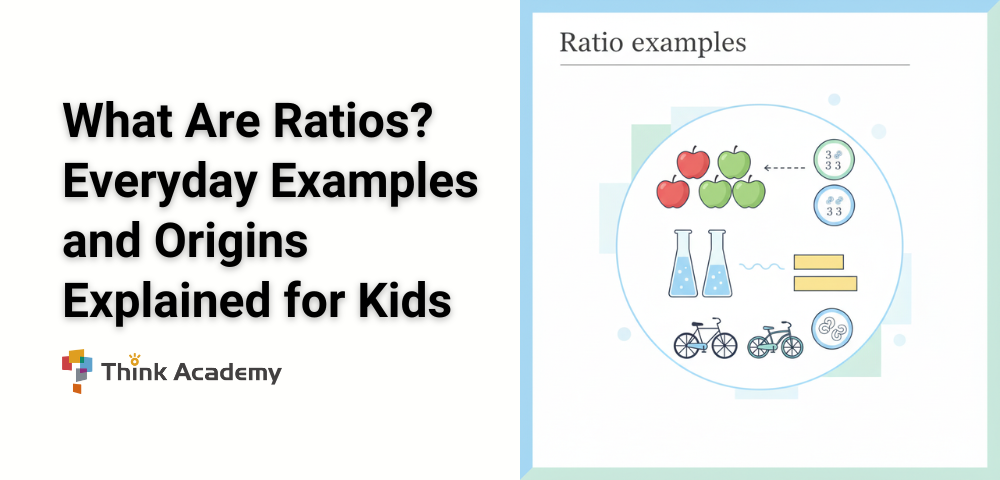
Ratio examples in daily life are one of the most effective ways for parents to help children understand this essential math concept. Ratios are not just abstract numbers found in textbooks; they describe relationships we use every day, from mixing ingredients and building structures to comparing sizes, speeds, and quantities. When children learn ratios through familiar situations, the idea becomes concrete, logical, and easier to remember. This article explains what ratios really mean, where the concept comes from, and how parents can use simple, everyday examples to teach ratios with confidence.
Early Ideas About Ratios
Long before formal mathematics existed, humans relied on proportional thinking as a practical tool for survival, construction, and communication. Ancient builders did not measure structures using equations, but they learned through experience that stability and balance depended on maintaining consistent relationships between length, width, and height. A wall that was too tall relative to its base would collapse; a column that was too thin could not support weight. These observations taught early societies that relationships between quantities mattered more than absolute measurements.
Music provides another powerful early example of ratio thinking. Long before musical notation, people discovered that harmonious sounds occurred when string lengths followed simple whole-number ratios, such as 2:1 or 3:2. These ratios produced predictable, pleasing tones, while other ratios created dissonance. This showed that ratios could describe invisible relationships—such as sound and vibration—even when the quantities themselves could not be seen.
Ratios also played a central role in daily life. Cooks adjusted ingredient amounts to preserve taste, traders compared quantities to ensure fair exchange, and artists scaled patterns to reproduce designs at different sizes. In each case, people were not counting totals; they were preserving proportions. Doubling a recipe meant doubling every ingredient, not adding random amounts. Enlarging a design required keeping the same shape relationships, not just making everything bigger.
These repeated experiences trained humans to think comparatively: How much of this compared to that? Over time, this way of thinking became so reliable that it was passed down through teaching, craft, and tradition. When formal mathematics later emerged, ratios were not invented from scratch—they were formalized descriptions of relationships people already understood intuitively.
This historical progression helps children understand an important idea: ratios are not artificial school rules. They are a way humans learned to describe balance, consistency, and fairness long before numbers were written down.

Turning Ratios Into Mathematics
Ratios became a formal part of mathematics when scholars began defining them precisely. Ancient Greek mathematicians, especially Euclid, developed a logical system for comparing quantities such as lengths, areas, and volumes. This framework allowed ratios to be used not only for observation but also for proof and problem-solving. Over time, ratios became central to arithmetic, geometry, algebra, science, and engineering.
What Is a Ratio Today?
In modern math, a ratio compares two quantities with the same unit and shows how much of one quantity there is relative to another. Ratios can be written in different ways:
- As a fraction (a/b)
- Using words (“a to b”)
- With a colon (a:b)
For example, if a recipe uses 1 cup of sugar and 2 cups of flour, the ratio of sugar to flour is 1:2. This describes the relationship between the ingredients, not the total amount used.
Important Distinctions Children Often Confuse
Understanding related concepts helps prevent confusion:
- A ratio compares quantities with the same unit.
- A rate compares quantities with different units, such as miles per hour.
- A proportion states that two ratios are equal, such as 1:2 = 2:4.
Making these distinctions early strengthens mathematical clarity and reasoning.

A Real-World Ratio Example at Home
A simple way to teach ratios is through cooking or drink mixing. If orange juice concentrate is mixed in a ratio of 1 part concentrate to 3 parts water, the taste stays consistent no matter how much is made. Using 1 cup of concentrate requires 3 cups of water, while 2 cups of concentrate require 6 cups of water. Although the total amount changes, the ratio remains 1:3. This hands-on experience clearly shows how ratios preserve relationships.
Why Everyday Ratio Examples Work for Learning
Everyday ratio examples help children move beyond memorizing procedures to understanding how quantities relate to each other. When math connects to familiar activities, children can predict outcomes, test ideas, and see why consistency matters. These experiences build a strong foundation for fractions, percentages, proportions, and algebraic thinking later on.
To support this learning at home, parents can download free math worksheets focused on ratios and proportional reasoning. These worksheets reinforce core concepts through real-world scenarios, clear visuals, and step-by-step practice—helping children strengthen their understanding of ratios in a structured and practical way.
About Think Academy
Think Academy, part of TAL Education Group, helps K–12 students succeed in school today by building strong math foundations and critical thinking skills. At the same time, we focus on the bigger picture—developing learning ability, curiosity, and healthy study habits that inspire a lifelong love of learning. With expert teachers, proven methods, and innovative AI tools, we support every child’s journey from classroom confidence to long-term growth.
Check our math programs:
- Early Childhood — PreK
- Lower Elementary — Grades K–2
- Upper Elementary — Grades 3–5
- Middle School — Advanced math topics, including Algebra 1, Algebra 2, and Geometry
Want more insights on math learning and parenting? Fill out the form on this page and subscribe to our newsletter for weekly tips and the latest resources.
Leave a Comment & Share Your Thoughts!

Share This Story, Choose Your Platform!
Related Posts










