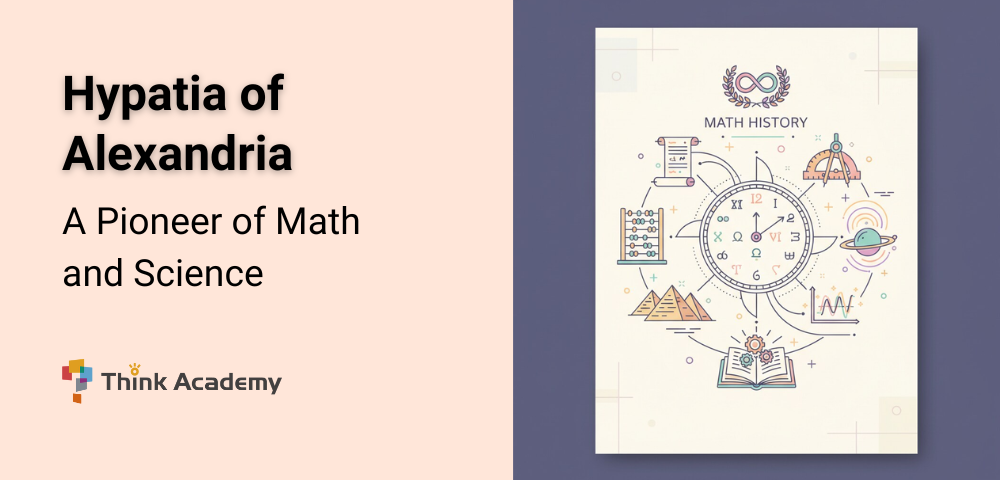
Hypatia of Alexandria: A Pioneer of Math and Science
The name Hypatia is often associated with brilliance, courage, and intellectual independence. Living more than 1,600 years ago, she remains one of the most well-known female mathematicians in history. For parents and children exploring the roots of math and science, Hypatia’s life offers a powerful reminder that learning is a timeless pursuit built on curiosity, discipline, and clear thinking.
This article explains who Hypatia was, what she contributed to mathematics and astronomy, and why her story still matters for young learners today.
Hypatia of Alexandria: A Scholar Ahead of Her Time
Hypatia was born in Alexandria, Egypt, around 350–370 CE, during a period when the city was one of the most important intellectual centers of the ancient world. She was the daughter of Theon of Alexandria, a respected mathematician and astronomer who played a major role in her education.
At a time when women rarely received formal schooling, Hypatia became a leading philosopher, mathematician, and astronomer. She later taught at the Neoplatonic school in Alexandria, where her lectures attracted students from across the Roman Empire. Contemporary accounts describe her as a clear, rigorous thinker and a highly respected teacher.
Her reputation was built not on status or authority, but on her ability to explain difficult ideas logically and precisely.

Hypatia’s Contributions to Mathematics
Hypatia is best known for her work as a teacher, editor, and commentator on foundational mathematical texts. While she did not introduce entirely new mathematical theories, her contributions were essential to preserving and clarifying key ideas that later shaped mathematics in the medieval and modern periods.
She is traditionally associated with commentaries on Diophantus’s Arithmetica, one of the earliest systematic works on algebra and number theory. This text focused on solving equations and exploring numerical relationships that resemble early algebraic thinking.
Hypatia also worked with Apollonius’s Conics, a detailed study of conic sections such as circles, ellipses, parabolas, and hyperbolas. These geometric ideas later became fundamental to physics, astronomy, and calculus.
By editing, teaching, and explaining these works, Hypatia helped ensure that complex mathematical knowledge remained accessible and was passed down through generations.
Mathematics Beyond Theory: Instruments and Applications
Hypatia’s work extended beyond abstract mathematics. Historical sources credit her with improving scientific instruments used in astronomy and measurement.
She is associated with refinements to the astrolabe, a tool used to determine the positions of stars and planets, and the hydrometer, which measures the density of liquids. These instruments highlight an important idea for students: mathematics is not just theoretical, but deeply connected to observing and understanding the real world.

Why Hypatia’s Story Matters for Children Today
Hypatia’s life carries lessons that remain relevant for modern learners.
She shows that:
- Mathematics develops over time through teaching, explanation, and refinement
- Understanding ideas deeply is just as important as discovering new ones
- Clear thinking and communication are core mathematical skills
For girls in particular, Hypatia stands as an early example of leadership in STEM fields. She succeeded in environments where women faced significant limitations, demonstrating that intellectual ability is not defined by gender or social expectations.
Her story also helps children see mathematics as a human endeavor shaped by real people, real challenges, and real curiosity.
What Parents Can Take Away from Hypatia’s Example
Sharing Hypatia’s story continues to inspire because it shows that learning, when guided by curiosity and clarity, can transcend time. She reminds us that strong mathematical thinking is built through explanation, practice, and confidence in understanding ideas deeply.
If your child is beginning to explore math concepts or building foundational skills, connecting history to hands-on practice can make learning more meaningful. Think Academy’s math worksheets are designed to help students strengthen number sense, reasoning, and problem-solving through structured, age-appropriate practice. They provide a practical way for children to apply mathematical thinking step by step, reinforcing the same habits of clarity and perseverance that scholars like Hypatia valued.
By combining inspiring stories with consistent practice, parents can help children see math not just as a subject to study, but as a skill to grow with confidence over time.
About Think Academy
Think Academy, part of TAL Education Group, helps K–12 students succeed in school today by building strong math foundations and critical thinking skills. At the same time, we focus on the bigger picture—developing learning ability, curiosity, and healthy study habits that inspire a lifelong love of learning. With expert teachers, proven methods, and innovative AI tools, we support every child’s journey from classroom confidence to long-term growth.
Check our math programs:
- Early Childhood — PreK
- Lower Elementary — Grades K–2
- Upper Elementary — Grades 3–5
- Middle School — Grades 6–10
Want more insights on math learning and parenting? Fill out the form on this page and subscribe to our newsletter for weekly tips and the latest resources.
Leave a Comment & Share Your Thoughts!
Share This Story, Choose Your Platform!
Related Posts