The Great Pizza Slice Mystery: Fractions in Real Life
Fractions often feel abstract to young learners when they are introduced only through symbols and worksheets. However, real-life fraction problems make these concepts concrete and intuitive. Everyday situations—such as sharing food—naturally involve dividing wholes into equal parts, which is the foundation of fractional thinking.
This math story uses a familiar scenario, a family pizza night, to help children understand fractions through observation, reasoning, and fair sharing.
A Delicious Dilemma: Dividing the Whole
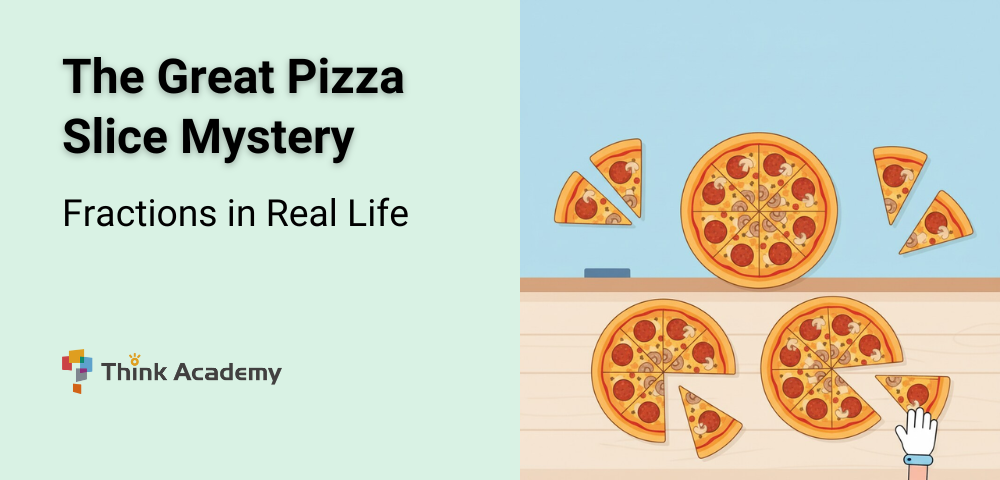
On Friday night, Lily (age 7) and her younger brother Tom (age 5) watched as their parents opened a large pizza cut into eight equal slices. There were four people in the family, and everyone wanted a fair share.
This situation introduced an important idea:
A fraction represents a part of a whole that has been divided into equal pieces.
Since there were:
- 8 total slices
- 4 people
Each person would receive 2 slices.
Their parents explained that this can be written as:
- 2 out of 8 slices → 2/8
This helped Lily and Tom see that fractions describe how many parts you have out of how many equal parts make up the whole.
Understanding Numerator and Denominator
As they talked about sharing, Lily’s dad introduced fraction vocabulary:
- The denominator (bottom number) shows how many equal parts the whole is divided into
- The numerator (top number) shows how many of those parts you have
So when Lily received 2 slices from an 8-slice pizza, she had 2/8 of the pizza.
This concrete example made fraction language meaningful rather than abstract.

Exploring Fractions with Different Toppings
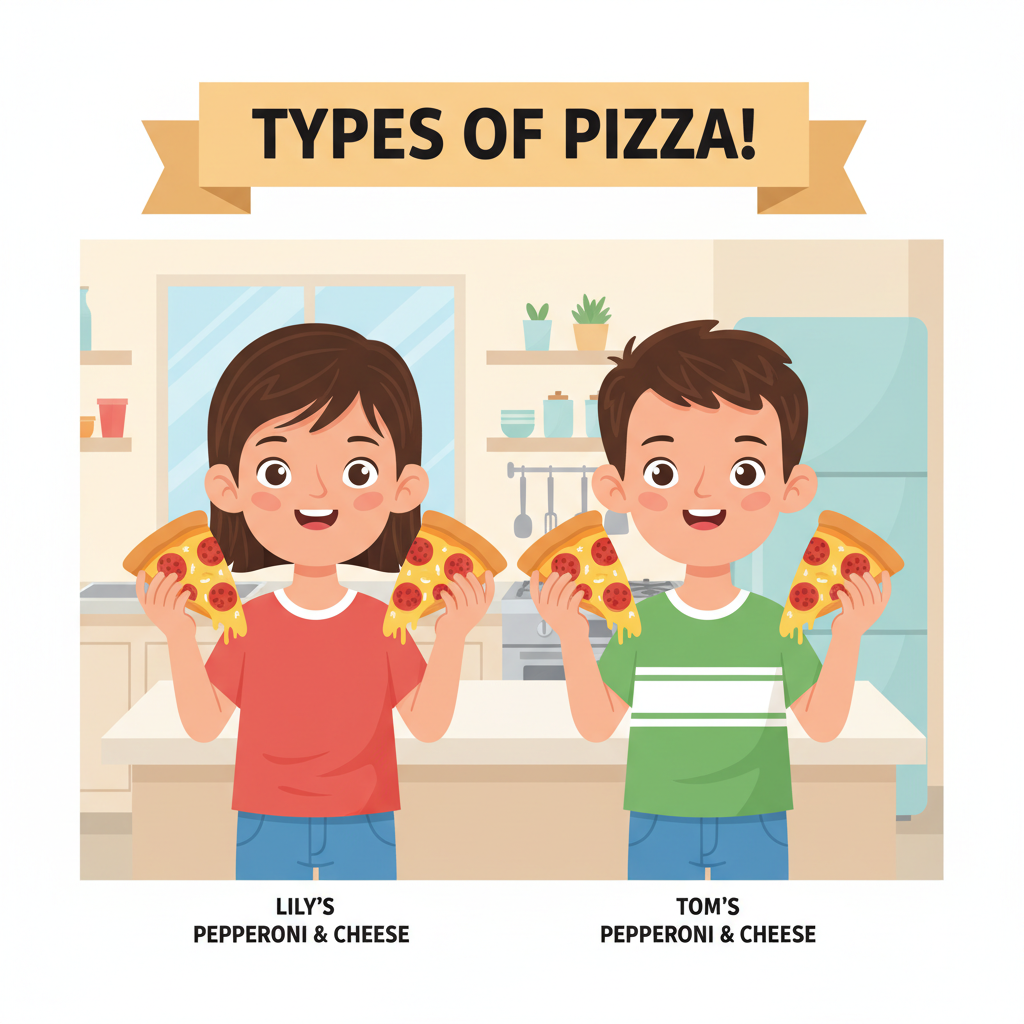
The pizza was half pepperoni and half cheese:
- 4 pepperoni slices
- 4 cheese slices
Lily preferred pepperoni, while Tom wanted cheese. This created a new real-life fraction problem: how to divide the pizza fairly while respecting preferences.
When Lily took 2 pepperoni slices, she had:
- 2 out of 4 pepperoni slices → 2/4, which simplifies to 1/2
Her parents explained that:
- 4/8 of the whole pizza is the same as 1/2
- These are called equivalent fractions
Without formal instruction, the children were learning that different fractions can represent the same amount.
Fractions Change When the Situation Changes
When friends arrived unexpectedly, the number of people sharing the pizza increased. To make the remaining pizza stretch further, the parents cut each remaining slice in half.
This showed an important fraction concept:
- Dividing each piece into smaller parts increases the total number of pieces
- The size of each piece changes, even though the total amount of pizza stays the same
Now, instead of whole slices, the children were sharing half-slices, reinforcing the idea that fractions depend on how the whole is divided.
What This Story Teaches About Fractions
Through this simple pizza-sharing experience, children learn that:
- Fractions represent equal parts of a whole
- Fair sharing requires equal division
- Fractions can be compared and simplified
- Equivalent fractions describe the same quantity in different ways
- Fractions change as situations change
These are core ideas that support later learning in:
- Fraction comparison
- Operations with fractions
- Ratios and proportional reasoning
Final Takeaway: Fractions Are Everywhere
Real-life fraction problems, like sharing pizza, help children see fractions as meaningful and practical rather than abstract symbols. When kids divide food, compare portions, and explain why a share is fair, they develop strong fraction intuition that supports later learning in ratios, decimals, and algebra.
To reinforce these ideas beyond everyday moments,
provide structured, grade-appropriate fraction practice from Kindergarten through Grade 10. These worksheets help students:
- Visualize fractions using models and number lines
- Practice identifying, comparing, and simplifying fractions
- Build confidence explaining fraction reasoning step by step
- Connect real-life scenarios to formal math concepts
When hands-on experiences are paired with guided worksheet practice, children gain both conceptual understanding and academic confidence, making fractions far less intimidating as math becomes more advanced.
About Think Academy
Think Academy, part of TAL Education Group, helps K–12 students succeed in school today by building strong math foundations and critical thinking skills. At the same time, we focus on the bigger picture—developing learning ability, curiosity, and healthy study habits that inspire a lifelong love of learning. With expert teachers, proven methods, and innovative AI tools, we support every child’s journey from classroom confidence to long-term growth.
Check our math programs:
- Early Childhood — PreK
- Lower Elementary — Grades K–2
- Upper Elementary — Grades 3–5
- Middle School — Advanced math topics, including Algebra 1, Algebra 2, and Geometry
Want more insights on math learning and parenting? Fill out the form on this page and subscribe to our newsletter for weekly tips and the latest resources.
Leave a Comment & Share Your Thoughts!
Share This Story, Choose Your Platform!
Related Posts