Winter Break Sudoku for Kids: Build Logic & Math Confidence
Winter break sudoku for kids offers a meaningful, screen-free way to keep children mentally active during long days at home. As the holidays wind down, many parents look for quiet activities that still support learning. Sudoku provides the perfect balance: enjoyable, self-paced puzzles that strengthen logical reasoning, number fluency, and critical thinking—skills essential for a smooth return to school.
Unlocking Learning: What Is Kids’ Sudoku?
Sudoku is a logic-based number placement puzzle that challenges children to fill a grid so that each row, column, and region contains all required symbols without repetition. It strengthens deductive reasoning, pattern recognition, and sustained focus—cognitive skills that benefit academic subjects far beyond math.
Children solving sudoku learn to:
- scan systematically for missing numbers
- test and reject possibilities
- spot repeated patterns
- build structured problem-solving routines
These abilities directly support school readiness, mathematical thinking, and executive functioning. Winter break sudoku for kids turns downtime into a brain-building opportunity wrapped in a playful, low-pressure format.

Creative Engagement: Easy Sudoku Activities for Home
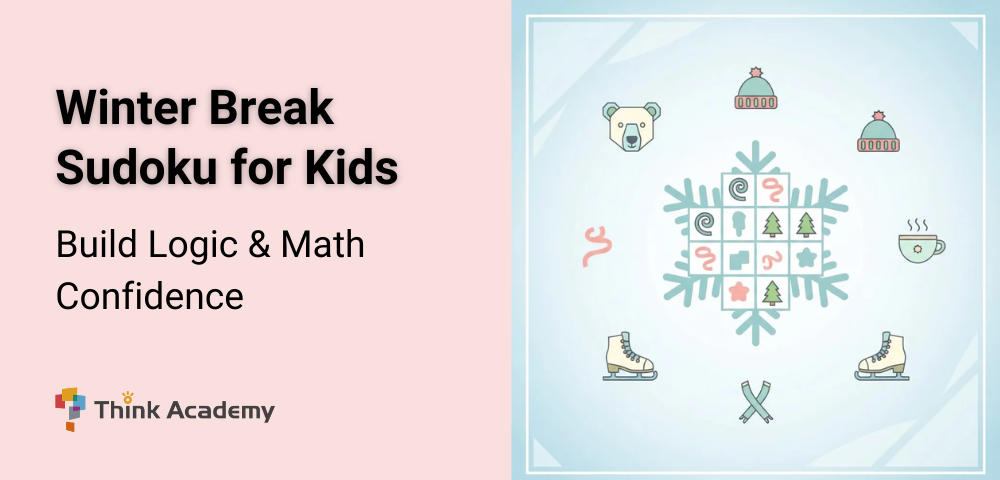
Sudoku is more accessible for young learners than many parents expect. Holiday-themed puzzles designed for children often use 4×4 or 6×6 grids with bright colors or icons instead of digits. These formats introduce sudoku rules gently, allowing kids to build early confidence before transitioning to traditional 9×9 puzzles.
Parents can find kid-friendly sudoku through:
- printable worksheets
- winter-themed puzzle books
- child-safe sudoku apps
- DIY grids made with stickers, shapes, or drawings
Smaller puzzles also allow for short, satisfying wins—important for motivation during long school breaks.
Download simple version of multiplication chart
Starting Simple: Tips for Beginners
Beginning sudoku should feel approachable, not intimidating. A few simple strategies help children get started:
- Remind them that each number or icon appears once per row, once per column, and once per region.
- Encourage pencil use for flexibility and less frustration.
- Have them identify “easy wins” first—rows or squares with multiple clues already given.
- Turn it into a shared activity: offer timed mini-challenges, create family puzzle races, or celebrate completed puzzles with small winter treats.
For preschoolers, replacing numbers with pictures creates an inviting introduction. Older kids exploring more complex logic can benefit from interactive apps that offer hints, progressive difficulty levels, or celebratory animations.

How Sudoku Supports Growth in Grades K–5
Sudoku strengthens foundational math and thinking skills in elementary learners. For younger children, sudoku enhances:
- number recognition
- sequencing
- spatial reasoning (left/right, above/below, inside/outside)
- attention to detail
By grades 3–5, sudoku becomes a powerful tool for developing:
- systematic elimination strategies
- flexible thinking
- “what-if” reasoning
- confidence in making and testing predictions
These align closely with Common Core State Standards, especially in Operations and Algebraic Thinking. Sudoku reinforces the kinds of analytical habits students need when recognizing patterns, comparing relationships, or solving multi-step problems.
Deepening Critical Thinking in Grades 6–8 and Beyond
More challenging sudoku variations—such as irregular boards, diagonal sudoku, or larger grids—push middle-school students to think several steps ahead. These puzzles improve endurance, attention control, and the ability to maintain multiple possibilities mentally.
Sudoku at this level nurtures:
- multi-step reasoning
- error-checking and revision
- perseverance through challenge
- self-regulated learning
It also provides a thoughtful alternative to screen time—an especially valuable option during long winter days indoors. Making winter break sudoku for kids part of an annual routine helps cultivate lifelong habits of quiet concentration and disciplined problem-solving.
Winter Break Sudoku for Kids: A Smart Choice
At its heart, winter break sudoku for kids turns passive free time into active learning. It blends entertainment with logic, offering children a simple yet powerful way to strengthen their mathematical thinking in a relaxed, enjoyable environment. With consistent yearly practice, sudoku becomes more than a puzzle—it becomes a family tradition that reinforces curiosity, confidence, and a love for reasoning.
To keep these skills growing beyond the holidays,
Think Academy offers free, high-quality math worksheets
that help children strengthen number sense, logical reasoning, and problem-solving—exactly the abilities sudoku develops. These structured practice sheets also support consistent at-home learning habits, giving families an easy, motivating way to maintain academic momentum throughout winter break and beyond.
About Think Academy
Think Academy, part of TAL Education Group, helps K–12 students succeed in school today by building strong math foundations and critical thinking skills. At the same time, we focus on the bigger picture—developing learning ability, curiosity, and healthy study habits that inspire a lifelong love of learning. With expert teachers, proven methods, and innovative AI tools, we support every child’s journey from classroom confidence to long-term growth.
Want more insights on math learning and parenting? Fill out the form on this page and subscribe to our newsletter for weekly tips and the latest resources.
Leave a Comment & Share Your Thoughts!

Share This Story, Choose Your Platform!
Related Posts










