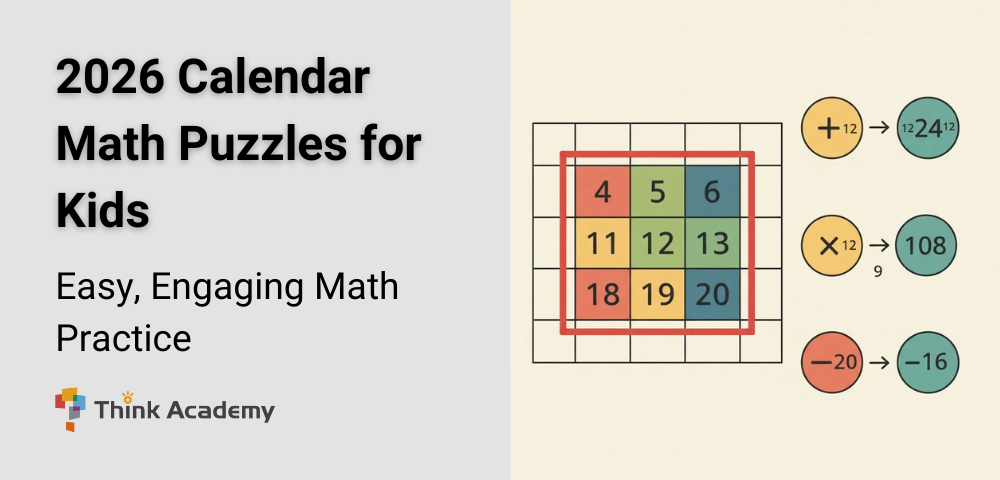
2026 Calendar Math Puzzles for Kids: Easy, Engaging Math Practice
2026 calendar math puzzles for kids transform a simple wall calendar into a powerful and playful math tool. Many parents look for ways to make math more engaging than worksheets—and using a calendar does exactly that. Because children see dates every day, these puzzles help them connect math to real life, making numbers meaningful, visual, and fun.
Unlock Learning with 2026 Calendar Math Puzzles
Calendar math teaches children how numbers behave in patterns—across days, weeks, and months. A calendar becomes an instant playground for exploring:
- number sequences
- counting and skip counting
- modular arithmetic (like why 3 + 4 = 1 week)
- elapsed time
- comparing quantities
- identifying shapes and patterns in date grids
For example, a simple puzzle like “If today is the 3rd and four days pass, what day is it?” leads to the surprising answer 7 → 1 week, or simply the 7th, showing kids how numbers wrap around inside a month.
These puzzles use the 2026 calendar to anchor learning in real, timely, seasonal examples.
Engaging Calendar Math Activities for Every Age
For Younger Children (Ages 4–7)
Young learners love puzzles that build number recognition, counting, and early operations.
Try these 2026-friendly puzzles:
- “What number comes after the 12th?” (sequences)
- “Find all the even numbers in the first week of March 2026.” (patterns)
- “How many days until Friday the 24th?” (counting forward)
- “Circle all the dates that end in 5.” (visual pattern spotting)
They can also explore the calendar structure:
- “How many days are in January 2026?” → 31
- “Which month has exactly 28 days?” → February (not a leap year)
- “Which months start on a Monday in 2026?”
These simple questions build early number sense and confidence.
For Older Children (Ages 8–12)
Older kids can tackle deeper puzzles involving patterns, elapsed time, and reasoning.
Examples using the 2026 calendar:
- Elapsed Time Challenges
“If your trip starts on July 7 and ends on July 21, how many days will you be gone?” → 14 days - Modular Arithmetic (Calendar Wrap-Around Math)
“If today is the 3rd, what date will it be 9 days later?”
3 + 9 = 12
“What about 3 + 30?”
3 + 30 = 33 → wraps to 2 (since January has 31 days) - Day-of-Week Patterns
“If January 1, 2026 is a Thursday, what day is January 15?”
14 days later → Thursday again - Fraction Questions
“What fraction of March has passed by the 10th?”
10/31 - Multiples & Prime Numbers
“Highlight all the multiples of 3 in August 2026.”
“Circle all the prime numbers in April 2026.”
These puzzles mimic Common Core–aligned skills such as reasoning, structure, and repeated patterns—but in a familiar format kids naturally understand.

Popular Math Concepts Hidden in Every Calendar
A single month grid contains almost every major elementary math concept:
1. Skip Counting & Multiplication
Counting by 7s reveals weekly patterns.
Row patterns help reinforce multiples (e.g., 7, 14, 21, 28 in February).
2. Modular Arithmetic (the math of clocks & calendars)
When dates “wrap around” the end of the month, kids see equations like:
3 + 4 = 1 (week wrap-around)
28 + 5 = 2 (new month)
This develops pre-algebraic thinking.
3. Fractions & Parts of a Whole
Every date is a fraction of the month:
- 10th in a 30-day month → 10/30 = 1/3
- 20th in February 2026 (28 days) → 20/28 = 5/7
4. Elapsed Time & Timeline Math
Kids learn to find durations with real meaning—events, holidays, deadlines.
5. Pattern Recognition
Calendar rows, columns, and diagonals reveal repeating structures used in algebra and number theory.
6. Comparing & Ordering Numbers
“Which date is greater?”
“Which week has the highest total of numbers?”
Calendar math strengthens numeracy without worksheets.

Boosting K–12 Math Skills with Calendar Fun
Using 2026 calendar math puzzles for kids builds key skills in:
- problem-solving
- number sense
- logical reasoning
- pattern recognition
- time and date fluency
- early algebra
These puzzles align naturally with Common Core expectations and help children see that math is something they use—not just something they study.
Because they fit into everyday routines (“How many days until your birthday?”), parents can reinforce math skills effortlessly.
Integrate Calendar Math for Lasting Learning
The greatest value of 2026 calendar math puzzles lies in their simplicity. A single calendar provides constant opportunities to practice math, explore patterns, and build curiosity. This habit teaches children that math is everywhere—and that learning can happen anytime, not just during schoolwork.
To support this growth even further, pair calendar math with Think Academy’s free worksheets. They offer structured practice in number sense, operations, skip counting, fractions, and problem-solving—skills strengthened naturally through calendar puzzles. Together, they help build a confident math foundation for every grade level.
About Think Academy
Think Academy, part of TAL Education Group, helps K–12 students succeed in school today by building strong math foundations and critical thinking skills. At the same time, we focus on the bigger picture—developing learning ability, curiosity, and healthy study habits that inspire a lifelong love of learning. With expert teachers, proven methods, and innovative AI tools, we support every child’s journey from classroom confidence to long-term growth.
Want more insights on math learning and parenting? Fill out the form on this page and subscribe to our newsletter for weekly tips and the latest resources.
Leave a Comment & Share Your Thoughts!

Share This Story, Choose Your Platform!
Related Posts










