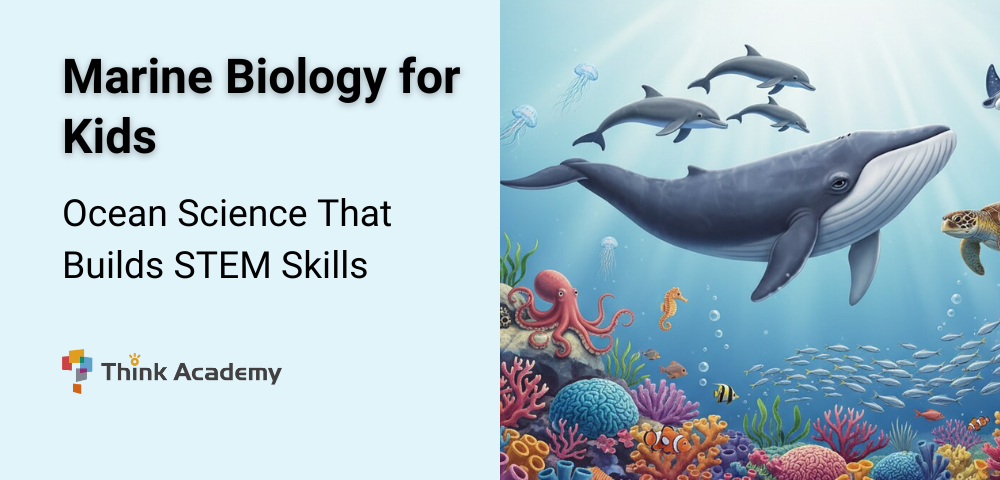
Marine Biology for Kids: Ocean Science That Builds STEM Skills
Marine biology is one of the most engaging ways for children to explore science through real-world systems, living organisms, and environmental interactions. By studying ocean life, students learn how ecosystems function, how organisms adapt, and how scientists use observation and data to understand the natural world. This makes marine biology a powerful entry point for building long-term STEM skills in K–12 learners.
From coral reefs to the deep sea, marine biology helps turn abstract science concepts into concrete, observable learning experiences.
What Is Marine Biology?
Marine biology is the scientific study of organisms that live in oceans and seas, as well as the ecosystems they form. It includes microscopic plankton, fish, coral, marine mammals, and the physical environments that support them.
Through marine biology, children begin to understand:
- How ecosystems are interconnected
- How organisms depend on their environment
- How changes in one part of a system affect the whole
These ideas are foundational not only for biology, but also for environmental science, earth science, and systems thinking across STEM disciplines.
Ocean Habitats and Scientific Adaptations
The ocean contains a wide range of habitats, each with unique conditions that shape how organisms survive.
Key examples include:
- Coral reefs, which demonstrate biodiversity and ecosystem balance
- Open ocean zones, where migration and food chains dominate
- Deep-sea environments, where extreme pressure and darkness lead to adaptations such as bioluminescence
Studying these habitats introduces children to core scientific concepts such as adaptation, energy transfer, and survival strategies—essential ideas across life sciences.
How Marine Biology Builds STEM Skills
Marine biology naturally integrates multiple STEM domains.
As children study ocean life, they practice:
- Scientific observation by identifying traits and behaviors
- Classification by grouping organisms based on shared characteristics
- Data reasoning by comparing sizes, populations, or habitats
- Logical explanation by describing cause-and-effect relationships
These skills align closely with K–12 science and math standards and prepare students for more advanced scientific learning.

Hands-On Activities That Reinforce Marine Science Concepts
Hands-on activities help children move from curiosity to scientific understanding. When marine biology concepts are paired with structured observation and simple data collection, students begin practicing the same skills scientists use in real research.
1. Modeling Ocean Layers with Density Experiments
This activity helps explain why oceans form layers and how salinity affects water movement.
How to do it:
- Fill a clear container halfway with fresh water
- Mix salt thoroughly into a separate cup of water
- Slowly pour the salt water into the container using a spoon to reduce mixing
- Add food coloring to each layer
What students learn:
- Density differences between salt water and fresh water
- How ocean layers and currents form
STEM skills reinforced:
- Observation
- Hypothesis testing
- Cause-and-effect reasoning
2. Building Marine Food Chains and Food Webs
Understanding ecosystems requires seeing how energy moves between organisms.
How to do it:
- Choose a marine habitat (reef, open ocean, deep sea)
- List producers, consumers, and predators
- Draw arrows showing energy flow
For older students:
- Combine multiple food chains into a food web
- Predict what happens if one species disappears
STEM skills reinforced:
- Systems thinking
- Logical sequencing
- Environmental reasoning
3. Classification and Adaptation Sorting
Marine biology relies heavily on classification based on observable traits.
How to do it:
- Collect images or cards of marine organisms
- Sort them by:
- Habitat
- Body type (fish, mammal, invertebrate)
- Adaptations (camouflage, shells, bioluminescence)
For older students:
- Require written explanations using evidence
STEM skills reinforced:
- Pattern recognition
- Categorization
- Evidence-based explanation
4. Measuring and Comparing Marine Animals
This activity connects biology with math concepts such as measurement and scale.
How to do it:
- Research average lengths of marine animals
- Measure those lengths using tape, string, or floor space
- Create comparison charts or bar graphs
For older students:
- Convert between meters and feet
- Compare ratios between species
STEM skills reinforced:
- Measurement
- Proportional reasoning
- Data representation
5. Scientific Observation and Recording
Observation is a core scientific skill.
How to do it:
- Watch a short marine documentary clip
- Record observations such as movement, feeding, or environment
For older students:
- Separate observation from inference
- Write short conclusions based on evidence
STEM skills reinforced:
- Scientific note-taking
- Critical thinking
- Data interpretation

Why Marine Biology Supports Long-Term STEM Learning
Marine biology teaches children how science works, not just scientific facts. Through structured exploration, students learn to observe carefully, analyze patterns, and explain outcomes using evidence.
These habits of mind support success in:
- Middle school science
- Data-driven learning
- Research projects and STEM competitions
Final Takeaway: Turning Ocean Curiosity Into STEM Literacy
Marine biology offers children a meaningful way to explore science through real-world systems. By studying ocean life, students build observation skills, logical reasoning, and data awareness that support STEM learning across subjects.
To reinforce these concepts with structured practice,
provide grade-appropriate STEM learning support from Kindergarten through Grade 10. Designed to strengthen both science and math foundations, these worksheets help students:
- Practice scientific classification and data organization
- Strengthen measurement, comparison, and graphing skills
- Apply math reasoning to real-world science topics
- Connect observation with explanation and evidence
When hands-on marine biology exploration is paired with targeted worksheet practice, children develop both curiosity-driven discovery and strong academic foundations—a combination that supports lifelong STEM learning.
About Think Academy
Think Academy, part of TAL Education Group, helps K–12 students succeed in school today by building strong math foundations and critical thinking skills. At the same time, we focus on the bigger picture—developing learning ability, curiosity, and healthy study habits that inspire a lifelong love of learning. With expert teachers, proven methods, and innovative AI tools, we support every child’s journey from classroom confidence to long-term growth.
Check our math programs:
- Early Childhood — PreK
- Lower Elementary — Grades K–2
- Upper Elementary — Grades 3–5
- Middle School — Advanced math topics, including Algebra 1, Algebra 2, and Geometry
Want more insights on math learning and parenting? Fill out the form on this page and subscribe to our newsletter for weekly tips and the latest resources.
Leave a Comment & Share Your Thoughts!

Share This Story, Choose Your Platform!
Related Posts










I want to be a marine biology I am 12