The History of Algebra: How It Shapes Modern Learning
Algebra may look like a mix of letters and numbers on a page, but behind it is a remarkable history of solving real-world problems. Understanding where algebra came from makes it more relatable and meaningful for today’s learners.
This article takes you back to the fascinating origins of algebra and shows how this ancient idea still powers the modern world.
The Birth of a Powerful Idea
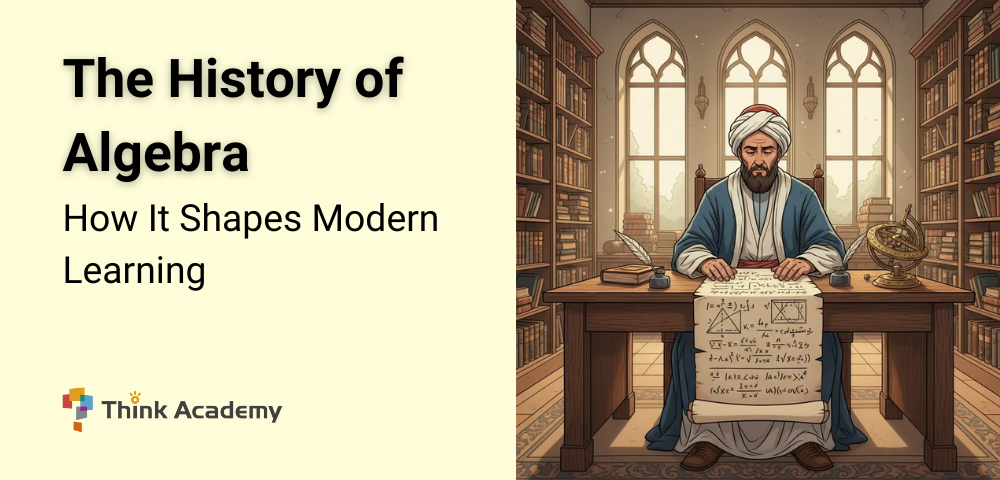
Imagine a vibrant 9th-century Baghdad marketplace—traders negotiating prices, scholars gathering to discuss astronomy, engineering, and philosophy. In the midst of this intellectual golden age lived a brilliant Persian mathematician: Muhammad ibn Musa al-Khwarizmi.
Before his time, people solved problems one by one without a general method. A calculation for dividing land among brothers required one approach, while dividing money required another. Nothing unified these cases.
Al-Khwarizmi changed everything.
In his groundbreaking book, The Compendious Book on Calculation by Completion and Balancing, he introduced a systematic way to solve different types of problems using the same rules. This shift—from solving isolated problems to creating a general problem-solving framework—became the foundation of algebra.
The word “algebra” comes from the Arabic term al-jabr, meaning “restoration” or “completion.” It referred to one of Al-Khwarizmi’s key operations: moving negative terms to the other side of an equation. Paired with al-muqabala (“balancing”), algebra emerged as a structured method for isolating unknowns and solving equations.
Al-Khwarizmi didn’t just do math—he created a new way of thinking.

From Specific Problems to Universal Solutions
Al-Khwarizmi’s genius was in turning everyday situations into universal mathematical rules.
In his era, many problems involved inheritance, land division, or trade. A typical will might say:
- the wife receives a certain fraction,
- the children divide the rest.
Such cases required careful calculations—mistakes could cause significant conflict. Al-Khwarizmi developed clear, step-by-step methods to solve them fairly and consistently.
He introduced techniques for solving:
- linear equations (variables to the power of 1)
- quadratic equations (variables to the power of 2)
These weren’t abstract puzzles. They were practical tools that made life more organized and fair:
- dividing land accurately
- calculating business profits
- allocating family inheritances
- planning construction and trade
His two key operations—al-jabr (restoring) and al-muqabala (balancing)—formed a toolkit that allowed people to isolate unknown quantities and find their values. This was revolutionary.

Algebra’s Enduring Legacy
Al-Khwarizmi’s works were translated into Latin several centuries later and spread across Europe. Scholars built upon his ideas, leading to major mathematical advances in the Middle Ages and Renaissance. Eventually, algebra became a core pillar of modern mathematics.
Today, algebra is everywhere:
- engineering
- computer science
- finance
- data analysis
- physics
- medicine and technology
When your child learns algebra, they are connecting to a 1,200-year-old tradition of problem-solving—one that shaped the modern world.
It is not just an academic requirement.
It is a universal language for understanding patterns, relationships, and the unknown.
Why This Matters for Today’s Students
When children say, “Why do I need to learn this?” the answer stretches back to Baghdad’s Golden Age:
Algebra was created to solve real problems.
It still does.
Understanding its origins helps students see algebra as:
- a detective tool for uncovering unknowns
- a framework for solving everyday challenges
- a gateway to advanced math and STEM fields
- a legacy of human innovation and curiosity
This historical connection also makes learning feel more meaningful. Instead of viewing equations as abstract, children can appreciate algebra as a powerful idea created to make life fairer, clearer, and more organized.
Conclusion
The story of algebra begins with human needs—land, trade, fairness, and practical problem-solving. Al-Khwarizmi transformed these challenges into a universal method that still shapes our world today.
As your child learns algebra, they’re not just studying symbols. They’re participating in a timeless tradition of reasoning and discovery. With the right mindset and encouragement, algebra becomes more than a subject—it becomes a tool that helps them understand how the world works.
About Think Academy
Think Academy, part of TAL Education Group, helps K–12 students succeed in school today by building strong math foundations and critical thinking skills. At the same time, we focus on the bigger picture—developing learning ability, curiosity, and healthy study habits that inspire a lifelong love of learning. With expert teachers, proven methods, and innovative AI tools, we support every child’s journey from classroom confidence to long-term growth.
Want more insights on math learning and parenting? Fill out the form on this page and subscribe to our newsletter for weekly tips and the latest resources.
Leave a Comment & Share Your Thoughts!

Share This Story, Choose Your Platform!
Related Posts