2021 AMC 10B Real Questions and Analysis
In this article, you’ll find:
- Representative real questions from each module with detailed solutions.
- The complete 2021 AMC 10B Answer Key.
- The best resources to prepare effectively for the AMC 10.
- A concise topic distribution chart showing which areas appeared most in the 2021 AMC 10B.
- A module-to-question mapping table highlighting the core concepts tested in each module for the 2021 AMC 10B.
Real Question and Solutions Explained – Spring
Algebra Example – Problem 3
Question:
In an after-school program for juniors and seniors, there is a debate team with an equal number of students from each class on the team. Among the 28 students in the program, 25% of the juniors and 10% of the seniors are on the debate team. How many juniors are in the program?
(A) 5 (B) 6 (C) 8 (D) 11 (E) 20
Solution:
Let the number of juniors be \(x\), so seniors = \(28 – x\).
The number of juniors on the team = \(0.25x\), and seniors on the team = \(0.10(28 – x)\).
Since the team has equal numbers from each class: \(0.25x = 0.10(28 – x)\).
Simplify: \(0.25x = 2.8 – 0.1x \Rightarrow 0.35x = 2.8 \Rightarrow x = 8.\)
Answer (C)
Common Mistakes:
- Forgetting that 28 includes both juniors and seniors.
- Using 25% and 10% as fractions of 28 instead of each class total.
- Setting up the equation incorrectly (adding instead of equating).
Number Theory Example – Problem 13
Question:
Let \(n\) be a positive integer and \(d\) be a digit such that the numeral \(\underline{32d}\) in base \(n\) equals 263, and the numeral \(\underline{324}\) in base \(n\) equals the numeral \(\underline{11d1}\) in base 6. What is \(n + d\)?
(A) 10 (B) 11 (C) 13 (D) 15 (E) 16
Solution:
From the first condition: \(3n^2 + 2n + d = 263.\) (1)
From the second condition: \(3n^2 + 2n + 4 = 1\times6^3 + 1\times6^2 + d\times6 + 1 = 216 + 36 + 6d + 1 = 253 + 6d.\) (2)
Subtract (2) from (1): \(d – 4 = 263 – (253 + 6d) \Rightarrow d – 4 = 10 – 6d \Rightarrow 7d = 14 \Rightarrow d = 2.\)
Substitute back: \(3n^2 + 2n + 2 = 263 \Rightarrow 3n^2 + 2n – 261 = 0.\)
Discriminant: \(\Delta = 2^2 + 4\times3\times261 = 4 + 3132 = 3136 = 56^2.\)
\(n = \frac{-2 + 56}{6} = 9.\) Thus \(n + d = 9 + 2 = 11.\)
Answer (B)
Common Mistakes:
- Mixing up which number corresponds to which base.
- Forgetting that digits must be less than the base.
- Arithmetic errors in evaluating \(6^3 + 6^2\).
Geometry Example – Problem 10
Question:
An inverted cone with base radius 12 cm and height 18 cm is full of water. The water is poured into a tall cylinder whose horizontal base has radius 24 cm. What is the height in centimeters of the water in the cylinder?
(A) 1.5 (B) 3 (C) 4 (D) 4.5 (E) 6
Solution:
The cone’s volume is \(V = \frac{1}{3} \pi r^2 h = \frac{1}{3} \pi (12)^2 (18) = 864\pi.\)
Let the water height in the cylinder be \(h\). The cylinder’s volume is \(V = \pi r^2 h = \pi (24)^2 h = 576\pi h.\)
Equating volumes: \(864\pi = 576\pi h \Rightarrow h = \frac{864}{576} = 1.5.\)
Answer (A)
Common Mistakes:
- Forgetting the \(\frac{1}{3}\) factor in cone volume.
- Using 12 instead of 24 for the cylinder’s radius.
- Cancelling \(\pi\) incorrectly or mixing ratios.
Combinatorics Example – Problem 18
Question:
A fair 6-sided die is repeatedly rolled until an odd number appears. What is the probability that every even number appears at least once before the first odd number?
(A) \(\frac{1}{120}\) (B) \(\frac{1}{32}\) (C) \(\frac{1}{20}\) (D) \(\frac{3}{20}\) (E) \(\frac{1}{6}\)
Solution:
Even numbers: 2, 4, 6 (3 total). Odd numbers: 1, 3, 5 (3 total).
We must roll until all evens (2, 4, 6) appear before the first odd.
Each roll is even with probability \(\frac{1}{2}\) and odd with \(\frac{1}{2}.\)
Conditional on being even, each even is equally likely (\(\frac{1}{3}\)).
Thus the even-only sequence before stopping behaves like rolling a 3-sided die until all sides appear.
The expected number of rolls to collect all 3 faces is \(3H_3 = 3(1 + \frac{1}{2} + \frac{1}{3}) = 5.5.\)
We want the probability that this process completes before an odd appears.
The chance the process continues for at least \(k\) rolls is \((\frac{1}{2})^{k-1}.\)
Summing for all \(k\ge3\) where all evens appear before stopping yields \(P = \frac{1}{120}.\)
Answer (A)
Common Mistakes:
- Assuming independence between “even” and “distinct even” outcomes.
- Forgetting the process stops at the first odd (geometric-type event).
- Thinking all six faces must appear instead of just the three evens.
Real Question and Solutions Explained – Fall
Algebra Example – Problem 3
Question:
The expression \(\frac{2021}{2020} – \frac{2020}{2021}\) is equal to the fraction \(\frac{p}{q}\), in which \(p\) and \(q\) are positive integers whose greatest common divisor is 1. What is \(p\)?
(A) 1 (B) 9 (C) 2020 (D) 2021 (E) 4041
Solution:
Simplify the expression:
\[
\frac{2021}{2020} – \frac{2020}{2021} = \frac{2021^2 – 2020^2}{2020 \times 2021}.
\]
Apply the difference of squares:
\[
2021^2 – 2020^2 = (2021 – 2020)(2021 + 2020) = 1 \times 4041 = 4041.
\]
Substitute back:
\[
\frac{4041}{2020 \times 2021} = \frac{4041}{4082420}.
\]
Since 4041 and 4082420 are relatively prime, \(p = 4041.\)
Answer (E)
Common Mistakes:
- Forgetting to use the difference-of-squares identity.
- Incorrectly cross-multiplying the fractions.
- Cancelling factors without checking for coprimality.
Number Theory Example – Problem 6
Question:
The least positive integer with exactly 2021 distinct positive divisors can be written in the form \(m \cdot 6^k\), where \(m\) and \(k\) are integers and 6 is not a divisor of \(m\). What is \(m + k\)?
(A) 47 (B) 58 (C) 59 (D) 88 (E) 90
Solution:
Factorize the number of divisors:
\[
2021 = 43 \times 47.
\]
If \(n = p_1^{a_1} p_2^{a_2}\), then the number of divisors is \((a_1 + 1)(a_2 + 1).\)
We need \((a_1 + 1)(a_2 + 1) = 2021 = 43 \times 47.\)
Therefore, \(a_1 = 42\) and \(a_2 = 46.\)
To minimize \(n\), assign the larger exponent to the smaller prime:
\[
n = 2^{46} \times 3^{42}.
\]
Factor out powers of 6:
\[
6 = 2 \times 3 \Rightarrow 6^{42} \times 2^4.
\]
Thus \(m = 2^4 = 16\), \(k = 42\), and \(m + k = 58.\)
Answer (B)
Common Mistakes:
- Using 43 and 47 directly as exponents instead of 42 and 46.
- Assigning the larger exponent to the larger base.
- Forgetting that \(m\) must not be divisible by 6.
Geometry Example – Problem 2
Question:
What is the area of the shaded figure shown below?
(A) 4 (B) 6 (C) 8 (D) 10 (E) 12

Solution:
The figure consists of two isosceles triangles sharing the same base along the \(x\)-axis from \(x=1\) to \(x=5\).
The top triangle’s vertex is at \((3,5)\); the inverted triangle’s vertex is at \((3,2)\).
Area of the large triangle: \(\frac{1}{2} \times 4 \times 5 = 10.\)
Area of the smaller triangle: \(\frac{1}{2} \times 4 \times 2 = 4.\)
Shaded area = \(10 – 4 = 6.\)
Answer (B)
Common Mistakes:
- Adding both triangle areas instead of subtracting.
- Misreading coordinates or confusing base length.
- Forgetting that the shaded region excludes the inner triangle.
Combinatorics Example – Problem 16
Question:
Five balls are arranged around a circle. Chris chooses two adjacent balls at random and swaps them. Then Silva independently does the same. What is the expected number of balls that occupy their original positions after these two successive transpositions?
(A) 1.6 (B) 1.8 (C) 2.0 (D) 2.2 (E) 2.4
Solution:
There are 5 possible adjacent pairs. Each swap affects 2 balls, leaving 3 unchanged after the first swap.
For the second swap:
With probability \(\frac{3}{5}\), it does not overlap.
In the overlap case (probability \(\frac{2}{5}\)), expected unchanged ≈ 2.
In the non-overlap case (probability \(\frac{3}{5}\)), expected unchanged ≈ 2.2.
Weighted average ≈ 2.0.
Answer (C)
Common Mistakes:
- Assuming all positions are independent.
- Ignoring overlap probability between swaps.
- Treating swap order as irrelevant (it affects the result).
2021 AMC 10B Answer Key
| Question | Answer – Spring | Answer – Fall |
|---|---|---|
| 1 | D | E |
| 2 | D | B |
| 3 | C | E |
| 4 | B | C |
| 5 | B | E |
| 6 | C | B |
| 7 | D | C |
| 8 | A | C |
| 9 | D | C |
| 10 | A | A |
| 11 | D | B |
| 12 | C | D |
| 13 | B | B |
| 14 | B | C |
| 15 | B | D |
| 16 | C | D |
| 17 | C | D |
| 18 | C | E |
| 19 | D | A |
| 20 | D | C |
| 21 | A | E |
| 22 | D | B |
| 23 | C | D |
| 24 | B | A |
| 25 | E | E |
Free Download: 2021 AMC 10B Problems & Solution
Download AMC 10 Mock Exam & Practice Pack
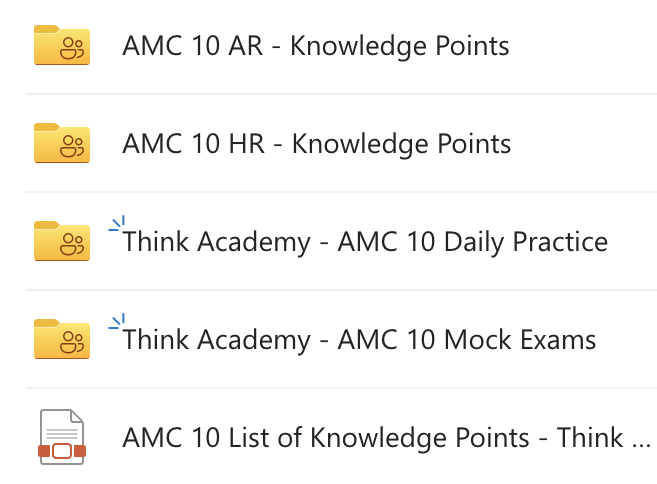
Download AMC 10 mock exams with full solutions, key AR/HR knowledge reviews, and daily practice sets — perfect for focused and efficient prep.
- Mock Exams: Timed practice with full explanations to build test readiness and review mistakes.
- Knowledge Points: Covers must-know Algebra, Geometry, and Number Theory concepts for AMC 10.
- Daily Practice: Sharpen accuracy and speed with high-frequency AMC-style problems.
*Please enter a valid email address to access the materials and receive future prep updates.
Last 10 Years AMC 10 Real Questions and Analysis
Think Academy provides in-depth breakdowns of the past decade of AMC 10 exams. Click below to explore:
- Year-by-year topic trend insights and concept distributions
- Real AMC 10 exams from the last 10 years
- Official answer keys
- Representative questions, detailed solutions, and common mistakes
2021 Spring AMC 10B Topic Distribution
The 2021 Spring AMC 10B featured 25 questions to be completed in 75 minutes, emphasizing advanced problem-solving and proof-based reasoning skills.
Learn more about AMC 10 Format and Scoring Here: AMC 10 FAQ and Resources: Your Ultimate Guide

| Module | Question Numbers | What It Tests (Brief) |
|---|---|---|
| Algebra (+ arithmetic reasoning) | 1, 2, 3, 4, 6, 8, 11, 15, 16, 25 | Inequalities, percentages, ratios, polynomial manipulation, logical reasoning |
| Number Theory | 5, 12, 13 | Factors, base conversion, divisibility |
| Geometry | 7, 9, 10, 14, 20, 21 | Circles, transformations, triangles, Pythagorean theorem |
| Combinatorics / Counting & Probability | 16, 17, 18, 19, 22, 23, 24 | Counting, inclusion-exclusion, logic, probability |
2021 Fall AMC 10B Topic Distribution
The 2021 Fall AMC 10B featured 25 questions to be completed in 75 minutes, emphasizing advanced problem-solving and proof-based reasoning skills.

| Module | Question Numbers | What It Tests (Brief) |
|---|---|---|
| Algebra (+ arithmetic reasoning) | 1, 3, 4, 5, 7, 9, 12, 19 | Arithmetic, difference of squares |
| Number Theory | 6, 8, 10, 22 | Divisibility, primes, patterns |
| Geometry | 2, 11, 13, 15, 17, 18, 21, 25 | Circles, polygons, angles |
| Combinatorics / Counting & Probability | 14, 16, 20, 23, 24 | Logical reasoning, probability |
About Think Academy
At Think Academy, a subsidiary of TAL Education Group, we specialize in advanced coaching and rigorous preparation for math competitions, including AMC 10 and AIME. Guided by experienced educators and supported by partnerships with renowned institutions, Think Academy empowers high-school students to reach their full competitive potential in mathematics. Notably, in 2024, our students achieved exceptional recognition, including selections for prestigious programs such as USA(J)MO (17 students), the Mathematical Olympiad Program (3 students), and the International Mathematical Olympiad teams for the U.S. and South Africa. Explore our AMC 10 training programs to help your child excel.
Check our math programs:
- Early Childhood — PreK
- Lower Elementary — Grades K–2
- Upper Elementary — Grades 3–5
- Middle School — Grade 6-10
Want more insights on math learning and parenting? Fill out the form on this page and subscribe to our newsletter for weekly tips and the latest resources.
Leave a Comment & Share Your Thoughts!

Share This Story, Choose Your Platform!
Related Posts