2016 AMC 8 Real Questions and Analysis
In this article, you’ll find:
- A concise topic distribution (with a pie chart)
- The core concepts typically tested in each module
- A module-to-question mapping table for the 2016 AMC 8
- Five representative real questions with solutions and common mistakes
- Best resources to prepare for AMC 8
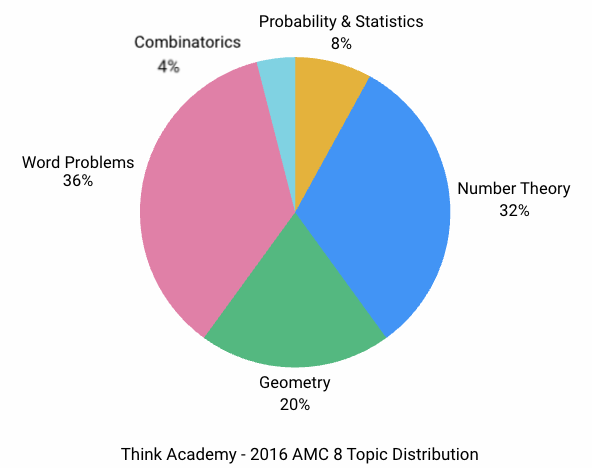
2016 AMC 8 Topic Distribution
The 2016 AMC 8 contains 25 multiple-choice questions completed in 40 minutes, emphasizing logical reasoning and conceptual understanding.
Learn more about AMC 8 Format and Scoring Here: AMC 8 FAQs: The Ultimate Guide for First-Time Test Takers
Detailed Module Analysis
| Module | Question Numbers | What It Tests (Brief) |
|---|---|---|
| Geometry | 2, 11, 16, 22, 25 | rectangle midpoint triangle area, diagonal tile count, racing geometry elimination, composite area, semicircle in isosceles triangle |
| Word Problems / Arithmetic | 1, 3, 4, 12, 14, 17, 20, 23, 24 | conversion / unit time, average remaining score, rate comparison, proportional reasoning, tank mileage, percent faster lap problem, LCM day pattern, digit divisibility building number |
| Number Theory / Algebra | 5, 7, 8, 10, 13, 15, 19, 21 | modular arithmetic, perfect square exponent check, telescoping sum, custom operator, prime divisor sum, largest power divisor, consecutive integer constraints, password count with restriction |
| Combinatorics & Logic | 18 | elimination tournament race logic reasoning |
| Probability & Statistics | 6, 9 | median graph statistics; chip drawing probability order |
Real Questions and Solutions Explained
Geometry Example – Problem 22
Question:
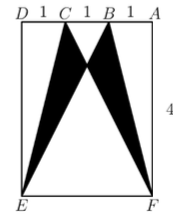
Rectangle DEFA below is a 3 × 4 rectangle with DC = CB = BA = 1. The area of the “bat wings” (shaded area) is:
(A) 2 (B) 2\(\frac{1}{2}\) (C) 3 (D) 3\(\frac{1}{2}\) (E) 5
Solution:
Consider trapezoid (????????????????) with parallel bases (????????=1) and (????????=3) and height (4).
\[
\text{Area}(????????????????)=\frac{1+3}{2}\cdot4=8.
\]
The two white isosceles triangles are similar in a height ratio (3:1) (AA similarity: alternate interior and vertical angles).
Hence their heights are 3 and 1, so their areas are
\[
\frac{1}{2}\quad \text{and}\quad \frac{9}{2}.
\]
Subtracting from the trapezoid gives the shaded area:
\[
8-\frac{1}{2}-\frac{9}{2}=8-5=3.
\]
Answer: (C)
Common Mistakes:
- Using rectangle base 4 instead of trapezoid average base \((1+3)/2\)
- Assuming both white triangles have the same height (they are in ratio 3:1)
- Subtracting side lengths instead of areas
Word Problem Example – Problem 1
Question:
The longest professional tennis match ever played lasted a total of 11 hours and 5 minutes. How many minutes was this?
(A) 605 (B) 655 (C) 665 (D) 1005 (E) 1105
Solution:
11 hours is \(11\times60=660\) minutes, and \(660+5=665\).
Answer: (C)
Common Mistakes:
- Multiplying \(11\times60\) incorrectly.
- Forgetting to add the extra 5 minutes.
- Turning 5 minutes into a decimal of an hour and rounding.
Number Theory Example – Problem 15
Question:
What is the largest power of 2 that is a divisor of \(13^{4}-11^{4}\)?
(A) 8 (B) 16 (C) 32 (D) 64 (E) 128
Solution:
Use difference of squares twice:
\[
13^{4}-11^{4}=(13^{2}-11^{2})(13^{2}+11^{2})=(169-121)(169+121)=48\cdot290.
\]
Now \(48=2^{4}\cdot3\) and \(290=2\cdot145\). Hence
\[
48\cdot290=(2^{4}\cdot3)(2\cdot145)=2^{5}\cdot(3\cdot145),
\]
so the greatest power of 2 dividing \(13^{4}-11^{4}\) is \(2^{5}=32\).
Answer: (C)
Common Mistakes:
- Stopping after the first factorization step.
- Missing the extra factor 2 inside 290.
- Guessing from parity without factoring.
Combinatorics Example – Problem 18
Question:
Question:
In an All-Area track meet, 216 sprinters enter a 100-meter dash competition. The track has 6 lanes, so only 6 sprinters can compete at a time. At the end of each race, the five non-winners are eliminated, and the winner will compete again in a later race. How many races are needed to determine the champion sprinter?
(A) 36 (B) 42 (C) 43 (D) 60 (E) 72
Solution:
Each race eliminates 5 sprinters. To leave exactly one champion from 216 entrants, we must eliminate \(216-1=215\) sprinters.
Number of races needed is \(215\div5=43\).
Answer: (C)
Common Mistakes:
- Dividing 216 by 5 directly.
- Double-counting the final race.
- Forgetting that the winner continues to future rounds.
Probability Example – Problem 9
Question:
What is the sum of the distinct prime integer divisors of 2016?
(A) 9 (B) 12 (C) 16 (D) 49 (E) 63
Solution:
Prime factorization: \(2016=2^{5}\cdot3^{2}\cdot7\).
Distinct primes are 2, 3, 7, and their sum is \(2+3+7=12\).
Answer: (B)
Common Mistakes :
- Including repeated prime powers in the sum.
- Missing the factor 7 in 2016.
- Adding all divisors instead of distinct primes.
Free Download: 2016 AMC 8 Problems
Download AMC 8 Mock Exams & Daily Practice Pack
Targeted AMC 8 preparation requires both daily skill-building and timed mock exam training. Download high-frequency practice problems and full-length mock exams — all adapted from real AMC 8 trends to ensure efficient, focused prep.
- Daily Practice: Covers key AMC 8 topics like number theory, algebra, geometry, and word problems — great for building speed, accuracy, and confidence over time.
- Mock Exams: Timed practice helps students simulate real test conditions, improve pacing, and reduce careless mistakes.
*Please enter a valid email address to access the materials and receive future prep updates.
For more detailed module resources, please visit the All-in-one AMC8 Resource Hub, featuring module practice, mock tests, and biweekly updates.
Recommended Reading
- 2017 AMC 8 Real Questions and Analysis
- How to Prepare for AMC 8 Math Competition
- All About 2026 AMC 8: Dates, Registration, Scores and Prep Tips
- AMC 8 FAQs: The Ultimate Guide for First-Time Test Takers
About Think Academy
Think Academy, part of TAL Education Group, helps K–12 students succeed in school today by building strong math foundations and critical thinking skills. At the same time, we focus on the bigger picture—developing learning ability, curiosity, and healthy study habits that inspire a lifelong love of learning. With expert teachers, proven methods, and innovative AI tools, we support every child’s journey from classroom confidence to long-term growth.
Check our math programs:
- Early Childhood — PreK
- Lower Elementary — Grades K–2
- Upper Elementary — Grades 3–5
- Middle School — Grade 6-10
Want more insights on math learning and parenting? Fill out the form on this page and subscribe to our newsletter for weekly tips and the latest resources.
Leave a Comment & Share Your Thoughts!

Share This Story, Choose Your Platform!
Related Posts