What’s a Good AMC 8 Score? Understand, Compare, and Aim for Your Best
AMC 8 scores are one of the first things families look up after the test—often with one question in mind: “Is this score good?” The most helpful way to answer is to combine national score trends, award cutoffs, and what the score reveals about a student’s contest readiness.
This guide explains:
- how AMC 8 scoring works
- what the average AMC 8 score looks like (2020–2025 data)
- what counts as a good AMC 8 score (including awards like Honor Roll and Achievement Roll)
- what your score likely indicates—and what to do next
How AMC 8 Scores Work
The AMC 8 is a 40-minute, 25-question multiple-choice contest for students in Grade 8 and below.
Scoring rules
- 25 problems
- 1 point per correct answer
- no penalty for wrong answers or blanks
- score range: 0–25
Because there is no guessing penalty, AMC 8 rewards a combination of accuracy, smart pacing, and problem selection. It is aligned with middle school curriculum, but it also tests lateral thinking and non-routine reasoning, especially in the later questions.
What Is the Average AMC 8 Score?
Across recent years, the average AMC 8 score has stayed surprisingly consistent.
Average AMC 8 Scores by Year (You Provided)
- 2025: 11.74
- 2024: 10.75
- 2023: 10.26
- 2022: 9.69
- 2020: 10.00
Key takeaway:
From 2020–2025, the average score hovered around 10 ± 0.75. That means many participants—who are already a self-selected group of motivated students—score close to 10–11.
This is important context: AMC 8 is not designed like a school test where most students score 80–95%. It is designed to differentiate levels of reasoning, especially at the top end.
AMC 8 Cutoff Scores (2020–2025 Trend)
AMC awards are percentile-based, so cutoffs shift slightly each year depending on exam difficulty and overall performance.
AMC 8 Cut-Off Scores Table
| Year | Distinguished Honor Roll (Top 1%) | Honor Roll (Top 5%) | Average Score |
|---|---|---|---|
| 2025 | 23 | 19 | 11.74 |
| 2024 | 22 | 18 | 10.75 |
| 2023 | 21 | 17 | 10.26 |
| 2022 | 22 | 19 | 9.69 |
| 2020 | 21 | 18 | 10.00 |
What the Trend Shows
- DHR (Top 1%) typically falls between 21–23
- HR (Top 5%) typically falls between 17–19
- The national average stays near 10–11
This also shows why small score changes matter: at the top, one additional correct answer can shift percentile rankings significantly.
What Is a Good AMC 8 Score?
A “good” AMC 8 score depends on your goal and the exam’s difficulty in that year. Based on 2020–2025 trends, these are reliable benchmarks families use to interpret performance.
Distinguished Honor Roll (22+ points)
Goal: Stand out for top schools and advanced contests.
- Roughly the top 1% of AMC 8 scorers
- Strong readiness for AMC 10, AIME, and advanced STEM pathways
- Common among students who later qualify for AIME and USA(J)MO
- Often valued by accelerated math tracks and selective programs
Honor Roll (18+ points)
Goal: Build a strong foundation for future competitions.
- Roughly the top 5% nationwide
- Signals readiness for AMC 10 and advanced enrichment
- Frequently recognized by math pathways and summer programs
- A strong competitive milestone for middle school students
Achievement Roll (15+ points, Grade 6 and below)
Goal: Gain early exposure and confidence.
- Awarded only to students in Grade 6 or below
- Recognizes strong performance within younger grades
- A score around 15 often falls in the Achievement Roll range, though the exact cutoff can vary slightly by year
- A good early indicator that a student can grow into Honor Roll-level results over time
AMC 8 Difficulty Levels: Why Scores Separate at the Top
To interpret scores correctly, it helps to understand how AMC 8 is structured. A common way to describe it is:
- Easy (Q1–Q15): fundamentals + careful reading
- Medium (Q16–Q20): multi-step reasoning and pattern recognition
- Hard (Q21–Q25): deeper insight (number theory, geometry, counting, logic)
Between 2020 and 2025, the biggest difference between “average,” “strong,” and “elite” performance usually comes from the medium and hard sections, not the first 10–15 questions.
2025 Exam Insight
In 2025, the AMC 8 saw a slight decrease in difficulty:
- no trick questions
- no topics beyond standard curriculum
- a stronger emphasis on solid foundations and fair reasoning
This aligns with the higher average score in 2024–2025.
What Your AMC 8 Score Likely Indicates (Use It as Diagnostic Data)
One of the most valuable ideas from experienced contest discussions is this:
Treat the score as diagnostic data, not a label.
Context—experience level, preparation, and test conditions—can shift performance significantly.
Below is a practical way to interpret what your score often reflects.
If Your Score Is Around the National Average (about 10–12)
What it often indicates:
- basic fundamentals are present
- students can solve many early questions
- medium problems (Q16–20) are the main growth area
Typical improvement focus:
- reading precision (what the question really asks)
- set-up skills for multi-step word problems
If Your Score Is in the 14–16 Range
What it often indicates:
- solid foundation and good early pacing
- enough skill to solve some medium questions
- improvement will come from reducing “avoidable losses”
Common gaps to address:
- contest-specific strategies (time choice, pattern recognition)
- topics that appear frequently in AMC 8 (counting, number theory, geometry reasoning)
If Your Score Is 18+ (Honor Roll Zone)
What it often indicates:
- strong consistency on early and medium questions
- you’re converting most Q1–20 correctly
- pushing higher requires skill on hard questions (Q21–25)
Next focus:
- deeper insight problems
- learning multiple methods and recognizing classic patterns
If Your Score Is 22+ (DHR Zone)
What it often indicates:
- very high accuracy + efficient reasoning
- reliable attempts on harder questions
- readiness to transition into AMC 10 and beyond
Next focus:
- building depth and speed under pressure
- high-level problem selection and proof-like reasoning
2026 AMC 8 Post-Exam Analysis Webinar (01/31)
The AMC 8 exam will be administered between January 22 and 30 (Attention: Due to a significant winter storm impacting the US, the AMC 8 competition window has been extended). Think Academy will host a free post-exam webinar on January 31 (formerly Jan. 29) , 2026, covering exam insights, difficulty analysis, and next-step guidance. Registration is open now.
- Date: Saturday January 31, 2026
- Time: 7:30–8:30 PM PST
- Platform: Zoom (Registrants will receive the meeting link by email 2 hours before the webinar.)
Following the webinar, we will offer 1-on-1 and group consultation sessions to help students gain a detailed understanding of their AMC 8 level and performance. Stay tuned for updates on this page.

How to Improve Your AMC 8 Score
If you want to raise your AMC 8 score, the fastest improvements come from structured review, not random practice.
Step 1: Analyze Your Test Like a Coach
After a practice test (or your real test), sort every missed question into one reason:
- concept gap (didn’t know what to do)
- misread (missed a condition or what was asked)
- careless (arithmetic, copying, units)
- time (ran out or chose a slow method)
This instantly tells you what to fix first.
Step 2: Target High-Frequency AMC 8 Topics
Focus on topics that repeatedly appear in AMC 8:
- Number theory: divisibility, primes, remainders, modular thinking
- Counting & probability: casework, complementary counting, basic permutations
- Geometry reasoning: angle chase, area logic, simple constructions
- Algebra basics: translating relationships, ratios, equations, patterns
Step 3: Learn Contest Techniques That Save Minutes
These techniques regularly turn hard-looking problems into quick wins:
- work backwards from answer choices
- plug in numbers to test conditions
- eliminate options strategically
- draw accurate diagrams and label clearly
Step 4: Practice Past AMC 8s Under Real Timing
A high-impact routine:
- take a full AMC 8 past paper in 40 minutes
- then review every problem (even correct ones)
- re-solve 3–4 missed problems the next day without looking
Track progress by:
- Q1–15 accuracy
- Q16–20 conversion rate
- Q21–25 attempt quality
What Should Students Do After Seeing Their Score?
If You’re Below Average
- focus on foundations + reading precision
- practice easier and medium problems until consistent
If You’re Around Average
- build a structured plan to improve medium problems
- aim to convert more Q16–20 reliably
If You’re Already Strong
- begin AMC 10 exposure early
- train for deeper reasoning and faster setups
Final Takeaway
A “good” AMC 8 score is not just a number. It depends on:
- how the score compares to national averages and award cutoffs
- grade level (especially Grade ≤6 for Achievement Roll)
- whether a student can convert medium and hard problems reliably
Use AMC 8 scores as a roadmap: diagnose gaps, train strategically, and build a pathway toward Honor Roll, Distinguished Honor Roll, and eventually AMC 10 readiness.
Next Step: Apply These Rules to Real AMC 8 Problems
To actually improve:
- Practice with official AMC 8 past papers
- Diagnose mistakes using the rules above
- Then take Think Academy’s free math evaluation
- Get personalized feedback and a clear preparation plan from experienced instructors
Download AMC 8 Past Papers
Notes: The AMC series adjusted its schedule, with the 2021 exam held in early 2022, so no separate 2021 test paper exists.
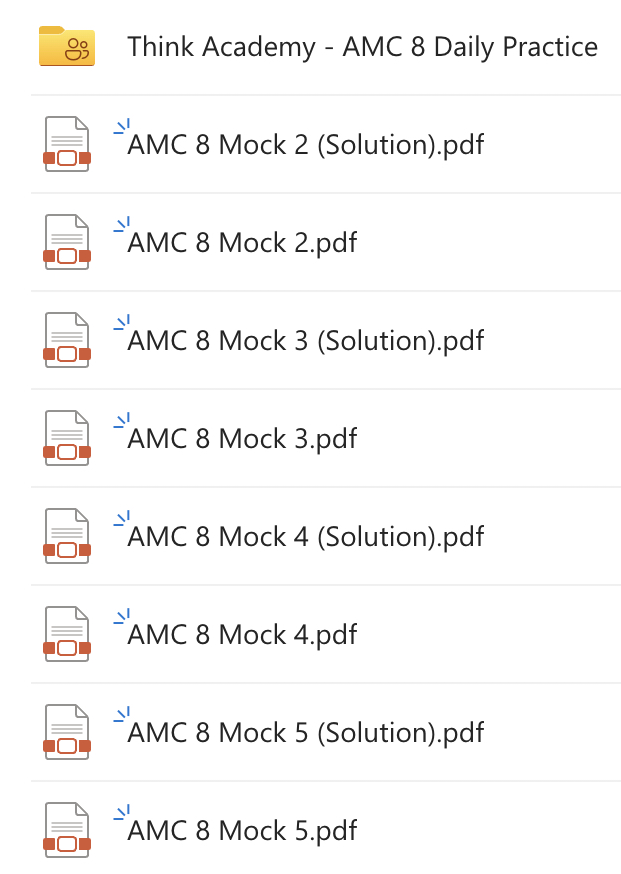
Download AMC 8 Mock Exams & Daily Practice Pack
Targeted AMC 8 preparation requires both daily skill-building and timed mock exam training. Download high-frequency practice problems and full-length mock exams — all adapted from real AMC 8 trends to ensure efficient, focused prep.
- Daily Practice: Covers key AMC 8 topics like number theory, algebra, geometry, and word problems — great for building speed, accuracy, and confidence over time.
- Mock Exams: Timed practice helps students simulate real test conditions, improve pacing, and reduce careless mistakes.
*Please enter a valid email address to access the materials and receive future prep updates.
For more detailed module resources, please visit the All-in-one AMC8 Resource Hub, featuring module practice, mock tests, and biweekly updates.
About Think Academy
Think Academy, part of TAL Education Group, helps K–12 students succeed in school today by building strong math foundations and critical thinking skills. At the same time, we focus on the bigger picture—developing learning ability, curiosity, and healthy study habits that inspire a lifelong love of learning. With expert teachers, proven methods, and innovative AI tools, we support every child’s journey from classroom confidence to long-term growth.
Check our math programs:
- Early Childhood — PreK
- Lower Elementary — Grades K–2
- Upper Elementary — Grades 3–5
- Middle School — Grade 6–10
Want more insights on math learning and parenting? Fill out the form on this page and subscribe to our newsletter for weekly tips and the latest resources.
Leave a Comment & Share Your Thoughts!

Share This Story, Choose Your Platform!
Related Posts