How to Read AMC 8 Questions: 8 Rules Top Scorers Use
Many students walk out of the AMC 8 thinking, “I knew the math—why did I still miss so many questions?”
In most cases, the issue isn’t formulas or content. It’s how AMC 8 questions are written and how they must be read under time pressure.
AMC 8 rewards students who can quickly identify structure, constraints, and intent. This guide uses 2025 AMC 8 examples to show not just what goes wrong, but how to build repeatable reading rules that apply to every future AMC 8, not just one year.
How AMC 8 Questions Are Designed
AMC 8 problems are intentionally ordered by thinking demand, not just difficulty.
- Problems 1–15 focus on fundamentals and careful interpretation.
- Problems 16–20 emphasize modeling, constraints, and logical structure.
- Problems 21–25 require insight, symmetry, and strategic shortcuts.
Most score plateaus happen because students read all questions the same way, even though the exam expects different kinds of thinking at different stages.
The 8 Golden Rules for Reading AMC 8 Questions
Before the Rules: An Important Reminder
Important note: These rules are not absolute or guaranteed to work in every situation. AMC 8 problems vary from year to year. Practice applying these rules, reflect on your mistakes, and discover which ones help you understand and approach questions most efficiently.
Rule 1: Read the Last Sentence First
Before touching the numbers, identify exactly what the question is asking.
Ask yourself:
- What is being asked?
- Is the answer a number, a count, a distance, an area, a percent, or a sum?
Many AMC 8 mistakes come from solving something interesting but not answering the actual question.
Habit: underline or mentally restate the final question phrase before solving.
Rule 2: Separate the Story from the Math
AMC 8 uses stories (games, cities, grids, food, people) to hide structure.
Ask yourself:
- What information is essential?
- What is just context or decoration?
If the story can be replaced by symbols, equations, or a simple diagram, do it immediately.
Rule 3: Circle Constraint Words
Certain words completely change the problem.
Common examples include:
- at least
- at most
- exactly
- distinct
- positive
- integer
- multiple of
Missing just one constraint can invalidate an otherwise correct solution.
Habit: circle or mentally highlight every constraint word before solving.
Rule 4: Identify the Type of Question Before Solving
Before calculating anything, decide what kind of problem this is.
Common AMC 8 types:
- counting
- geometry
- number theory
- logic or casework
- optimization (least / greatest)
- symmetry or pairing
This prevents brute force and saves time.
Rule 5: Match Strategy to Difficulty Level
AMC 8 questions are intentionally ordered, and your approach should change as the test progresses.
- Q1–10: use direct methods and don’t overthink
- Q11–15: look for structure, elimination, or constraints
- Q16–20: expect multi-step reasoning and read twice
- Q21–25: look for symmetry, invariants, pairing, or shortcuts — brute force almost never works here
Rule of thumb: if a hard problem looks long, you’re probably solving it the wrong way.
Rule 6: When You See These Words, Pause and Re-think
Certain phrases are strong strategy signals in AMC 8.
Examples:
- “sum of all” → think pairing or averaging
- “largest / smallest” → think extreme placement
- “no two differ by” → think structure or residues
- “repeatedly” → think patterns or sequences
- “for all possible” → think symmetry
AMC 8 rewards recognizing what kind of thinking is expected, not just computing.
Rule 7: Decide Before Solving Whether Algebra Is Necessary
Not every equation-based problem needs algebra.
Ask yourself:
- Can I reason with logic?
- Can I use time = distance ÷ speed thinking?
- Can I test answer choices?
- Can I use symmetry?
Top AMC students often solve algebra-looking problems without writing equations.
Rule 8: After Solving, Double-Check the Question
Before bubbling an answer, re-read the question carefully.
Check:
- units
- “least” vs “greatest”
- “how many” vs “which”
- whether the question asks for an intermediate value or the final result
Many AMC 8 errors are correct math → wrong target.
How These Rules Show Up Across the AMC 8
Understanding the rules becomes much easier when you see how they appear across different parts of the test.
Level 1: Easy Problems Still Punish Careless Reading (Problems 1–10)
Early AMC 8 problems look friendly, but they quietly test whether students can identify what actually matters.
Consider Problem 1 from 2025.
Context excerpt: “The eight-pointed star… What percent of the entire grid is covered by the star?”
At first glance, many students focus on the star’s shape. Strong readers immediately focus on the phrase “percent of the entire grid.” The grid is the whole. The star is just a part. The fastest solution comes from counting or subtracting, not analyzing the star’s geometry.
This pattern repeats across many early problems. Stories about hieroglyphs, card games, or delivery routes are not the point. They are wrappers for place value, equal sharing, or shortest-path logic.
For example, Problem 3 includes the phrase “all the cards are distributed evenly.” That single phrase tells you conservation matters more than arithmetic. Problem 6 includes “the sum is a multiple of…”, which signals modular thinking, not repeated addition.
The key habit here is learning to separate story from structure. If the story can be replaced by symbols or a simple diagram, it usually should be.
Level 2: Medium Problems Test Structure, Not Speed (Problems 11–15)
This is where many students scoring in the mid-teens begin to struggle.
Problem 11 (tetromino tiling) does not ask how many tilings exist. It asks which tiles must be used, given that one tile is fixed. The phrase “at least one tile is an S tile” is not background — it is the engine of the problem. Strong readers turn that phrase into controlled case analysis rather than brute force.
Similarly, Problems 12 and 15 include words like largest, least, and greatest. These are optimization signals. They tell you the problem is not about an average or typical case. It’s about extremes. Students who ignore those words often compute something correct — but irrelevant.
By this point in the test, reading twice before solving often saves more time than rushing into calculations.
Level 3: Hard Problems Test Insight and Symmetry (Problems 16–25)
Hard AMC 8 problems are not necessarily longer. They are cleaner, but they demand the right perspective.
Problem 25 asks for the sum of the areas determined by all possible paths. Students who try to compute individual cases quickly get stuck. Students who recognize symmetry realize that paths can be paired, averaged, or reflected, turning an impossible task into a short one.
Problem 16 includes the condition “no two numbers differ by exactly…”. That phrase is not a restriction to work around — it forces a structure. Problem 19 (two cars with changing speed limits) is not about distance at all; it’s about equal time. Problem 20 repeats the phrase “half of what remains”, which signals a geometric pattern, not repeated subtraction.
At this level, AMC 8 rewards students who ask why the question is written this way before asking how to solve it.
How to Practice These Rules Effectively
When using AMC 8 past papers, practice deliberately and explicitly at first. The goal is not speed—it is building correct reading habits.
During practice sessions:
Before solving a problem, pause and write one sentence:
“This problem is asking for _____.”
After solving, label any mistake as one of the following:
- misread
- concept gap
- careless
- time issue
Then look for patterns over time:
- Do misreads happen more often on word problems?
- On questions 16–20?
- On optimization or symmetry questions?
This kind of reflection turns practice into skill-building, not repetition.
It’s important to note that this is a practice method, not an exam requirement. Students should not stop during the real AMC 8 to write sentences or label mistakes. Instead, the purpose of this structured practice is to train the brain.
With enough repetition, these steps become automatic and internal:
- identifying what the question is really asking
- noticing constraints immediately
- choosing the right strategy instinctively
As students become more experienced, careful reading turns into a subtle habit, not a checklist. By the time exam day arrives, there is no need to be explicit—the thinking happens naturally, quickly, and quietly.
That is when these rules stop feeling like rules and start feeling like intuition.
Why This Matters More Than Extra Practice
Many students do dozens of problems, memorize techniques, and still plateau.
The difference between:
- 12 → 15
- 16 → 18
- 19 → 22
is usually reading precision and strategy, not new math content.
Next Step: Apply These Rules to Real AMC 8 Problems
To actually improve:
- Practice with official AMC 8 past papers
- Diagnose mistakes using the rules above
- Then take Think Academy’s free math evaluation
- Get personalized feedback and a clear preparation plan from experienced instructors
Download AMC 8 Past Papers
Notes: The AMC series adjusted its schedule, with the 2021 exam held in early 2022, so no separate 2021 test paper exists.
Download AMC 8 Mock Exams & Daily Practice Pack
Targeted AMC 8 preparation requires both daily skill-building and timed mock exam training. Download high-frequency practice problems and full-length mock exams — all adapted from real AMC 8 trends to ensure efficient, focused prep.
- Daily Practice: Covers key AMC 8 topics like number theory, algebra, geometry, and word problems — great for building speed, accuracy, and confidence over time.
- Mock Exams: Timed practice helps students simulate real test conditions, improve pacing, and reduce careless mistakes.
*Please enter a valid email address to access the materials and receive future prep updates.
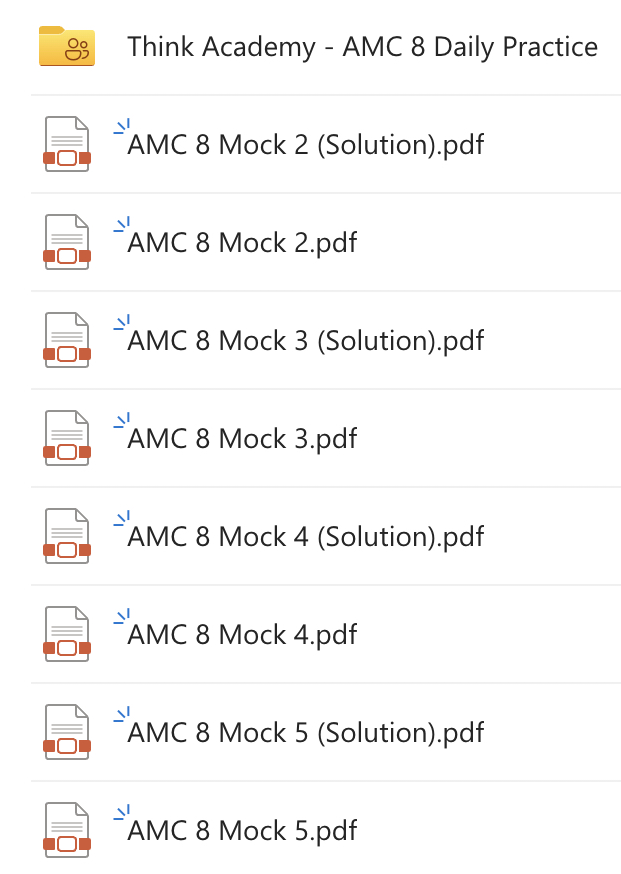
For more detailed module resources, please visit the All-in-one AMC8 Resource Hub, featuring module practice, mock tests, and biweekly updates.
About Think Academy
Think Academy, part of TAL Education Group, helps K–12 students succeed in school today by building strong math foundations and critical thinking skills. At the same time, we focus on the bigger picture—developing learning ability, curiosity, and healthy study habits that inspire a lifelong love of learning. With expert teachers, proven methods, and innovative AI tools, we support every child’s journey from classroom confidence to long-term growth.
Check our math programs:
- Early Childhood — PreK
- Lower Elementary — Grades K–2
- Upper Elementary — Grades 3–5
- Middle School — Grade 6–10
Want more insights on math learning and parenting? Fill out the form on this page and subscribe to our newsletter for weekly tips and the latest resources.
Leave a Comment & Share Your Thoughts!

Share This Story, Choose Your Platform!
Related Posts