Algebra 1 Guide: Pre-Algebra and Algebra 2 Compared
Algebra 1 is more than just another math class—it’s a gateway to advanced problem-solving and abstract thinking. For many students, it marks the shift from arithmetic to symbolic reasoning. For parents, it often represents a major academic milestone in their child’s math journey.
In this guide, you’ll learn:
- What Algebra 1 covers and when it’s typically taught
- How it compares to Pre-Algebra, Algebra 2, and Math 1
- How to tell if you or your child is ready—and what comes next
- Plus: Free Algebra 1 worksheet downloads and a readiness quiz
Don’t have time to read every word? Our podcast covers it all in just six quick minutes.
Where Does Algebra 1 Fit in the Math Sequence?
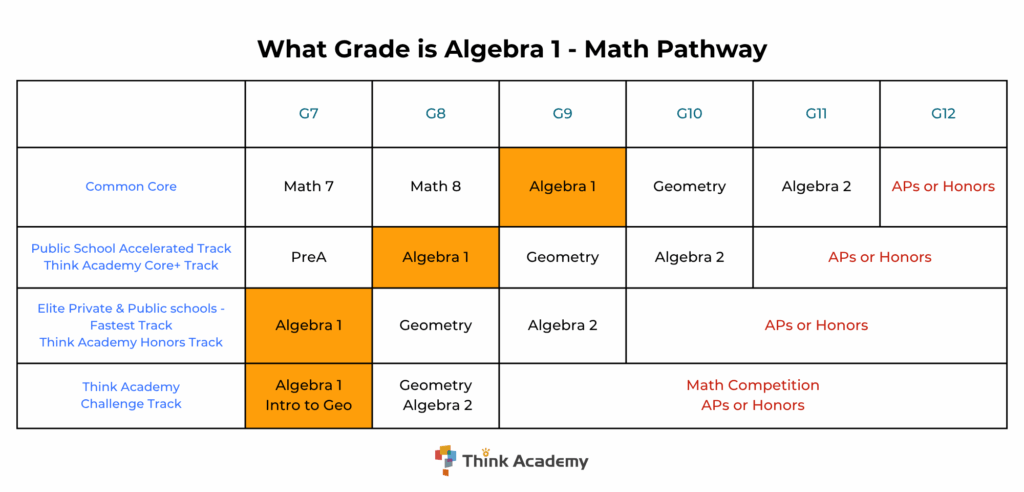
Most students take Algebra 1 between Grade 7 and Grade 9, depending on their school’s curriculum and academic readiness.
Here’s how it fits into common U.S. math pathways:
- Traditional Track: Pre-Algebra → Algebra 1 → Geometry → Algebra 2 → Pre-Calculus / AP Calculus
- Integrated Math Track: Math 1 (includes most Algebra 1 topics) → Math 2 → Math 3
Understanding where Algebra 1 falls in this sequence helps families plan ahead and prepare for each step with confidence.
What Do You Learn in Algebra 1?
Algebra 1 introduces students to the language of mathematics—using symbols, rules, and operations to represent and solve problems. These concepts build a foundation for future courses like Algebra 2, Geometry, and standardized tests such as the SAT.
- Number and Quantity: operation of radicals, exponents, ratio, rate, and proportion
- Expressions: exponential expressions, radical expressions, operation of polynomials, factorization of polynomials
- Equations: linear equations, quadratic equations, system of linear equations
- Inequalities: linear inequalities, compound inequalities
- Functions: linear functions, quadratic functions, exponential functions, square root functions, inverse and direct functions, graph transformation
- Sequences: arithmetic sequences, geometric sequences, recursive formula
- Statistics and Probabilities: statistical plots, data measurement, correlation, regression line, best fit line
Learn more about the topics covered in Algebra 1:
- How to Multiply Polynomials: From 1 Term to 3 Terms
- How to Divide a Polynomial by a Monomial in 2 Simple Steps
What Grade Is Algebra 1?
Students are usually placed in Algebra 1 based on test scores, previous math grades, and teacher recommendations. In some districts, students take it as early as Grade 7 or 8, especially if they’ve mastered Pre-Algebra.
Early placement can create more opportunities for advanced courses later in high school.
Is Algebra 1 Hard?
It depends on the student’s background and mindset. Algebra 1 is often the first class to require:
- Abstract thinking (working with symbols instead of numbers)
- Multi-step problem-solving
- Interpreting graphs and patterns
For students who are well-prepared and practice regularly, Algebra 1 can be challenging but rewarding. A shaky Pre-Algebra foundation, however, may lead to frustration.
Pre-Algebra vs. Algebra 1 vs. Algebra 2
Understanding how algebra evolves across Pre-Algebra, Algebra 1, and Algebra 2 helps students and families make smarter decisions about readiness, placement, and long-term learning.
Below are four examples showing how math topics progress across Pre-Algebra, Algebra 1, and Algebra 2.
| Concept | Pre-Algebra | Algebra 1 | Algebra 2 |
|---|---|---|---|
| Expressions & Equations | Simplifying expressions with variables (e.g., 3x + 2) | Solving linear equations and inequalities (e.g., 2x + 5 = 11) | Solving quadratic, rational, and exponential equations (e.g., x² + 3x = 10) |
| Polynomials | Recognizing terms (monomial, binomial), basic operations | Adding, subtracting, multiplying polynomials | Factoring higher-degree polynomials, long division, synthetic division |
| Functions | Intro to functions as input-output rules | Linear, quadratic functions; interpreting and graphing | Polynomial, rational, exponential, and logarithmic functions |
| Number Systems | Whole numbers, integers, fractions, decimals | Real numbers, irrational numbers | Complex numbers (e.g., i, imaginary solutions to quadratic equations) |
Highlights of Algebra Progression
Pre-Algebra
- Introduces the use of letters (variables) to represent unknowns
- Focuses on fluency with numbers and simple algebraic thinking
- Acts as the bridge from arithmetic to algebra
Algebra 1
- Expands on Pre-Algebra with functions, graphing, polynomials, and systems of equations
- Shifts from solving equations to modeling relationships between variables
- Still within the real number system, but begins formal symbolic reasoning
Algebra 2
- Deepens Algebra 1 topics and introduces more abstract math
- Evolves from:
- Linear & quadratic equations → higher-degree polynomials
- Basic functions → exponential, logarithmic, and trigonometric functions
- Real numbers → complex numbers
- Simple graphing → Analytic geometry
- Requires algebraic fluency and prepares students for advanced math
Summary
- Pre-Algebra → Algebra 1: From understanding variables to using functions to express relationships
- Algebra 1 → Algebra 2: From simple modeling to analyzing multi-step, abstract functions with geometry connections
- A strong foundation at each level supports long-term success in math, science, and standardized testing
Algebra 1 vs. Math 1 (Integrated Math)
Math 1 is part of the Integrated Math model, which blends Algebra 1 with Geometry and basic Statistics. Students revisit and deepen these topics over time (Math 1 → Math 2 → Math 3).
| Algebra 1 | Math 1 |
|---|---|
| Focuses on algebra only | Combines algebra, geometry, and some statistics |
| Traditional sequence | Integrated sequence |
| Taught in 8th–9th grade | Usually 9th grade in integrated districts |
If your school uses the Integrated Math pathway, Math 1 replaces Algebra 1, though the topics may be covered in a different order or depth.
A Snapshot from Real Students
A recent community poll with over 240 votes showed just how varied Algebra 1 experiences can be:
- 39% said they can solve polynomials easily
- 27% said they have occasional trouble
- 10% struggle a lot
- 4% don’t understand anything
- 17% said: “What even is a polynomial?”
Students shared a wide range of experiences—from excelling with strong teaching, to struggling due to missing foundational skills or inconsistent instruction.
As one student said:
“Algebra 1 isn’t hard—it’s just different. You need space to experiment, try things in multiple ways, and really understand what each step means.”
Possible Challenges Facing Algebra 1
Struggling with Algebra 1 is more common than it seems, and it’s not a sign of low ability. Here are some common reasons students may find it difficult:
- Weak Pre-Algebra Foundation: Gaps in basic skills (like solving simple equations or understanding variables) make Algebra 1 harder to grasp.
- Learning Style Mismatch: Not all teaching methods work for everyone. Some students need visual aids, real-world examples, or step-by-step breakdowns.
- Ineffective Study Habits: Long cram sessions can be less effective than short, consistent practice.
- Emotional Pressure: Stress, fear of failure, or lack of confidence can block focus and learning.
The good news? With the right support, pacing, and resources, most students can turn Algebra 1 from a struggle into a success.
“I studied for hours, stayed up late, and still failed—until I realized I wasn’t learning the way my brain needed. Once I found the right explanation, everything started to make sense.” – A Grade 8 student
“It’s not that I’m bad at math—I just missed one key concept early on. Fixing that one thing made the rest of Algebra 1 finally click.” – A Grade 9 student
How to Know If You’re Ready for Algebra 1
Here are a few key signs:
- You’re confident solving one-step and two-step equations
- You understand ratios, proportions, and percentages
- You can apply math to real-world problems
- You’re curious about patterns and logic
Still unsure?
✅ Jump to [G6 and Above] and:
✅ Take the Readiness Quiz
What Comes After Algebra 1?
After completing Algebra 1, students typically move on to:
- Geometry (logic, proofs, and spatial reasoning)
- Algebra 2 (advanced functions and symbolic reasoning)
- Or Math 2 (if in the integrated track)
These courses continue developing students’ ability to solve real-world and theoretical problems and prepare them for Pre-Calculus and AP-level coursework.
More Middle School Algebra Resources Ready for You
We’ve created a full library of printable resources — from foundational math to logic-based challenges — organized by grade to support every stage of your child’s journey.
Final Thoughts: Build the Right Foundation Now
Algebra 1 is more than a subject—it’s a turning point. It opens up advanced math, improves test readiness, and builds habits of logical thinking.
Evaluate Now. Start strong. Learn deeply. And remember: building a solid foundation in Algebra 1 makes everything that comes after much more manageable.
About Think Academy
Think Academy, a leading K–12 math education provider wholly owned by TAL Education Group, is dedicated to helping students build strong mathematical foundations and critical thinking. Our structured curriculum provides multiple course levels designed to accommodate students with diverse academic goals and proficiency levels, ensuring targeted and effective learning experiences. Supported by advanced teaching methods, expert instructors, and innovative AI technology, Think Academy consistently demonstrates excellence, trustworthiness, and proven expertise in mathematics education.
Want more insights on math education and parenting tips? Subscribe to our newsletter for weekly expert advice and updates on the latest learning tools.
Leave a Comment & Share Your Thoughts!
Share This Story, Choose Your Platform!
Related Posts