High School GPA Planning for Rising 9th Graders: Summer Academic Planning
The summer before 9th grade is one of the few times families can make decisions without day-to-day homework pressure. With clear academic planning, students often enter freshman year with stronger routines, fewer skill gaps, and more realistic expectations—factors that typically support a steadier high school GPA.
This guide explains how to use summer to:
- protect high school GPA in freshman year
- choose the right level of rigor through course planning
- build a long-term high school plan—especially for STEM-leaning students
- Real student admit cases
The Real Goal of 9th Grade Course Planning for High School GPA
College Admissions Reality: Rigor and Performance
Most selective colleges typically value:
- Rigor: challenging coursework relative to what your school offers
- Performance: strong, consistent grades
A decision rule that often helps families avoid common pitfalls:
- Hardest track + GPA drop → often not worth it
- Too easy + no growth → can limit later options
- Best-fit rigor + stable grades → often best for high school GPA
Why freshman-year GPA matters
Freshman grades set the baseline. Policies vary by district, and colleges may interpret transcripts differently, but the math is consistent:
- If a student earns a 3.2 freshman-year GPA, moving to a 3.8 cumulative later typically requires multiple semesters of near-straight A performance.
- If a student starts near 3.8–4.0, they usually have more flexibility to increase rigor later without undermining overall high school GPA.
Academic planning implication: build stable habits in 9th grade, then increase rigor gradually.
Course Planning Focus: Why Math Decisions Matter for High School GPA
Math is often where families feel pressure to “move up” into honors or accelerated tracks. That’s understandable. Math is a sequence subject, and early placement can affect later options.
At the same time, math is also a common source of early grade drops in 9th grade—often because small gaps compound. From an academic planning perspective, math is a practical starting point because it is:
- measurable,
- sequential, and
- closely tied to STEM pathways.
Regular vs Honors/Accelerated Math: Affect High School GPA
Regular Math
What it usually means
- Standard pacing
- Core skills and grade-level practice
High school GPA impact
Regular math can support a stable high school GPA when a student needs to solidify fundamentals or build consistent study habits in the first year of high school.
Honors/Accelerated Math
What it usually means
- faster pacing
- deeper complex problem sets
High school GPA impact
Honors/Accelerated works best when a student already has strong prerequisite mastery and can handle faster pacing without losing accuracy. If fundamentals are incomplete, the class can feel “always behind,” which often shows up as lower quiz/test grades and a less stable high school GPA.
Quick comparison
| Track | What changes | Common GPA risk |
|---|---|---|
| Regular | standard pacing | may feel too slow for advanced students |
| Honors/Accelerated | fast pacing, depth workload | faster pace can expose gaps → grade drops |
Practical takeaway for academic planning
For most families, the best course planning decision is the option that lets your child earn strong grades at the highest sustainable intensity. That combination typically supports both learning and high school GPA over time.
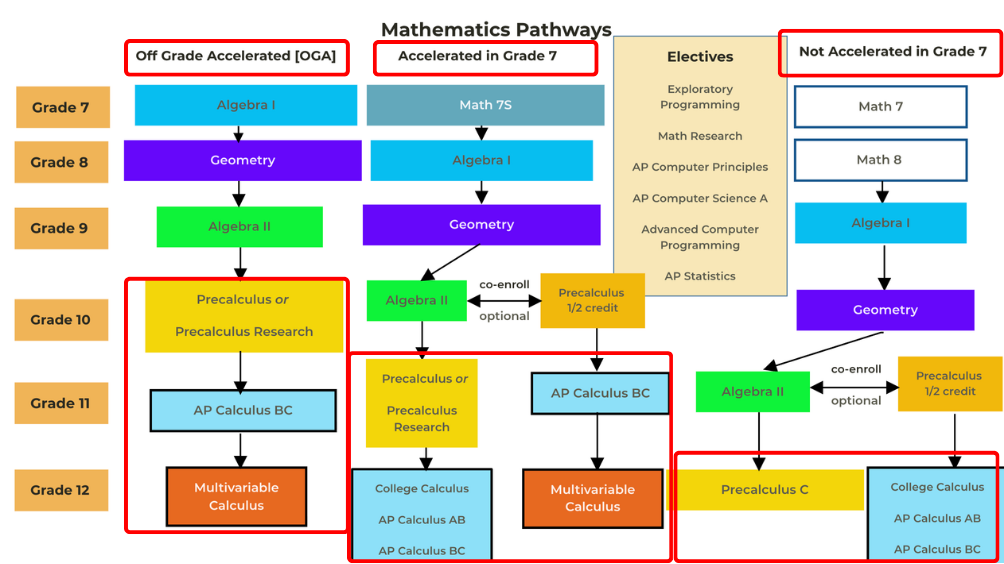
AP Math Sequence High School Plan
Pathway A: Accelerated in middle school → earlier calculus → “more APs” options
A typical accelerated track looks like:
- Grade 8: Algebra 1
- Grade 9: Geometry
- Grade 10: Algebra 2
- Grade 11: Pre-Calc or AP Calculus BC
- Grade 12: AP Calculus AB/BC or Multivariable Calculus
A double accelerated track looks like:
- Grade 8: Geometry
- Grade 9: Algebra 2
- Grade 10: Pre-Calc
- Grade 11: AP Calculus BC
- Grade 12: Multivariable Calculus
What accelerated track unlocks:
- earlier access to AP Calculus
- potential room for additional advanced options in Grade 12
- more flexibility for STEM-aligned scheduling
Pathway B: Not accelerated → later calculus → fewer advanced slots
A typical regular track looks like:
- Grade 8: Math 8
- Grade 9: Algebra 1
- Grade 10: Geometry
- Grade 11: Algebra 2
- Grade 12: Pre-Calculus
Summer Academic Planning for Accelerated Readiness
Summer is the best time for preparation and a smoother first semester. Summer preparation tends to work best when the goal is specific:
- “My child needs stronger algebra fluency before honors math.”
- “We want to preview geometry concepts so 9th grade feels manageable.”
- “We want to confirm readiness for accelerated math without a GPA risk.”
This keeps your course planning admissions-aware: it targets sustainable rigor, not short-term acceleration.
What to do in summer
Use a short weekly routine that most students can sustain:
- 2–3 practice sessions/week (30–45 minutes)
- Error review (record mistakes and fix patterns)
- 1 cumulative mixed set/week (simulate school tests)
- One planning check-in (compare workload to fall schedule)
High School Plan Beyond This Summer
A strong high school plan supports admissions, but it also supports direction. For STEM-leaning students, math planning can be a practical career skills decision because it affects readiness for:
- engineering and computer science pathways
- physics and advanced lab sciences
- data science and quantitative electives
Recommend reading:
- AP Science Planning: Biology, Chemistry, and Pre-AP Guide
- AP Physics 1 vs 2 vs C: Difficulty, Prereqs, and Planning
STEM math skills that matter
For students aiming STEM, these skills typically show up in grades and placement readiness:
- algebra fluency: functions, equations, modeling
- geometry reasoning: proofs, spatial logic
- multi-step problem solving under time limits (useful for advanced tracks and competitions)
If these skills are strong, acceleration is often safer. If they are inconsistent, building mastery first is usually the better academic planning move—especially to protect high school GPA.
Student Case Examples: Academic Planning in Action
Case Study 1
Admission Result: Harvard University
Academics (quantifiable + AP count + notable point)
- GPA: 4.0 unweighted
- APs: 9 AP courses spread across Grades 10–12 (paced rigor, not a single-year overload)
- Testing: strong SAT (old format) and multiple SAT Subject Tests; mostly 5s on AP exams (one 4 reported).
- Notable point: She explicitly emphasizes pacing rigor over time and protecting academic consistency.
Non-Academic
- Activities described as not “super flashy,” but included meaningful initiatives (e.g., involvement with Girls Who Code), school roles (including TA experience), and real-life responsibilities.
- Essay focus on personal experience and authenticity; she also stresses strong relationships that supported recommendations.
Case Study 2
Admission Result: Duke University
Academics
- Class rank: 2 / 450
- Course rigor: 12 APs total (school max); nearly all available honors courses
- Grades: One A- for one semester (AP Physics 1); otherwise highly consistent
- AP scores submitted: four 5s (junior-year APs) + one 4 (sophomore-year AP)
- College coursework: 2 community college summer courses, both A
- Test score: ACT 35 (superscore)
- Notable point: Admissions notes reportedly flagged a single A-, showing how selective reads can focus on consistency within a rigorous load.
Non-Academic
- Activities (student-reported): varsity tennis (4 years; 7th in state), orchestra concertmaster, officer roles
- Context: from a lower-applicant state/region; file comments emphasized “values” and “character”
- Writing/rec letters: two supplemental essays praised for character; recommendation strength varied across two teachers
Case Study 3
Admission Result: University of North Carolina at Chapel Hill
Academics (quantifiable + AP count + notable point)
- GPA: 4.0 UW / 4.45 W
- Class rank: 20 / 330
- Course rigor: 15 AP + 9 Honors
- ACT: 35
- Notable point: Strong academics coming from a rural context can be especially legible to admissions—high rigor + high performance stands out.
Non-Academic
- Choir; Cross Country captain; painting; student leadership role (Young Democrats Vice President)
- Honors include Governors Honors Program Finalist, All-State Choir (9/10/11), AP Scholar w/ Distinction, Scholastic Gold Key (painting), NHS
Case Study 4
Admission Result: Northwestern University
Academics (quantifiable + AP count + notable point)
- GPA: 4.0 UW / 4.54 W
- AP scores: 12 AP exams scored 5; 2 AP exams scored 4
- Total AP exams: 14
- Notable point: This highlights AP exams distributed across Grade 9 and Grade 12, suggesting a long academic runway rather than a short-term spike.
Parent Takeaways from These 4 Student Cases
1) High school GPA stability is a core signal
Across Harvard, Duke, UNC, and Northwestern, the academic profiles share one thing: very strong GPA performance (often near the top of the class). Even small dips can be noticed at highly selective levels (e.g., a single A- being flagged in the Duke file), so the safest strategy is usually:
- confirm readiness before stepping up rigor
- protect consistency during transitions (especially 9th–10th grade)
2) Rigor works best when it is paced over multiple years
The strongest-looking course loads were not “one-year spikes.” They were multi-year trajectories:
- Harvard: 9 APs spread across 10–12
- Northwestern: AP exams distributed across years (long runway)
- Duke/UNC: heavy rigor but still paired with stable performance
Planning implication: build a sequence—foundation first, then increasing challenge—rather than rushing to stack APs early.
3) AP count matters less than AP performance + fit
These cases show high AP volume, but what makes it credible is:
- strong grades alongside rigor
- strong AP scores where submitted (many 5s, some 4s)
- course choices that appear sustainable in context (school limits, availability, pacing)
Parent action: focus on the highest level your child can do well, not the highest level available.
4) For STEM-leaning students, math readiness is a long-term lever
These cases align with one predictable pattern: sustained academic strength supports more advanced options later, especially for STEM. A good STEM-oriented academic planning approach usually:
- confirms algebra/geometry mastery early
- builds problem-solving stamina
- accelerates only when performance remains stable
Parent action: treat math as a sequence decision. Use summer to strengthen foundations or preview next-year topics so 9th grade rigor does not destabilize high school GPA.
Think Academy: STEM Math Academic Planning
A strong plan is typically the one that keeps high school GPA stable while showing year-over-year rigor, with course planning that matches your child’s readiness and long-term direction (especially for STEM math). If your child needs support in advanced learning or competition-style problem-solving, Think Academy’s middle school math program is designed for the “summer before 9th grade” decision point.
What we build in our students
- Advanced mastery: Algebra 1, Geometry, Algebra 2, Pre calculus + deep problem-solving foundations (often 1–2 years ahead)
- Competition preparation: AMC 8, AMC 10, Olympiad-style questions
- STEM-ready profiles: stronger math records for selective tracks and rigorous course planning
Our Proud Achievements
- ???? 90%+ scored above the 90th percentile
- ???? 94% placed into the highest middle school math track
- ???? Over 1,000 national competition awards in 2024 and 2025 each
Free Personalized Evaluation
To choose honors vs accelerated without guesswork, start with clarity: strengths, gaps, and the next step.
Your free evaluation includes:
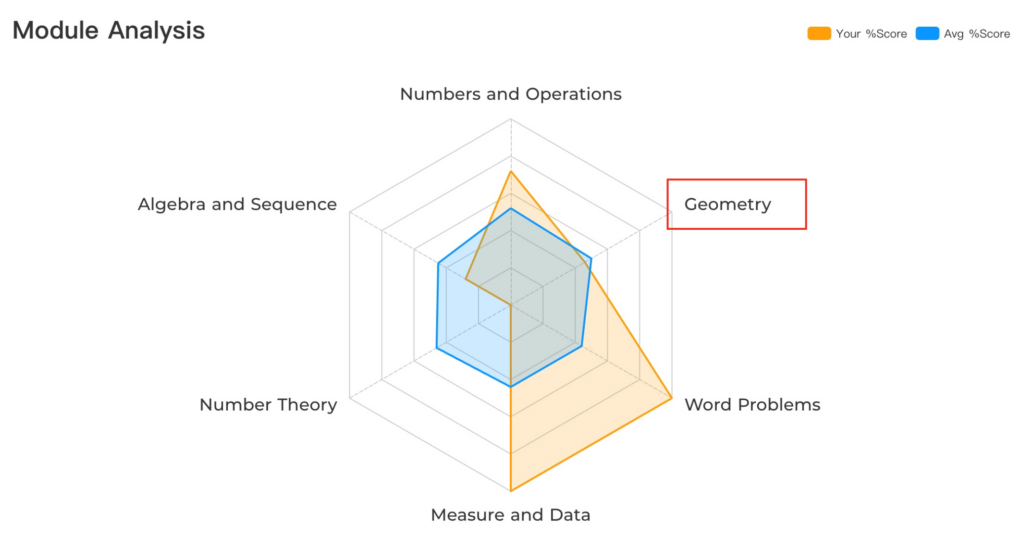
- Peer comparison & ranking across key domains
- Skill-by-skill breakdown: number sense, algebra, geometry, and more
- Concept-level insights: where your child excels or needs support
- A clear next-step plan — personalized by our expert instructors
Recommend Reading:
- Summer Planning for Rising 9th Graders: Academics, Interests, and Summer Programs
- Rising 9th Grader Parent Guide: Top 50 College Prep with Real Student Cases
About Think Academy
Think Academy, part of TAL Education Group, helps K–12 students succeed in school today by building strong math foundations and critical thinking skills. At the same time, we focus on the bigger picture—developing learning ability, curiosity, and healthy study habits that inspire a lifelong love of learning. With expert teachers, proven methods, and innovative AI tools, we support every child’s journey from classroom confidence to long-term growth.
Check our math programs:
- Early Childhood — PreK
- Lower Elementary — Grades K–2
- Upper Elementary — Grades 3–5
- Middle School — Grade 6–10
Want more insights on math learning and parenting? Fill out the form on this page and subscribe to our newsletter for weekly tips and the latest resources.

Leave a Comment & Share Your Thoughts!

Share This Story, Choose Your Platform!
Related Posts