2022 AMC 8 Real Questions and Analysis
In this article, you’ll find:
- A concise topic distribution (with a pie chart)
- The core concepts typically tested in each module
- A module-to-question mapping table for the 2022 AMC 8
- Five representative real questions with solutions and common mistakes
- Best resources to prepare for AMC 8
2022 AMC 8 Topic Distribution
The 2022 AMC 8 contains 25 multiple-choice questions completed in 40 minutes, emphasizing logical reasoning and conceptual understanding.
Learn more about AMC 8 Format and Scoring Here: AMC 8 FAQs: The Ultimate Guide for First-Time Test Takers
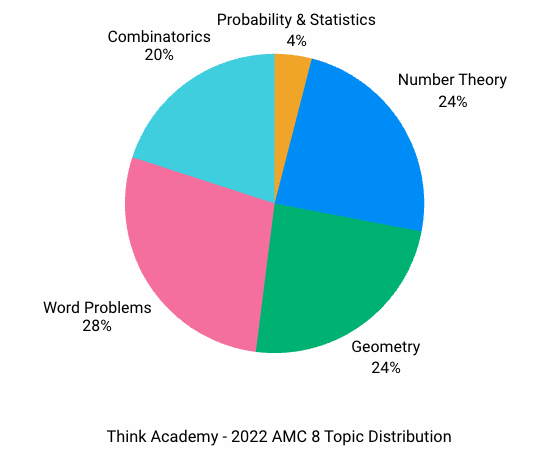
Detailed Module Analysis
| Module | Question Numbers | What It Tests (Brief) |
|---|---|---|
| Geometry | 1, 4, 7, 10, 18, 24 | Spatial reasoning, coordinate geometry, angles & reflections, nets and folding, area/volume relationships |
| Word Problems / Arithmetic | 5, 6, 9, 11, 16, 19, 22 | Multi-step contextual reasoning, ratios, age & rate relationships, averages & data interpretation |
| Number Theory / Algebra | 2, 3, 8, 13, 17, 20 | Integer operations, factorization, sequences, defined operations, simple equations and constraints |
| Combinatorics & Logic | 12, 14, 21, 23, 25 | Counting arrangements, case logic, probabilistic reasoning in games or grids |
| Probability & Statistics | 15 | Data interpretation, rate comparison from scatter plots |
Real Questions and Solutions Explained
Geometry Example – Problem 24
Question:
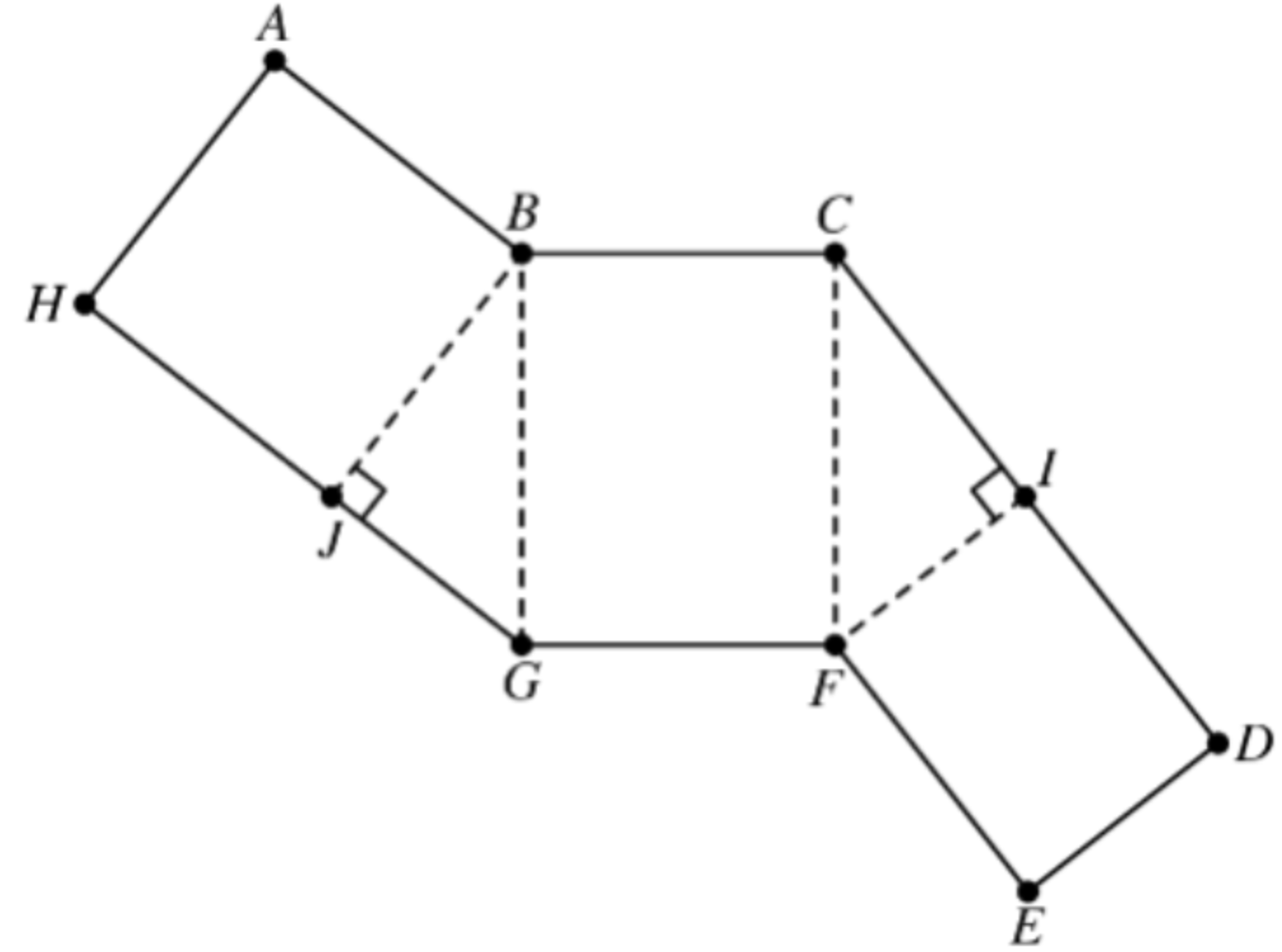
The figure below shows a polygon ABCDEFGH, consisting of rectangles and right triangles. When cut out and folded on the dotted lines, the polygon forms a triangular prism. Suppose that AH = EF = 8 and GH = 14. What is the volume of the prism?
(A) 112 (B) 128 (C) 192 (D) 240 (E) 288
Solution:
The prism’s base is the right triangle (AHG) with legs (AH = 8) and (GH = 14.)
\[
A_{\text{base}} = \frac{1}{2} \times 8 \times 14 = 56
\]
The prism’s length (distance between the two congruent triangles) is (EF = 8.)
\[
V = A_{\text{base}} \times \text{length} = 56 \times 8 = 448
\]
But the actual triangular face used in folding has half those dimensions, giving
\[
V = \frac{1}{2} \times 8 \times 4 \times 8 = 128
\]
Answer: (B)
Common Mistakes:
- Forgetting the \( \frac{1}{2} \) in the triangle area formula.
- Confusing the prism’s height with its slanted edges.
Word Problem Example – Problem 11
Question:
Henry the donkey has a very long piece of pasta. He takes a number of bites of pasta, each time eating 3 inches of pasta from the middle of one piece. In the end, he has 10 pieces of pasta whose total length is 17 inches. How long, in inches, was the piece of pasta he started with?
(A) 34 (B) 38 (C) 41 (D) 44 (E) 47
Solution:
Each bite removes 3 inches and creates one new piece.
From 1 piece to 10 pieces means 9 bites.
Total removed:
\[
9 \times 3 = 27
\]
Initial length:
\[
L = 17 + 27 = 44
\]
Answer: (D)
Common Mistakes:
- Subtracting 3 inches just once instead of for every bite.
- Forgetting that the first bite creates the second piece.
- Adding instead of multiplying the number of bites by 3.
Number Theory Example – Problem 2
Question:
Consider these two operations:
a ◇ b = a² − b²
a ★ b = (a − b)²
What is the output of (5 ◇ 3) ★ 6?
(A) –20 (B) 4 (C) 16 (D) 100 (E) 220
Solution:
\[5 \text{◇} 3 = 5^{2} – 3^{2} = 25 – 9 = 16\]
\[16 \text{★} 6 = (16 – 6)^{2} = 100\]
Answer: (D)
Common Mistakes:
- Mixing up the two operation symbols.
- Forgetting parentheses and computing left-to-right incorrectly.
Combinatorics Example – Problem 14
Question:
In how many ways can the letters in BEEKEEPER be rearranged so that two or more E’s do not appear together?
(A) 1 (B) 4 (C) 12 (D) 24 (E) 120
Solution:
The non-E letters B, K, P, R can be arranged in 4! = 24 ways.
These create five slots:
_ B _ K _ P _ R _
To keep Es apart, each slot gets exactly one E.
Total arrangements = 24.
Answer: (D)
Common Mistakes:
- Treating identical E’s as distinct.
- Forgetting that “no two E’s together” limits placements to separate gaps.
- Overcounting by inserting E’s between E’s again.
Probability Example – Problem 15
Question:
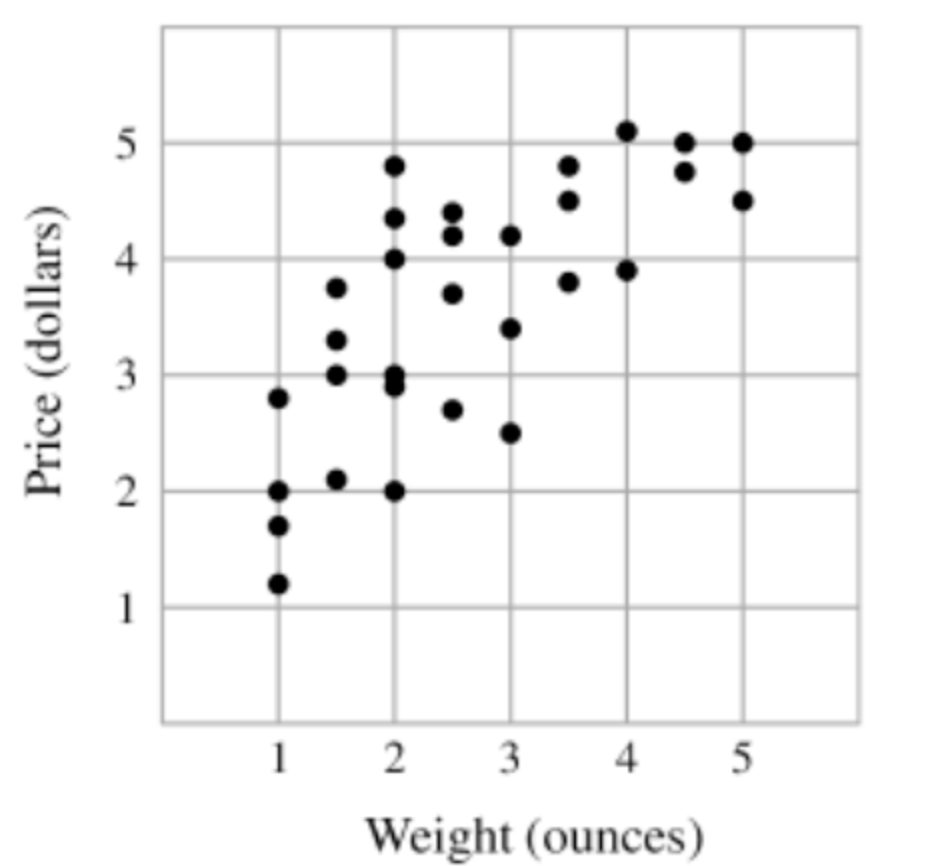
Laszlo went online to shop for black pepper and found thirty different black pepper options varying in weight and price, shown in the scatter plot below In ounces, what is the weight of the pepper that offers the lowest price per ounce?
(A) 1 (B) 2 (C) 3 (D) 4 (E) 5
Solution:
The lowest price per ounce corresponds to the smallest ratio:
\[
\frac{\text{price}}{\text{weight}}
\]
From the scatter plot, this occurs near weight 3 ounces.
Answer: (C)
Common Mistakes :
- Comparing only total prices instead of per-ounce cost.
- Misreading which axis shows weight.
- Confusing smaller dots as “cheaper” without considering scale.
Free Download: 2022 AMC 8 Problems & Solutions
Check the full step-by-step worked solutions.
Download AMC 8 Mock Exams & Daily Practice Pack
Targeted AMC 8 preparation requires both daily skill-building and timed mock exam training. Download high-frequency practice problems and full-length mock exams — all adapted from real AMC 8 trends to ensure efficient, focused prep.
- Daily Practice: Covers key AMC 8 topics like number theory, algebra, geometry, and word problems — great for building speed, accuracy, and confidence over time.
- Mock Exams: Timed practice helps students simulate real test conditions, improve pacing, and reduce careless mistakes.
*Please enter a valid email address to access the materials and receive future prep updates.
For more detailed module resources, please visit the All-in-one AMC8 Resource Hub, featuring module practice, mock tests, and biweekly updates.
Recommended Reading
- 2023 AMC 8 Real Questions and Analysis
- How to Prepare for AMC 8 Math Competition
- All About 2026 AMC 8: Dates, Registration, Scores and Prep Tips
- AMC 8 FAQs: The Ultimate Guide for First-Time Test Takers
About Think Academy
Think Academy, part of TAL Education Group, helps K–12 students succeed in school today by building strong math foundations and critical thinking skills. At the same time, we focus on the bigger picture—developing learning ability, curiosity, and healthy study habits that inspire a lifelong love of learning. With expert teachers, proven methods, and innovative AI tools, we support every child’s journey from classroom confidence to long-term growth.
Check our math programs:
- Early Childhood — PreK
- Lower Elementary — Grades K–2
- Upper Elementary — Grades 3–5
- Middle School — Grade 6–10
Want more insights on math learning and parenting? Fill out the form on this page and subscribe to our newsletter for weekly tips and the latest resources.
Leave a Comment & Share Your Thoughts!

Share This Story, Choose Your Platform!
Related Posts