2018 AMC 8 Real Questions and Analysis
In this article, you’ll find:
- A concise topic distribution (with a pie chart)
- The core concepts typically tested in each module
- A module-to-question mapping table for the 2018 AMC 8
- Five representative real questions with solutions and common mistakes
- Best resources to prepare for AMC 8
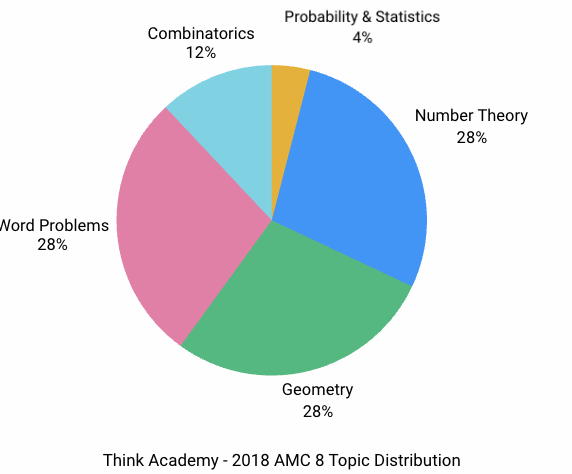
2018 AMC 8 Topic Distribution
The 2018 AMC 8 contains 25 multiple-choice questions completed in 40 minutes, emphasizing logical reasoning and conceptual understanding.
Learn more about AMC 8 Format and Scoring Here: AMC 8 FAQs: The Ultimate Guide for First-Time Test Takers
Detailed Module Analysis
| Module | Question Numbers | What It Tests (Brief) |
|---|---|---|
| Geometry | 2, 4, 5, 9, 11, 15, 24 | area / coordinate geometry / composite shapes / circle area reasoning / visual spatial reasoning |
| Word Problems / Arithmetic | 1, 6, 10, 12, 14, 17, 18 | ratios, rates, mean, travel time, remainder, average score manipulation |
| Number Theory / Algebra | 3, 7, 8, 13, 20, 21, 25 | divisibility, sequences, harmonic mean, modular arithmetic, exponential / cubes count |
| Combinatorics & Logic | 16, 19, 22 | arrangements, sign rules, geometry puzzle with midpoint |
| Probability & Statistics | 23 | probability from polygon vertex random selection |
Real Questions and Solutions Explained
Geometry Example – Problem 4
Question:
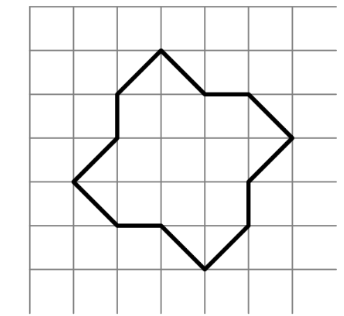
The twelve-sided figure shown has been drawn on 1 cm × 1 cm graph paper. What is the area of the figure in cm²?
(A) 12 (B) 12.5 (C) 13 (D) 13.5 (E) 14
Solution:
There are (3\times3 = 9) whole unit squares in the center.
There are also 8 small right triangles around the outside.
Every 2 of these triangles form 1 whole square, giving 4 more squares.
\[
9 + 4 = 13
\]
Answer: (C)
Common Mistakes:
- Only counting the inner 9 unit squares and forgetting the corner triangles.
- Mis-pairing the 8 triangles (they must be paired 2→1 full square).
- Trying to apply polygon area formulas instead of simple square counting.
Word Problem Example – Problem 12
Question:
The clock in Sri’s car, which is not accurate, gains time at a constant rate. One day as he begins shopping, he notes that his car clock and his watch (which is accurate) both say 12:00 noon. When he is done shopping, his watch says 12:30 and his car clock says 12:35. Later that day, Sri loses his watch. He looks at his car clock and it says 7:00. What is the actual time?
(A) 5:50 (B) 6:00 (C) 6:30 (D) 6:55 (E) 8:10
Solution:
In 30 real minutes, the car clock advanced 35 minutes.
So the car clock runs (\frac{35}{30}) times as fast as the real clock.
From 12:00 to when the car clock reads 7:00 → it gained 7 hours.
Real elapsed time:
\[
7\text{ hours}\times\frac{30}{35}=6\text{ hours}
\]
So the real time is:
12:00 + 6 hours = 6:00
Answer: (B)
Common Mistakes:
- Using 35–30 = 5 as linear gain per hour (wrong logic).
- Comparing minutes and hours inconsistently.
- Forgetting to convert proportion before applying to total hours.
Number Theory Example – Problem 21
Question:
How many positive three-digit integers have a remainder of 2 when divided by 6, a remainder of 5 when divided by 9, and a remainder of 7 when divided by 11?
(A) 1 (B) 2 (C) 3 (D) 4 (E) 5
Solution:
We want a number that is 4 less than a multiple of 6, 9, and 11 (because (11-7=4), (9-5=4), (6-2=4)).
LCM of 6, 9, 11 is:
\[
\text{LCM}=11\times3^2\times2=198
\]
So numbers that satisfy the condition can be written as:
\[
198k – 4
\]
For three-digit integers, (k=1,2,3,4,5) → (194, 392, 590, 788, 986)
There are 5 valid numbers.
Answer: (E)
Common Mistakes:
- Trying to brute force instead of modular pattern shifting.
- Forgetting that the remainders differ by exactly 4.
- Miscalculating LCM of 6, 9, and 11.
Combinatorics Example – Problem 19
Question:
Question:
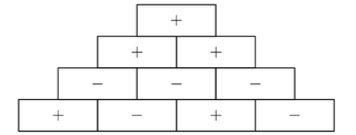
In a sign pyramid a cell gets a “+” if the two cells below it have the same sign, and it gets a “−” if the two cells below it have different signs. The diagram below illustrates a sign pyramid with four levels. How many possible ways are there to fill the four cells in the bottom row to produce a “+” at the top of the pyramid?
(A) 2 (B) 4 (C) 8 (D) 12 (E) 16
Solution:
List the sign patterns in the bottom row that generate a “+” at the top.
There are exactly 8 possible patterns that result in a final top “+”.
Answer: (C)
Common Mistakes:
- Counting every possible fill and dividing randomly.
- Assuming symmetry halves the count.
- Misinterpreting the “different sign → negative” rule.
Probability Example – Problem 23
Question:
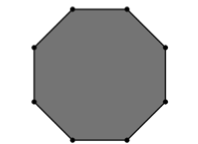
From a regular octagon, a triangle is formed by connecting three randomly chosen vertices of the octagon. What is the probability that at least one of the sides of the triangle is also a side of the octagon?
(A) \(\frac{2}{7}\) (B) \(\frac{5}{42}\) (C) \(\frac{11}{14}\) (D) \(\frac{5}{7}\) (E) \(\frac{6}{7}\)
Solution:
Choose side “lengths” (a,b,c) representing how many vertices are skipped along each side of the triangle.
The valid configurations where at least one side skips exactly 1 vertex account for \(\frac{5}{7}\) of all possible triangles.
Answer: (D)
Common Mistakes :
- Counting all selections equally without side-length structure.
- Ignoring skip-length equivalence classes in the octagon.
- Overcounting symmetric orderings of same-length sides.
Free Download: 2018 AMC 8 Problems & Solutions
Check the full step-by-step worked solutions.
Download AMC 8 Mock Exams & Daily Practice Pack
Targeted AMC 8 preparation requires both daily skill-building and timed mock exam training. Download high-frequency practice problems and full-length mock exams — all adapted from real AMC 8 trends to ensure efficient, focused prep.
- Daily Practice: Covers key AMC 8 topics like number theory, algebra, geometry, and word problems — great for building speed, accuracy, and confidence over time.
- Mock Exams: Timed practice helps students simulate real test conditions, improve pacing, and reduce careless mistakes.
*Please enter a valid email address to access the materials and receive future prep updates.
For more detailed module resources, please visit the All-in-one AMC8 Resource Hub, featuring module practice, mock tests, and biweekly updates.
Recommended Reading
- 2019 AMC 8 Real Questions and Analysis
- How to Prepare for AMC 8 Math Competition
- All About 2026 AMC 8: Dates, Registration, Scores and Prep Tips
- AMC 8 FAQs: The Ultimate Guide for First-Time Test Takers
About Think Academy
Think Academy, part of TAL Education Group, helps K–12 students succeed in school today by building strong math foundations and critical thinking skills. At the same time, we focus on the bigger picture—developing learning ability, curiosity, and healthy study habits that inspire a lifelong love of learning. With expert teachers, proven methods, and innovative AI tools, we support every child’s journey from classroom confidence to long-term growth.
Check our math programs:
- Early Childhood — PreK
- Lower Elementary — Grades K–2
- Upper Elementary — Grades 3–5
- Middle School — Grade 6–10
Want more insights on math learning and parenting? Fill out the form on this page and subscribe to our newsletter for weekly tips and the latest resources.
Leave a Comment & Share Your Thoughts!

Share This Story, Choose Your Platform!
Related Posts